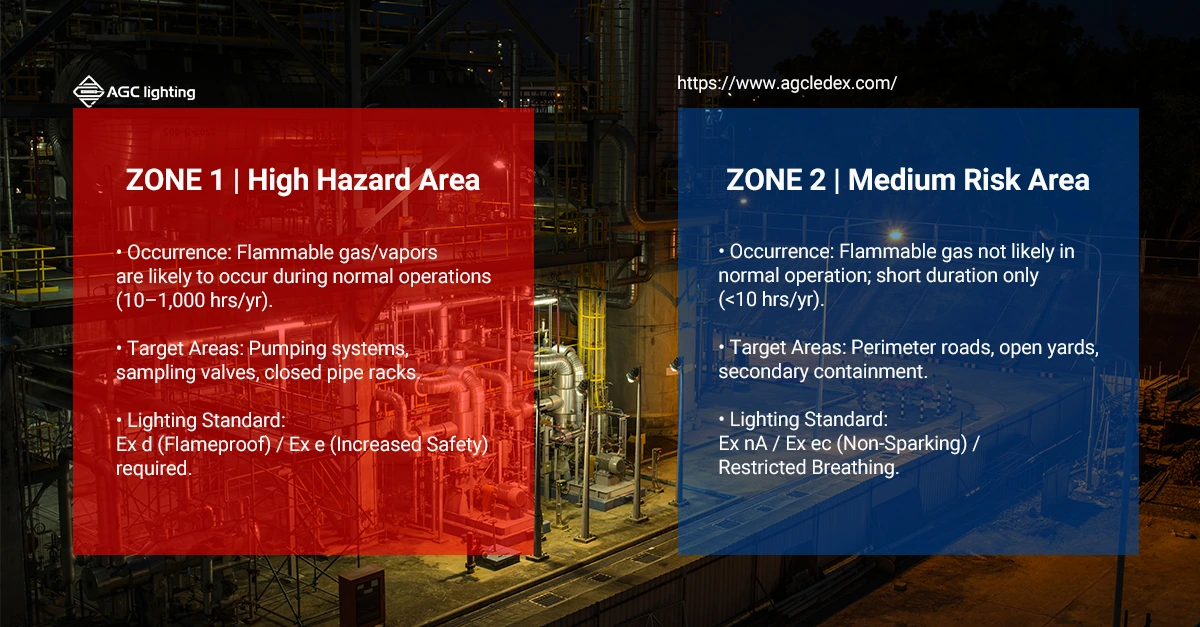
The key difference between Zone 1 and Zone 2 lighting is how likely an explosive atmosphere is, and that sets how much protection the luminaire must provide.
Zone 1 luminaires are built to ATEX category 2G and equipment protection level (EPL) Gb. Zone 2 luminaires are built to category 3G and EPL Gc.
A Zone 1 luminaire can serve a Zone 2 area if the rest of its marking fits. A Zone 2 luminaire cannot serve a Zone 1 area.
Zone 1 vs Zone 2 Lighting
|
|
Zone 1 |
Zone 2 |
|
Explosive atmosphere |
Likely during normal operation |
Not likely; short duration only |
|
Minimum Equipment Protection Level (EPL) |
Gb |
Gc |
|
ATEX Category |
2G (or higher) |
3G (or higher) |
|
Protection Methods |
Ex db (flameproof), Ex eb (increased safety), Ex mb (encapsulation) |
Ex nA/nR (non-sparking/restricted breathing), Ex ec, Ex mc |
|
Enclosure Construction |
Heavy-wall copper-free cast aluminum alloy or compression-molded GRP. |
Extruded aluminum, light-gauge die-cast aluminum, or engineered polycarbonate. |
|
Cable Gland Requirements |
Direct entry requires certified flameproof barrier glands or compound seals. |
Standard increased safety (Ex eb/Ex ec) glands with IP66 seals. |
|
Flame Path Maintenance |
Mandatory periodic inspection of joint gaps and grease with non-hardening paste. |
Visual inspection of external gaskets, seals, and housing integrity. |
|
Relative cost (LED luminaires) |
higher |
Lower |
|
Fixture construction |
Heavier |
Lighter |
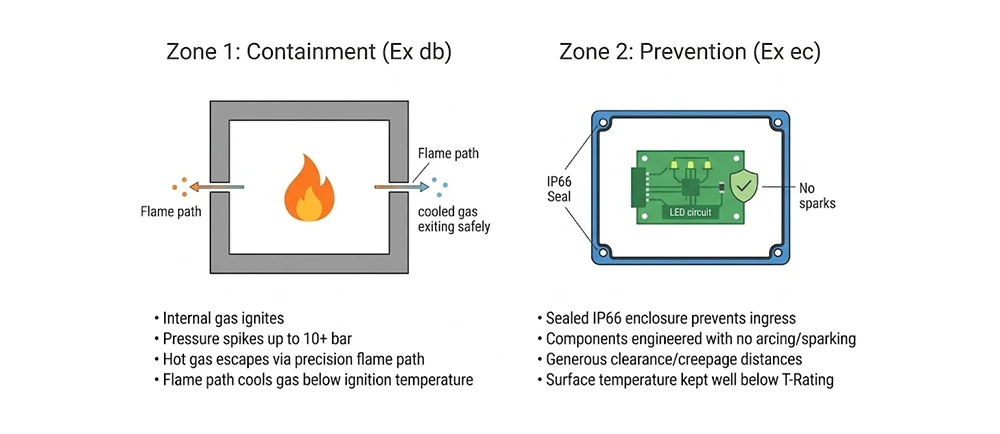
The Mechanical Difference: Containment (Ex db) vs. Prevention (Ex ec)
Zone 1 and Zone 2 luminaires center on how the housing manages an ignition event.
Zone 1 installations dominated by the flameproof concept (Ex db, governed by IEC 60079-1) do not attempt to prevent gas from entering the housing. Instead, they assume explosive gas will inevitably enter, mix with oxygen, and ignite on an electrical arc or faulty component.
Zone 2 fixtures, governed predominantly by increased safety non-sparking (Ex ec, updated into IEC 60079-7 from the legacy Ex nA standard), abandon heavy containment. Because hazardous gases are present only during rare plant upsets, the standard relies entirely on avoidance.
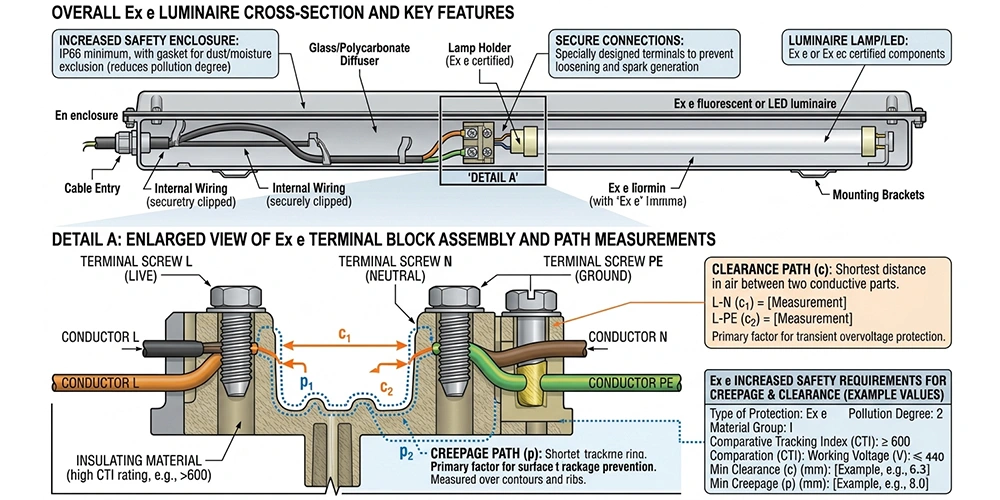
Ex ec luminaires use components that cannot spark or arc under standard operating parameters. Creepage and clearance distances between electrical conductors are substantially wider than standard industrial fixtures. Enclosures are sealed to at least IP54 (typically IP66 for outdoor industrial luminaires) to keep out particulate contamination and moisture. Because there is no internal blast pressure to contain, walls can remain thin, reducing raw material and total mass.
Thermal Management and the T-Rating
Solid-state LEDs generate significant heat at the p-n junction. In common industrial fixtures, aluminum fins discharge this heat directly into the ambient air. In hazardous area lighting, thermal dissipation is constrained by the surface Temperature Class (T-Rating, T1 through T6) defined in IEC 60079-0.
- T4: Maximum external surface temperature of 135°C
- T5: Maximum external surface temperature of 100°C
- T6: Maximum external surface temperature of 85°C
A common objection: if two luminaires are both T4, are they interchangeable?
No. Certification may only apply within defined temperature limits, and the T-class holds inside the ambient range printed on the certificate.
In an Ex db Zone 1 luminaire, the thick cast metal housing and thick lens resist heat transfer. Heavy walls trap internal heat, causing junction temperatures to rise unless the LED driver currents are down-throttled. This creates an engineering conflict: run the LEDs harder and risk breaching the T-class ceiling in high ambient environments (+50°C to +55°C), or derate the luminaire and accept lower lumen efficacy.
Zone 2 Ex ec fixtures feature lighter, high-conductivity extruded aluminum chassis that conduct heat directly to the exterior. With lower thermal resistance across the enclosure boundary, an Ex ec luminaire can maintain an efficient T5 or T4 rating at elevated ambient temperatures without aggressively throttling driver output.
Can a Zone 1 Luminaire Be Used in Zone 2, and Should It Be?
It can.
Zone 2 has a lower likelihood of an explosive atmosphere, so equipment assessed for Zone 1 covers it. But the reverse fails, because a Zone 2 fixture was never assessed for an atmosphere that is likely to occur in normal operation.
So why doesn't anyone buy Zone 1 lighting at all?
Many plants are mostly Zone 2: the areas surrounding Zone 1 locations, well-ventilated process areas, and outdoor plant areas where ventilation limits how long a release lasts.
Fitting every luminaire there to Zone 1 level may add cost and weight without adding the safety the classification calls for.
At AGC Lighting, we provide both Zone 1 and Zone 2 hazardous location lighting.
Need assistance matching hazardous area classification boundaries to fixture mechanical limits? Send your plant layout drawings and Hazardous Area Dossier to our engineering team for an optical and compliance review.