In hazardous industrial environments such as oil refineries, chemical plants, and offshore platforms, increased safety (Ex e) luminaires rely on strict insulation coordination to avoid sparks, tracking, and ignition risks. Among all design requirements, clearance and creepage distance are the most critical parameters governed by IEC 60079-7, the international standard for increased safety equipment. Correct design of these two values directly ensures the validity of Ex certification and long-term safe operation.
Clearance and Creepage Distance – Core Definitions
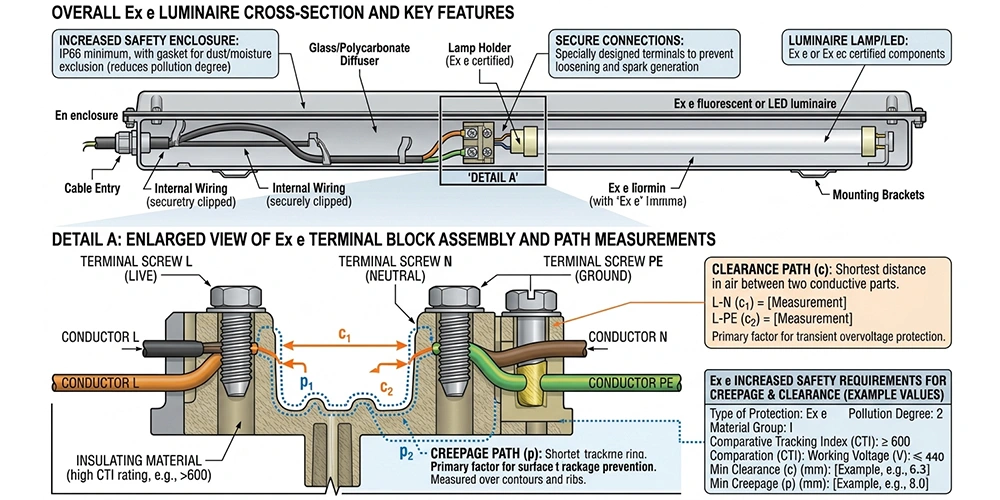
Clearance is the shortest distance through air between live components. It prevents electrical breakdown and arcing under voltage surges.
Creepage distance is the shortest path along the surface of insulating materials between conductive parts. It protects against tracking and insulation failure caused by moisture, dust, or chemical pollution.
In Ex e luminaires, both values must be calculated and verified according to IEC 60079-7. Insufficient distances will lead to failure in type tests and create explosion hazards.
Key Factors Defined by IEC 60079-7
IEC 60079-7 does not provide fixed values. The required clearance and creepage distance are determined by four practical conditions:
- Rated operating voltage
- Pollution degree (most hazardous areas use Pollution Degree 3)
- Insulation material group (CTI value)
- Overvoltage category of the power system
These parameters must be evaluated together to meet the standard’s safety requirements.
Why Ex e Luminaires Need Stricter Design
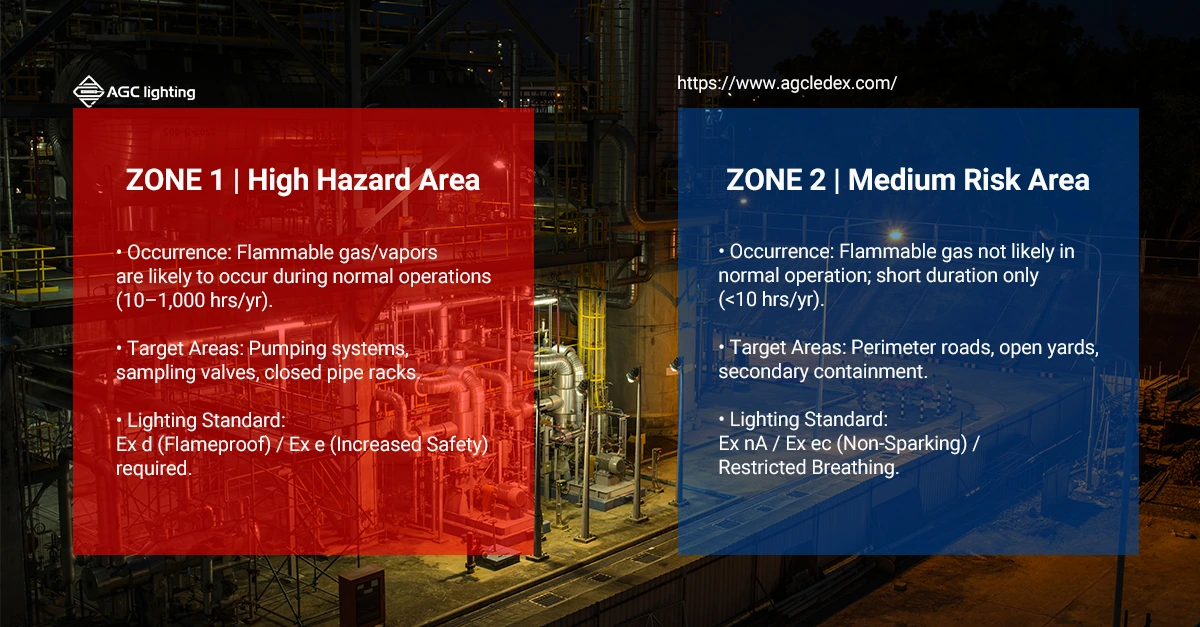
Ex e equipment is designed to avoid arcs, sparks, and excessive temperatures during normal operation, making it widely used in Zone 2 and Zone 22 hazardous areas. Compared with standard luminaires, Ex e products require larger clearances and longer creepage paths to maintain stability in harsh conditions including high humidity, salt spray and vibration.
Poor design in this area will cause tracking, short circuits, reduced insulation performance and even loss of explosion protection.
Practical Design Guidelines
To achieve reliable compliance with IEC 60079-7, designers should follow practical engineering principles. Use high-CTI insulating materials suitable for Pollution Degree 3 environments. Add insulation barriers and ribs to extend creepage paths effectively.
Maintain sufficient safety margins to compensate for thermal expansion and component tolerances. All designs must be validated by third-party type testing to ensure Ex e certification remains valid.
Key Takeaways
Clearance and creepage distance are fundamental safety features of increased safety luminaires, strictly regulated by IEC 60079-7. Correct design prevents electrical breakdown, surface tracking and ignition risks in explosive atmospheres.
- Clearance protects against arcing through air
- Creepage distance prevents insulation tracking over surfaces
- Both must comply with IEC 60079-7 for Ex e validity
AGC Lighting designs Ex e luminaires with strict adherence to IEC 60079-7, with optimized clearance, creepage, insulation, and thermal performance for reliable use in hazardous locations.