T-rating (also called Temperature Class or T-code) is the maximum external surface temperature a hazardous-location luminaire is allowed to reach under its rated conditions. The rating exists so the fixture itself cannot become an ignition source for the flammable gases, vapors, or combustible dusts present in the classified area.
The rating is easy to look up and easy to misread. One nameplate can carry two T-ratings, one for gas and one for dust. One product family can carry different T-ratings at different wattages or ambient temperatures.
In this blog, let’s explore how the rating works, how to match it to a gas or a dust, and what to check on a real nameplate.
What is a T-rating
The terms T-rating, temperature class, and T-code describe the same physical metric: the maximum external surface temperature of an apparatus. The core operating principle is that the maximum fixture surface temperature (T-rating) must be lower than the atmosphere auto-ignition temperature.
Temperature class (IECEx/ATEX)
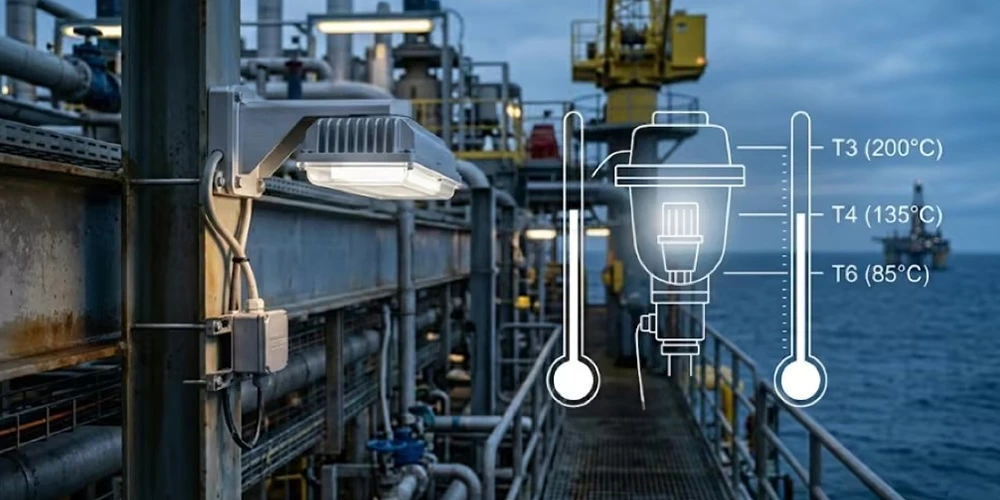
Governed by international standards, the zone system divides gas and vapor hazards into six distinct temperature classes, designated T1 through T6. There are no intermediate subdivisions.
If a fixture runs at 136 °C, it misses the T4 threshold (135 °C) and must be categorized under the much hotter T3 class (200 °C).
T-Code (NEC 500/CEC)
Governed by North American standards (NFPA 70 National Electrical Code and CSA C22.1), the traditional Class/Division system uses 14 individual T-Codes.
In addition to the base T1 through T6 ratings, the NEC introduces lettered subdivisions: T2A through T2D, T3A through T3C, and T4A. These subdivisions provide finer thermal grading, allowing equipment to operate closer to specific gas thresholds without dropping into a drastically hotter category.
Here is a complete table about the T-ratings.
|
Temperature Class (IECEx / ATEX) |
NEC 500 / CEC T-Code |
Maximum Surface Temperature (°C) |
Maximum Surface Temperature (°F) |
|
T1 |
T1 |
450°C |
842°F |
|
T2 |
T2 |
300°C |
572°F |
|
- |
T2A |
280°C |
536°F |
|
- |
T2B |
260°C |
500°F |
|
- |
T2C |
230°C |
446°F |
|
- |
T2D |
215°C |
419°F |
|
T3 |
T3 |
200°C |
392°F |
|
- |
T3A |
180°C |
356°F |
|
- |
T3B |
165°C |
329°F |
|
- |
T3C |
160°C |
320°F |
|
T4 |
T4 |
135°C |
275°F |
|
- |
T4A |
120°C |
248°F |
|
T5 |
T5 |
100°C |
212°F |
|
T6 |
T6 |
85°C |
185°F |
Matching T-rating to gas and vapor hazards
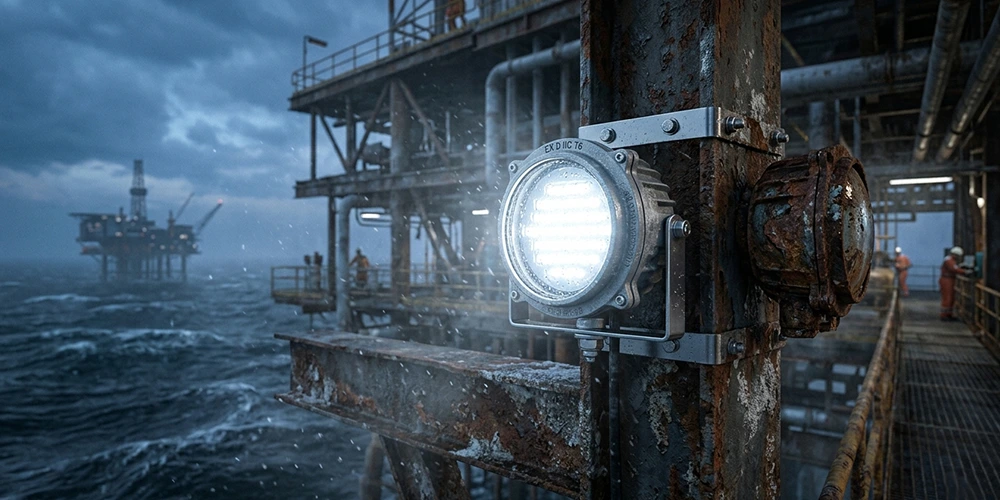
In Class I, or Zones 0, 1, and 2 locations, the atmosphere contains or can contain flammable gases, vapors, or mists. Luminaires’ maximum surface temperature must remain below the Auto-Ignition Temperature (AIT) of every gas present.
Gases are divided into groups based on their experimental safe gaps and minimum igniting currents (NEC Groups A, B, C, D; IECEx Groups IIC, IIB, IIA). However, a gas group designation does not determine the required T-rating.
Gas group and auto-ignition temperature are independent chemical properties:
- Hydrogen (Group B / Group IIC): Highly explosive with extremely low ignition energy, yet it has an exceptionally high auto-ignition temperature of roughly 560°C. A standard T1-rated fixture is thermally sufficient for hydrogen.
- Carbon Disulfide (CS2, Group IIC): Requires a maximum surface temperature below its AIT of roughly 90°C to 102°C. Only a certified T6 luminaire (maximum 85°C) can be safely installed in its presence.
- Gasoline Vapors (Group D / Group IIA): Auto-ignite around 280°C, requiring a fixture rated T3/T2A or better.
In Class I, Division 2 locations, the NEC adds an extra margin: the marked maximum surface temperature must not exceed 80% of the AIT. For a material with a 300 °C AIT, the fixture surface must stay at or below 240 °C.
When several gases can be present, use the most restrictive (lowest) AIT.
The ambient temperature matters for a T-rating
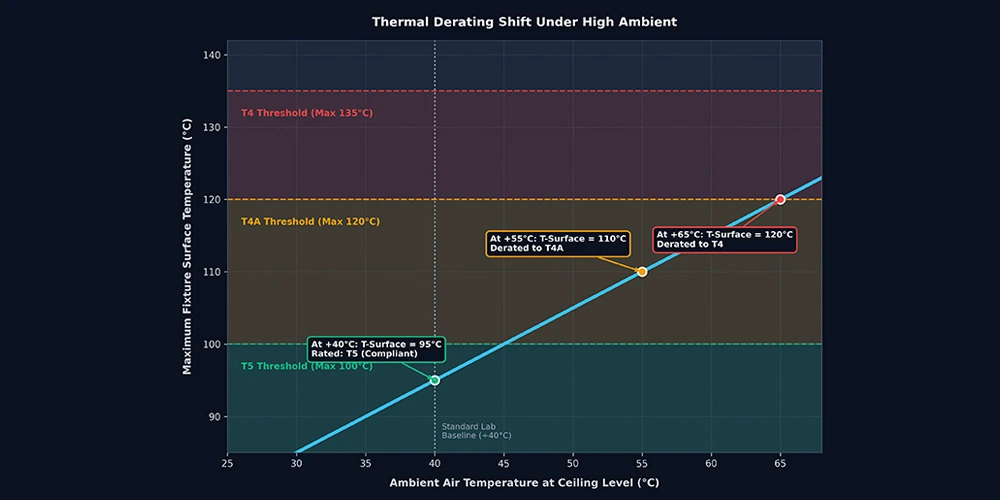
A luminaire’s T-rating is not an absolute constant. It is directly tied to the ambient temperature of the testing environment. For example, our HA05 Premium Zone 1 luminaire lists a gas rating of T4 and an operating temperature range of -40°C to 65°C.
A T-rating therefore only means something at a stated ambient.
The surface of a luminaire is as hot as the surrounding air plus the heat the luminaire produces itself. Put the same luminaire in a hotter location, and its surface gets hotter too. A T4 rating at 40 °C does not guarantee T4 performance at 55 °C.
Therefore, if your site runs hotter than the stated range, then the luminaire is not certified for your site, whatever its T-rating says.
Matching T-rating to combustible dust
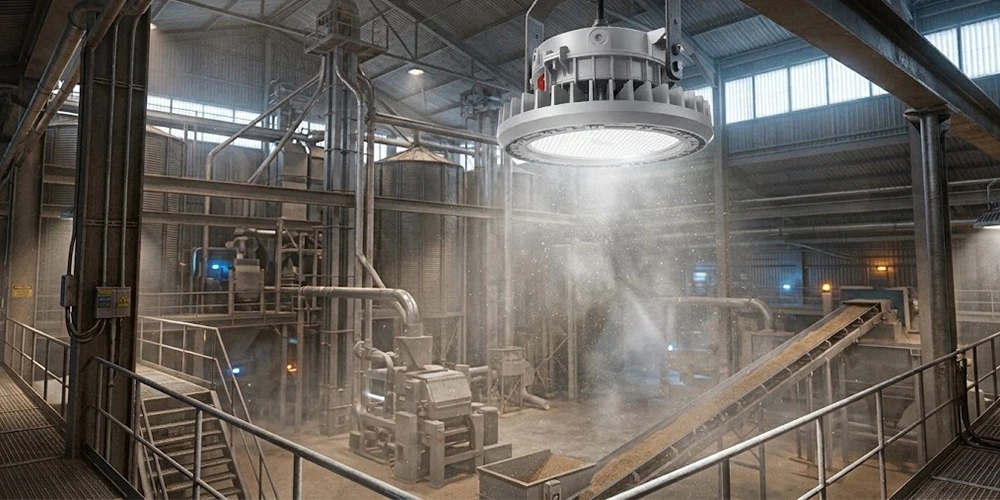
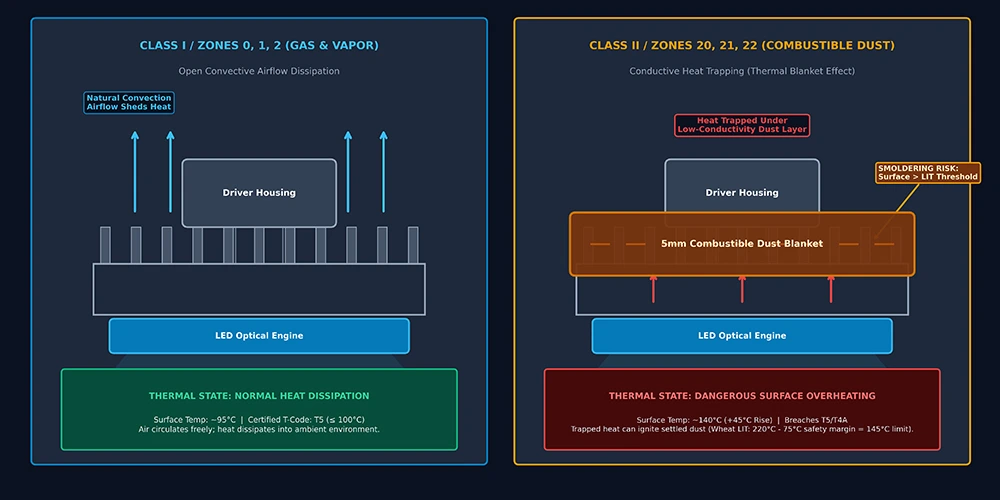
Class II / Zones 20, 21, 22 environments like grain storage, coal processing facilities, wood flour milling, and pharmaceutical manufacturing introduce a physical thermal mechanism entirely absent in gas atmospheres: conductive heat retention via layer insulation.
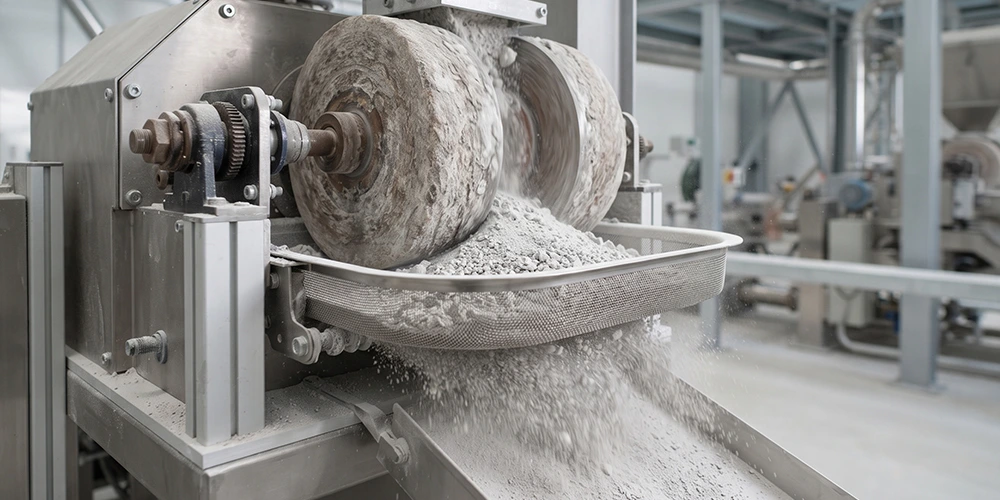
Airborne dust settles onto horizontal exterior surfaces. As dust accumulates across cooling fins and flat housings, it forms an insulating blanket with low thermal conductivity. Instead of dissipating into the surrounding atmosphere, heat becomes trapped within the fixture housing.
Field measurements show that a 5 mm layer of industrial grain or coal dust can increase an LED housing surface temperature by 30°C to 50°C compared to clean-air operation. A luminaire operating at 90°C in clean air can quickly exceed 135°C when coated with settled particulates.
Therefore, selection must consider both the dust-cloud ignition temperature and the dust-layer ignition temperature. The limit is the lower of two values: the ignition temperature of a 5 mm dust layer minus 75 and two-thirds of the dust cloud ignition temperature.
Because dust ignition mechanisms differ fundamentally from gas auto-ignition, standards move away from traditional T1-T6 letter codes for dust enclosures. Instead, they require the exact certified surface temperature to be stamped directly in degrees Celsius, like T135 °C.
Need help with your upcoming project?
Contact our engineering team today. We’ll review your project specifications and deliver a tailored lighting solution to ensure your project's success.