

In hazardous locations, lighting is never just about providing enough lux. Engineering contractors, EPCs and distributors must ensure every luminaire installed in potentially explosive atmospheres is compliant with ATEX, correctly matched to the zone, and robust enough for long‑term operation. A clear understanding of ATEX lighting zones is the foundation for safe and successful projects, whether they are in Europe, the Middle East, Asia or other industrial regions.
- What ATEX Means In Real Projects
- Gas Zones: Zone 0, Zone 1, Zone 2
- Dust Zones: Zone 20, Zone 21, Zone 22
- Gas Groups, Temperature Classes And Surface Temperature
- Types Of Explosion Protection For Luminaires
- Comparative View: Gas And Dust Requirements
- From Zoning To Product Choice
- Regional And Market Considerations
- The Role Of Engineers And Distributors
What ATEX Means In Real Projects
ATEX is the European regulatory framework that governs equipment for explosive atmospheres. In practice, it affects how project teams select, document and install lighting in areas with flammable gases, vapours or combustible dusts. Even outside the EU, many global operators follow ATEX or closely related IECEx standards because they are recognised by international owners, auditors and insurance companies.
For engineers and distributors, ATEX zoning is the language that connects the risk on site with the certification on the product label. Once the zone is defined, the required equipment category, type of protection and temperature limits follow logically.
Gas Zones: Zone 0, Zone 1, Zone 2
Gas and vapour hazards are classified into three main ATEX gas zones. The table below summarises how they differ and what this means for lighting.
| Gas Zone | Presence of explosive gas atmosphere | Typical locations | Usual equipment category | Lighting implications |
|---|---|---|---|---|
| Zone 0 | Present continuously, for long periods, or frequently | Inside tanks, vessels, sumps, enclosed process spaces | II 1G | Highly specialised solutions; luminaires rarely installed directly in this volume |
| Zone 1 | Likely to occur in normal operation occasionally | Around process equipment, pumps, offshore platforms, loading | II 2G | Core area for Ex luminaires; robust, often Ex d or Ex de, with strict T‑class limits |
| Zone 2 | Not likely in normal operation, or only for a short period if it occurs | Perimeter of Zone 1, compressor rooms, fuel depots | II 3G | Lower probability of hazard; often lighter, more economical designs for Ex Zone 2 |
In many oil and gas, petrochemical and chemical projects, Zone 1 and Zone 2 drive most of the lighting specification. Zone 1 fittings are selected where flammable gases can appear during normal operation; Zone 2 models are used to cover surrounding areas and reduce cost and weight while remaining compliant.
Dust Zones: Zone 20, Zone 21, Zone 22
Combustible dusts create a similar risk profile in industries such as food processing, grain handling, plastics and pharmaceuticals. Dust zones mirror the gas zones but focus on dust clouds and layers.
| Dust Zone | Presence of combustible dust atmosphere | Typical locations | Usual equipment category | Lighting implications |
|---|---|---|---|---|
| Zone 20 | Present continuously, for long periods, or frequently | Inside silos, hoppers, mills, dust collectors | II 1D | Highly specialised; luminaires inside the process volume require strict surface temperature |
| Zone 21 | Likely to occur in normal operation occasionally | Bagging stations, discharge points, transfer areas | II 2D | Common focus for Ex dust luminaires, usually Ex tb with high IP and easy‑to‑clean housing |
| Zone 22 | Not likely in normal operation, or only for a short period | Surroundings of Zone 21, dusty halls and packings | II 3D | Cost‑effective Ex dust lighting, with emphasis on dust‑tight design and controlled T‑surface |
For dust, the maximum surface temperature of the luminaire must stay safely below the ignition temperature of both dust layers and dust clouds. Smooth surfaces and high ingress protection simplify cleaning and reduce accumulation.
Gas Groups, Temperature Classes And Surface Temperature
Zoning alone is not sufficient. The specific gas or dust present in the area determines the gas group and temperature class, which must match the marking on the luminaire.
For gases and vapours, ATEX divides atmospheres into gas groups IIA, IIB and IIC. Group IIA covers less demanding gases such as propane, group IIB includes ethylene, and group IIC covers highly sensitive gases like hydrogen and acetylene. Luminaires marked for IIC can generally be used in IIB and IIA, but not the other way round.
Temperature class, from T1 to T6, indicates the maximum surface temperature of the equipment. A T6 luminaire, for example, has a very low maximum surface temperature, typically not exceeding 85∘C85^\circ C85∘C, suitable for gases that ignite easily. For dust hazards, the critical value is the declared maximum surface temperature compared to the dust ignition data. Engineering teams should always cross‑check these values against the hazardous area classification documents.
Types Of Explosion Protection For Luminaires
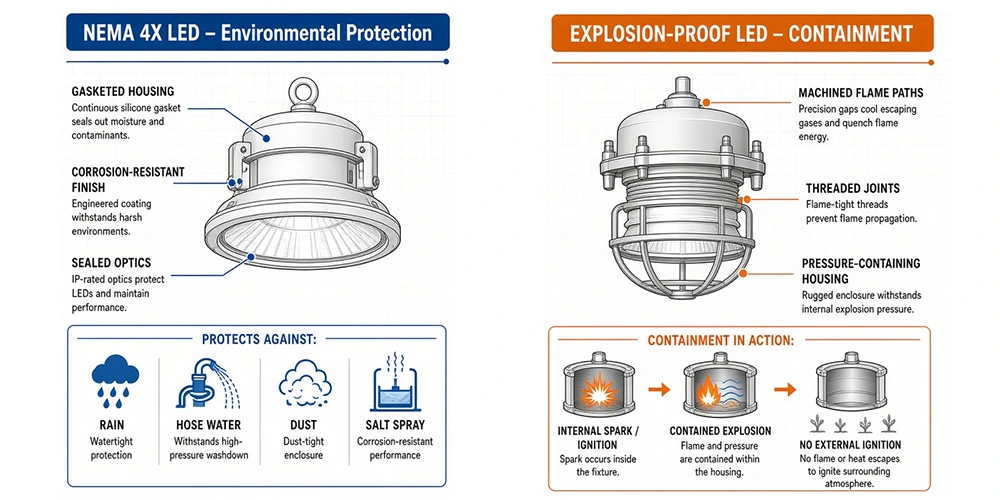
ATEX luminaires use several types of protection to achieve compliance. Flameproof “Ex d” enclosures are designed to withstand and cool an internal explosion before it reaches the outside atmosphere, making them common in Zone 1 gas areas. Increased safety “Ex e” prevents arcs, sparks and hot surfaces in normal operation and is often combined with Ex d in hybrid designs such as Ex de floodlights.
In Zone 2, protection concepts like Ex nR or Ex ec allow simpler, lighter designs while still controlling ignition sources, reflecting the lower probability of an explosive atmosphere. For dust zones, protection by enclosure “Ex tb” or “Ex tc” focuses on preventing dust ingress and keeping surface temperatures under control. Some modern LED systems also use optical protection concepts like Ex op is or Ex op pr when optical radiation is relevant.
Comparative View: Gas And Dust Requirements
For many distributors and EPCs, projects involve both gas and dust risks. A combined view helps with product standardisation.
| Aspect | Gas (G) zones | Dust (D) zones | Impact on lighting selection |
|---|---|---|---|
| Zone range | Zone 0, 1, 2 | Zone 20, 21, 22 | Determines equipment category (1/2/3) and certification scope |
| Atmosphere form | Gas or vapour | Dust cloud and dust layer | Influences test methods and marking (G vs D or GD) |
| Grouping | IIA, IIB, IIC | IIIA, IIIB, IIIC | Higher group letters indicate more demanding atmospheres |
| Temperature criterion | T‑class (T1–T6), max surface temperature | Max surface temperature vs dust ignition data | Critical for LED drivers and heat management |
| Typical protection | Ex d, Ex e, Ex nR, Ex ec | Ex tb, Ex tc | Drives housing design, gasket selection and maintenance procedures |
Specifying luminaires that carry both gas and dust certifications (e.g. Ex db IIC and Ex tb IIIC) can simplify procurement, especially for global operators with mixed hazards on the same site.
From Zoning To Product Choice
Once the zone classification and hazard details are known, engineers and distributors can translate them into concrete lighting choices. The process typically starts with the hazardous area drawings, which indicate boundaries for each zone. Gas or dust group and ignition temperature data further refine the requirements.
From there, the project team selects ATEX‑certified luminaires whose markings match or exceed the zone, category, group and temperature limits. Environmental conditions such as ambient temperature, corrosion exposure, vibration and cleaning methods influence housing material, ingress protection and mechanical strength. Optical performance must also fit the application: mounting height, beam distribution, glare control and required lux levels all affect which lumen packages and optics are suitable.
Lifecycle factors are increasingly important. Long LED lifetime, high lumen maintenance, and consistent quality across batches help reduce maintenance in difficult, elevated or offshore locations. For distributors, offering a coherent product platform across Zone 1/21 and Zone 2/22, with shared accessories and installation methods, adds value for both installers and end users.
Regional And Market Considerations
Although ATEX originates in Europe, many projects in the Middle East, Asia‑Pacific, Africa and Latin America either require ATEX directly or accept it alongside IECEx. Global operators often specify ATEX or dual‑certified products to simplify corporate standards and audits. In some markets, such as North America, the NEC/CEC Class/Division or Class/Zone systems apply, and cross‑acceptance rules must be checked case by case.
For engineers and distributors working across borders, clear documentation in English plus relevant local languages, together with understandable explanations of ATEX markings, helps site teams install and inspect Ex luminaires correctly. Early coordination with the owner’s engineers, notified bodies and insurance representatives reduces the risk of redesign or replacement late in the project schedule.
The Role Of Engineers And Distributors
ATEX lighting zones provide the framework, but people turn that framework into safe, reliable installations. Engineering contractors interpret risk assessments, define lighting philosophies and select the right Ex protection concepts for each area. Distributors ensure that the specified products are available, correctly documented and supported locally.
By understanding the practical meaning of each zone, recognising the link between gas or dust group and temperature class, and reading ATEX markings with confidence, both engineers and distributors can guide end users toward compliant, efficient and maintainable lighting solutions in hazardous areas.
Would you like this adapted into a specific brand voice (for example, tailored to AGC Lighting with some product‑type examples), or kept neutral for use across multiple brands and channels?