
In hazardous industries such as oil & gas, petrochemical processing, and marine engineering, selecting the correct explosion protection method is not just a technical decision—it directly impacts safety, maintenance, and long-term operational costs.
Among the protection concepts defined in IEC 60079 standards, Ex d (Flameproof) and Ex e (Increased Safety) are the two most commonly used methods for electrical equipment, especially lighting. While both aim to prevent ignition of explosive atmospheres, they are based on fundamentally different engineering philosophies.
Ex d: The "Containment" Strategy (Flameproof)
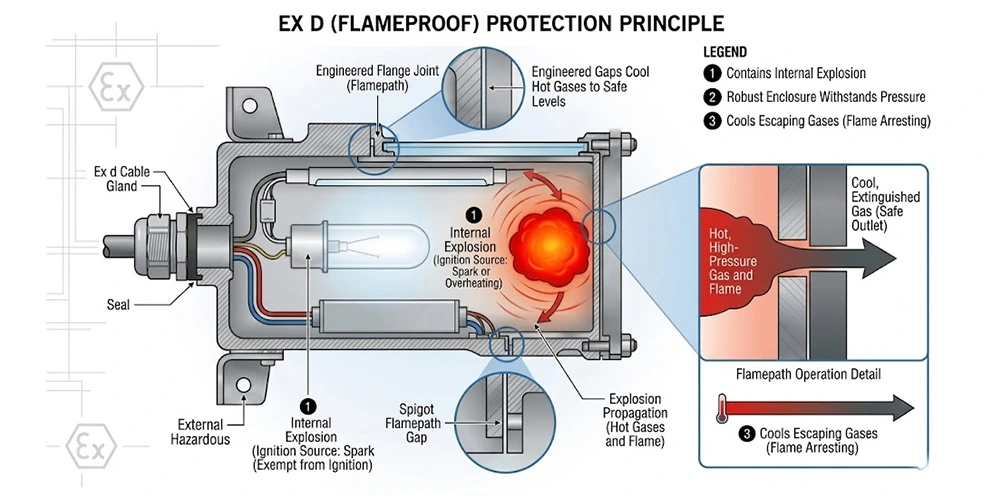
The core philosophy of Ex d is containment.
In this concept, it is assumed that an internal ignition—such as a spark or high temperature—may occur inside the equipment. Instead of preventing it, the enclosure is designed to safely withstand and contain the explosion.
The enclosure must be:
- Mechanically strong enough to resist internal explosion pressure
- Precisely engineered with flamepaths that cool escaping gases
- Designed to prevent flame propagation to the external hazardous atmosphere
This makes Ex d equipment highly robust and reliable in environments where ignition sources are unavoidable.
Typical advantages of Ex d
- Suitable for equipment that may generate sparks or heat
- High mechanical strength for harsh industrial conditions
- Widely used in Zone 1 and Zone 2 hazardous areas
Limitations of Ex d
- Heavy structure (typically aluminum or stainless steel)
- Requires careful maintenance of flamepaths
- Higher installation and transportation cost
Ex e: The "Prevention" Strategy (Increased Safety)
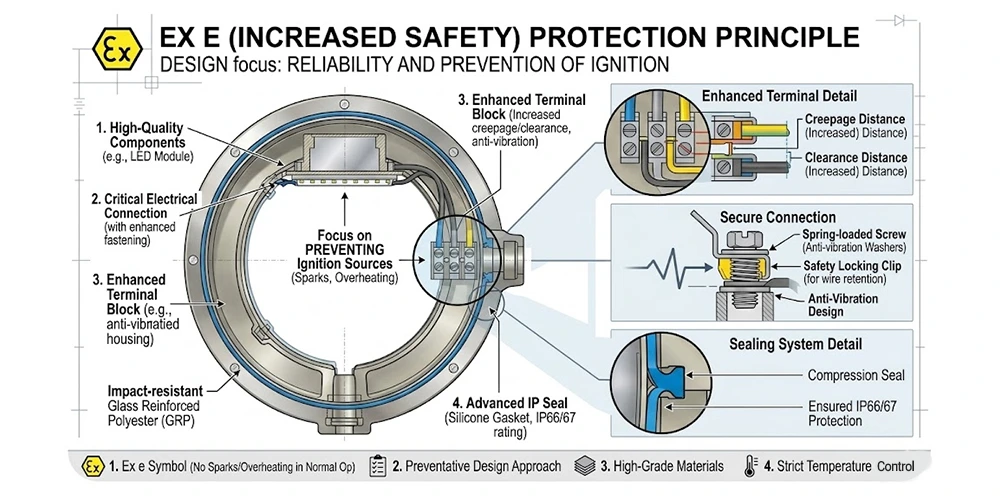
Unlike Ex d, the philosophy of Ex e is prevention.
This method is applied to equipment that, under normal operation and specified fault conditions, does not produce arcs, sparks, or excessive temperatures. Additional safety measures are introduced to ensure that ignition sources are avoided altogether.
Key design features include:
- Increased creepage and clearance distances
- Prevents electrical tracking and arcing
- Reliable electrical connections
- Anti-vibration terminals reduce the risk of loose contacts and overheating
- High ingress protection (IP66/67)
- Prevents dust, moisture, and explosive gases from entering the enclosure
Because it does not need to withstand internal explosions, Ex e equipment is typically lighter and more flexible in design.
Typical advantages of Ex e
- Lightweight construction (often GRP or engineered plastics)
- Excellent corrosion resistance
- Easier installation and maintenance
- Lower overall system cost
Limitations of Ex e
- Cannot be used with components that generate sparks
- More dependent on correct installation quality
- Application scope is more restricted than Ex d
Ex d vs. Ex e: Key Differences
| Feature | Ex d (Flameproof) | Ex e (Increased Safety) |
| Protection Concept | Contain explosion | Prevent ignition |
| Zone Application | Zone 1 (Primary) and Zone 2 | Zone 2 (primary), Zone 1(conditional) |
| Engineering Logic | Contain and Cool | Prevent and Reliable |
| Enclosure Material | Heavy-duty Metal (Aluminum/Stainless Steel) | High-grade Plastics(GRP/Polycarbonate) or Lightweight Metal |
| Weight | Heavy (May require structural support) | Light (Saves on structural costs) |
| Corrosion Resistance | Moderate(Depends on coating/material) | Excellent (With GRP/Plastic) |
| Typical Use | Drivers, High-wattage LEDs, Group llC gases | Low-heat LEDs, Terminal boxes. Linear lights |
How to Choose: Practical Guidance
Both Ex d and Ex e play critical roles in hazardous area protection. Their differences lie not in safety level, but in how safety is achieved—containment versus prevention.
A clear understanding of these principles enables engineers and buyers to make informed decisions that balance safety, cost, and operational efficiency.
Specify Ex d when you need a "fortress" to contain potential internal ignitions from high-power electronics.
Choose Ex e when you prioritize prevention, lightweight design, and superior resistance to corrosive elements.
By understanding these engineering principles, you ensure more than just regulatory compliance—you ensure the long-term safety of your personnel and the uninterrupted productivity of your facility.