
- 1. Compression of Safety Margins for Temperature Classes (T-Class)
- 2. Physical Failure of Sealing Systems (IP Protection)
- 3. Connection Stability and Thermal Stress Imbalance
- 4. The Arrhenius Accelerated Aging Effect on Electronic Components
- 5. Optoelectronic Performance Fluctuations in LED Lighting Systems
- Defining True High-Temperature Explosion-Proof Design
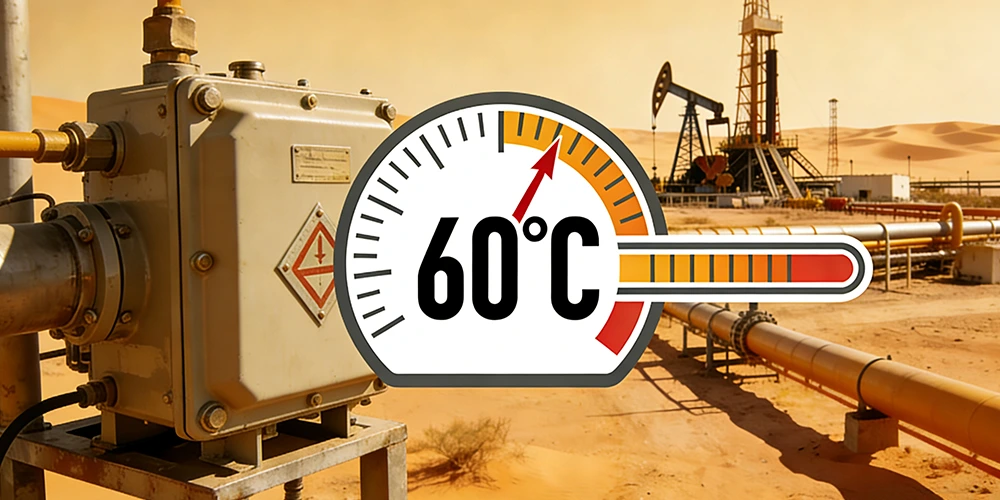
In oil and gas regions across the Middle East, chemical plants in India, or mines in Africa, industrial equipment consistently faces extreme ambient temperatures ranging from 50°C to 60°C. In such harsh conditions, explosion-proof (Ex) equipment faces far more than just "heat dissipation" challenges; its physical properties, certification compliance, and long-term operational integrity undergo rigorous, comprehensive testing.
The following is an in-depth technical analysis of the impact of sustained high temperatures on explosion-proof lighting fixtures:
1. Compression of Safety Margins for Temperature Classes (T-Class)
The core metric of explosion-proof design is ensuring that the equipment’s surface temperature remains consistently below the ignition temperature of flammable gases or dust in the surrounding environment.
Superposition of Temperature Rise: With a high ambient baseline of 60°C, the heat generated by internal components adds to the environmental heat, leading to a significant increase in the enclosure’s surface temperature.
Compliance Drift: Equipment that originally meets T6 or T5 ratings in a 25°C laboratory environment will see its safety margins contract sharply during high-temperature field operations. This may even cause the device to exceed its rated temperature class, posing a severe risk of explosion-proof failure.
2. Physical Failure of Sealing Systems (IP Protection)
Gaskets and seals are typically the most heat-sensitive "weak links" in an explosion-proof enclosure.
Elastomer Creep: Under sustained high temperatures, sealing rings may undergo permanent plastic deformation or softening, leading to a loss of the Ingress Protection (IP) rating.
Micro-circulation Degradation: Thermal expansion and contraction caused by extreme diurnal (day-to-night) temperature swings create a "breathing effect." This can lead to micro-cracks during cooling, increasing the risk of moisture and corrosive gas ingress—a critical concern in Zone 1/21 hazardous locations.
3. Connection Stability and Thermal Stress Imbalance
Discrepancies in the coefficients of thermal expansion (CTE) between different materials translate into mechanical stress in high-temperature environments.
Torque Degradation: The clamping force of cable glands and terminal blocks may shift due to thermal expansion.
Connection Failure: Fasteners or threaded components pre-tightened at 25°C may loosen at 60°C due to the thermal cycling characteristics of the materials. This directly compromises the sealing reliability of the lighting fixture.
4. The Arrhenius Accelerated Aging Effect on Electronic Components
According to the fundamental laws of electronic reliability, for every 10°C increase in operating temperature, the expected lifespan of components is often reduced by half.
Performance Degradation: High temperatures accelerate the evaporation of electrolyte in capacitors, trigger semiconductor parameter drift, and cause severe lumen depreciation in LEDs.
Material Embrittlement: Plastic supports and insulating materials subjected to prolonged thermal stress will undergo accelerated aging, becoming brittle and losing their original structural integrity.
5. Optoelectronic Performance Fluctuations in LED Lighting Systems
High-performance LED fixtures demand rigorous thermal management; extreme heat triggers a series of critical chain reactions:
Driver Failure: The conversion efficiency of power supply modules decreases at high temperatures, accompanied by a weakened surge protection capability.
Lifespan Depreciation: Key metrics such as L70 and L90 (Lumen Maintenance) will experience a significantly accelerated drop-off under high ambient temperature conditions.
Defining True High-Temperature Explosion-Proof Design
To withstand extreme climates, superior explosion-proof equipment must utilize systemic redundancy to counteract thermal stress:
Derating Design: Ensuring electronic components operate significantly below their maximum rated load to minimize internal heat generation.
Enhanced Thermal Architecture: Implementing larger heat dissipation fins or materials with superior thermal conductivity.
Specialized Material Application: Selecting high-temperature resistant fluororubber (FKM/Viton) seals and UV/Salt-spray resistant enclosure coatings.
For instance, AGC’s explosion-proof products go beyond baseline certification. Our fixtures undergo long-term thermal cycling verification at 50°C–60°C, ensuring robust and reliable operation in real-world industrial environments.