
As the global energy transition moves into deeper waters, renewable sources like solar and wind have become the backbone of the power grid. However, the inherent volatility of these sources—their "intermittency"—remains a primary bottleneck for large-scale applications. To bridge the energy gap when the sun sets, or the wind dies down, Hydrogen (H2) is rapidly evolving from a laboratory concept to industrial-scale application as a high-energy-density, zero-carbon energy carrier.
Yet, behind the clean future built by hydrogen lies a complex web of technical challenges. Hydrogen is fundamentally different from traditional natural gas or gasoline; its unique physical and chemical properties introduce immense safety risks at every stage of production, storage, and utilization. For engineering designers and site managers, Explosion-proof lighting is not merely an optional accessory—it is the first line of defense against catastrophic accidents.
- I. The "Temperament" of Hydrogen: Why It’s Among the Most Dangerous Industrial Gases
- II. Decoding Ex Certification: Why Group IIC is the Mandatory Standard
- III. Safety Scenarios Across the Entire Value Chain
- 1. Green Hydrogen Production:
- 2. Storage and Distribution:
- 3. End-Use: Industrial and Agricultural Transformation
- IV. A Non-Negotiable Investment in Safety
I. The "Temperament" of Hydrogen: Why It’s Among the Most Dangerous Industrial Gases
To understand the necessity of explosion-proof lighting, one must analyze the physical characteristics of hydrogen. As the lightest element in the universe, its "lightness" grants it high diffusivity but also creates unique risks:
Extreme Leakage Risk and Low Detectability: Hydrogen is colorless and odorless, making it undetectable by human senses. Due to its tiny molecular weight (14 times lighter than air), it escapes through microscopic welds or seals and rapidly accumulates at the ceiling or in dead corners of enclosed spaces, forming invisible "explosive gas clouds".
Ultra-Low Ignition Energy: This is a critical technical parameter. Compared to propane or ethylene, hydrogen has an extremely low ignition threshold. Even a faint static spark, an arc from a switching operation, or the residual heat from a non-compliant luminaire is sufficient to ignite a hydrogen-air mixture.
Wide Flammability Limits: Hydrogen has a broad explosive concentration range in air (4% to 75%), meaning it reaches explosive conditions almost immediately upon leaking.
The Threat of Invisible Flames: When ignited, hydrogen burns with a pale blue flame that is nearly invisible in daylight. This "invisible fire" poses a massive challenge for firefighting and prevents personnel from detecting the danger immediately.
II. Decoding Ex Certification: Why Group IIC is the Mandatory Standard
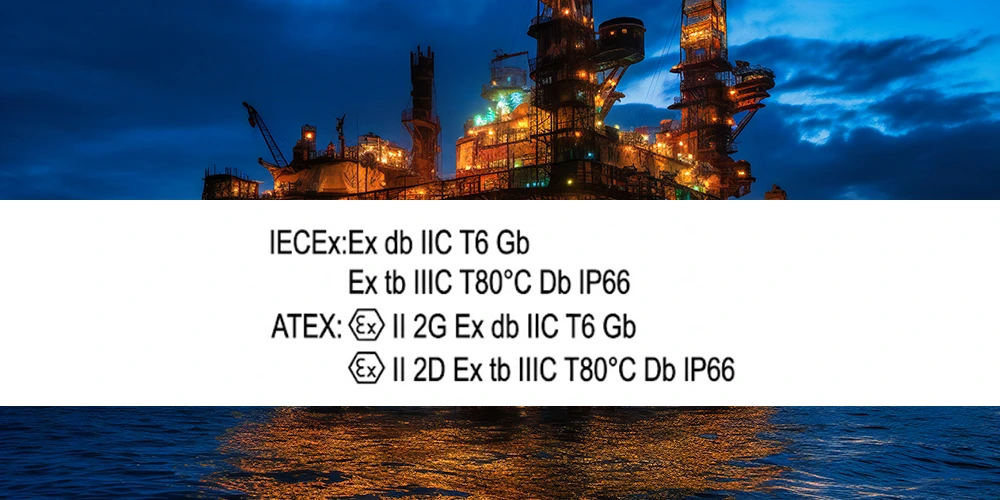
In the field of explosion-proof electrical equipment, not all "Ex lamps" are suitable for hydrogen environments. According to the International Electrotechnical Commission (IEC) and ATEX directives, explosive gases are classified into groups based on their level of risk:
Group IIA: Represented by propane; lowest risk level.
Group IIB: Represented by ethylene; medium risk level.
Group IIC: The highest risk level; includes Hydrogen and Acetylene.
Hydrogen’s classification under Group IIC means it demands the highest level of explosion protection in the industry. Engineers must focus on the following core points during equipment selection:

1. The Distinction Between IIC and IIB + H2
In the market, you will find luminaires labeled as Group IIC, while some others are marked as IIB + H2. IIB + H2 indicates the device has passed standard IIB testing plus specific explosion tests for hydrogen. For hydrogen applications, both are generally acceptable, provided the certificate explicitly mentions hydrogen (H2).
2. Temperature Class (T Class)
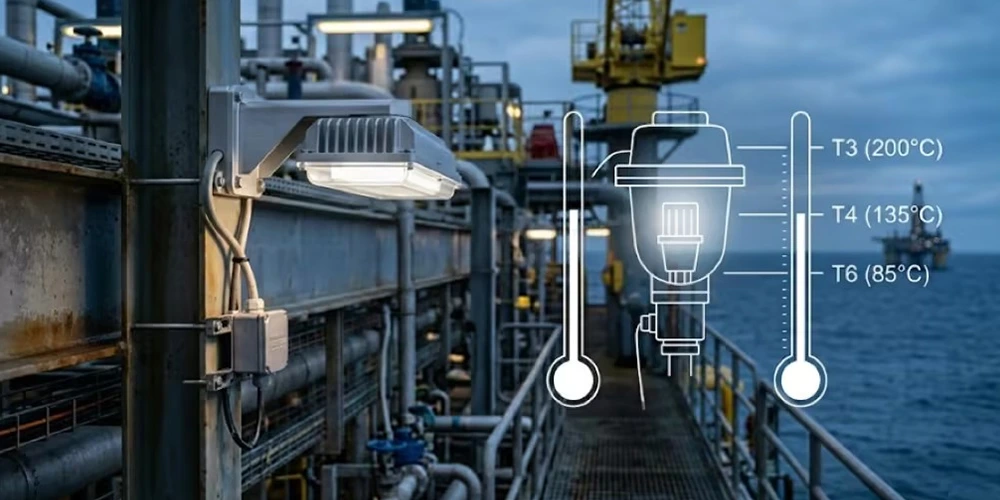
Despite hydrogen’s high auto-ignition temperature (approx. 560°C), it has an extremely low minimum ignition energy (MIE), making it highly susceptible to spark-induced explosions. Consequently, explosion-proof lighting must strictly adhere to T4 or T6 temperature ratings. By maintaining low surface temperatures, these fixtures eliminate the risk of the enclosure itself becoming an ignition source for the surrounding explosive atmosphere.
III. Safety Scenarios Across the Entire Value Chain
The hydrogen value chain is long and complex. From upstream production to downstream utilization, lighting requirements vary at each node.
1. Green Hydrogen Production:
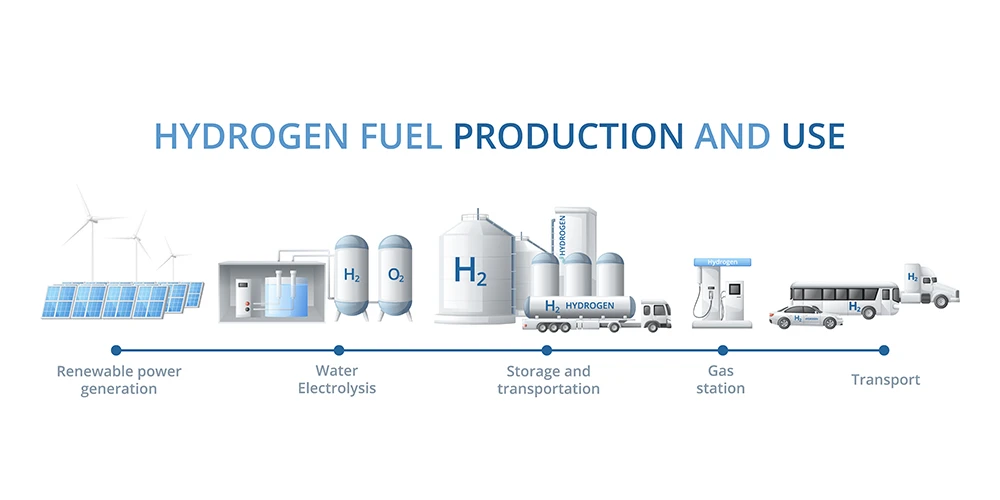
Electrolyzer Halls. The current trend involves using wind and solar power for water electrolysis (Green Hydrogen). In electrolysis plants, high-pressure pipe joints, valves, and compressors are potential leak points.
- Zoning: These areas are typically defined as Zone 1 (high-frequency risk) or Zone 2 (abnormal condition risk).
- Lighting Challenge: Since hydrogen accumulates at the top of high-ceiling facilities, ceiling-mounted high bays must feature top-tier IIC certification and superior thermal management.
2. Storage and Distribution:
High Pressure and Cryogenic Challenges Hydrogen is typically stored in tanks at high pressures (350–700 bar) or as liquid hydrogen at cryogenic temperatures (-253°C).
- Maritime Transport: When liquid hydrogen is transported via tankers, pump rooms and storage holds are extremely hazardous enclosed spaces. Here, Ex-lights must not only be explosion-proof but also highly resistant to salt spray corrosion.
- Hydrogen Refueling Stations (HRS): As public-facing facilities, HRS lighting must balance Ex-safety with visual guidance to ensure driver safety during nighttime operations.
3. End-Use: Industrial and Agricultural Transformation
Hydrogen is replacing fossil fuels in heavy industries like steelmaking and heavy machinery.
Maintenance Workshops: Workshops servicing hydrogen-powered vehicles must re-evaluate their electrical systems. Traditional industrial lighting must be replaced with Group IIC LED luminaires, as any minor leak during fuel system maintenance could lead to a disaster if ignited by a lamp's internal components.
IV. A Non-Negotiable Investment in Safety
Hydrogen is the essential path to achieving Net-Zero emissions, but its rollout must prioritize safety. Choosing lighting solutions with high-level Ex-certification (such as Group IIC) is not just about complying with ATEX or IECEx regulations—it is about protecting assets, the environment, and, most importantly, human lives.
As you plan your next hydrogen project, please review your lighting checklist:
- Does it carry Group IIC certification?
- Is it rated for the appropriate Zone 1 or Zone 2 area?
- Does the manufacturer have a proven technical track record in hazardous area lighting?