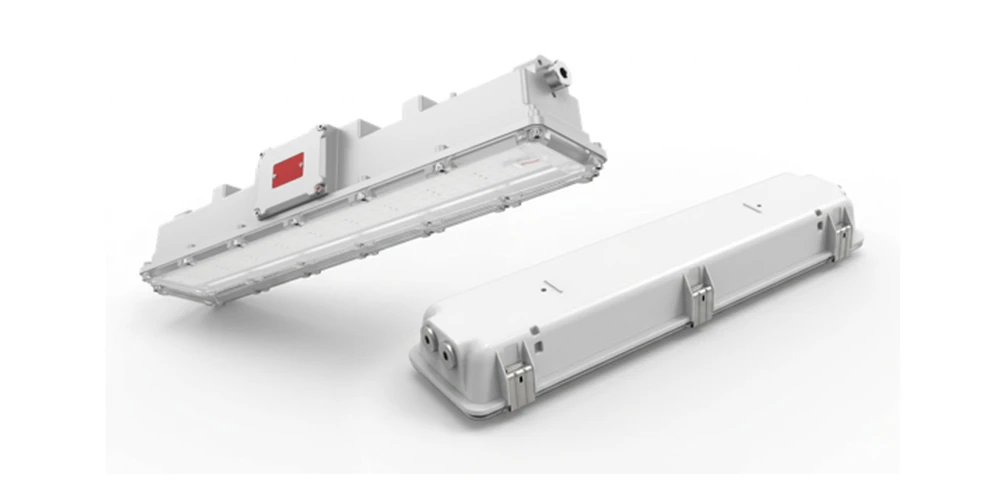

In hazardous locations such as chemical plants, gas stations, or pharmaceutical workshops, explosion-proof linear lights are the core equipment for ensuring production safety. However, many engineers often overlook a subtle but critical structural difference when procurement or schematic design is concerned: the number of cable entry holes on a single side of the luminaire.
Some believe an extra hole is "redundancy," while others argue that one fewer hole is a "downgrade" in specifications. This article will provide an in-depth comparison between the single-side dual cable entry and the single cable entry across four core dimensions.
Construction Efficiency and Wiring Logic: The "Convenience" Debate of Series Connection
In large-scale industrial lighting projects, luminaires are often arranged in rows. The design of the cable entries directly determines the electrician's installation speed.
Single Entry Solution: Traditional "T-type" or "Branch" Structure
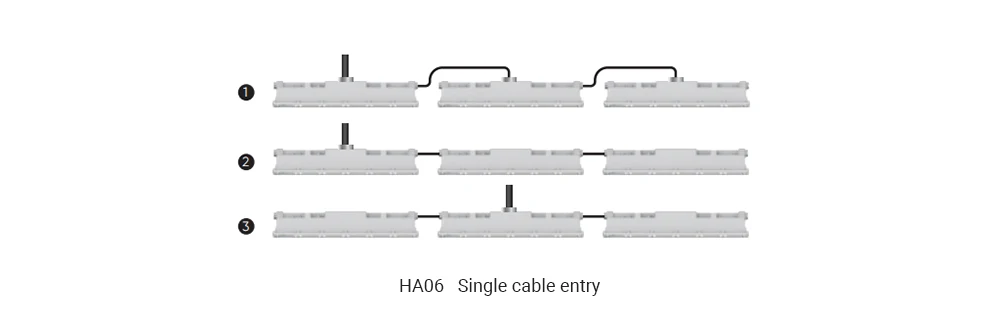
A single-side single cable entry means each fixture has only one "inlet." If multiple lights need to be connected, installers usually have two options:
- External Junction Box: Adding an explosion-proof junction box outside the fixture. The main line enters the junction box, and a branch wire is then connected to the light.
- Intermediate Splicing: Stripping and splicing the main cable. However, this is an extremely dangerous and non-compliant operation in hazardous areas, as any exposed joints will compromise the overall explosion-proof rating.
Dual Entry Solution: True "Daisy Chain" Series Connection
The single-side dual-hole design is specifically optimized for series construction. One cable enters through the left hole, passes through the internal terminal block of the fixture, and another cable leads directly out of the right hole to connect to the next light.
Advantage: No extra external junction boxes are required; the construction site remains tidy, and the wiring logic is as clear as "holding hands."
Efficiency: Experimental data indicates that in the same environment, the dual-hole series solution improves construction speed by approximately 30% - 50% compared to the single-hole solution.

System Cost and Bill of Materials (BOM): Unit Price vs. Total Integrated Cost
At first glance, the unit cost of a single-entry luminaire appears lower. However, when evaluating the "turnkey price" of an entire lighting project, the conclusion is often the opposite.
| Single Cable Entry Solution | Single-Side Dual Cable Entry Solution | |
| External Accessories | Requires additional procurement of Ex-certified junction boxes and sealing glands. | Requires only the fixture's included accessories, typically equipped with one certified blanking plug. |
| Cable Usage | More branches are required; cable paths may overlap. | Cables pass through the luminaires; the path is the shortest and most economical. |
| Labor Hours | Installing junction boxes adds extra steps, leading to high labor costs. | One-step installation with a highly streamlined process. |
Although the production cost of dual-entry luminaires is slightly higher (due to the additional machining process and higher terminal block specifications), it offsets the expense of explosion-proof junction boxes and high wages for specialized technicians. In large-scale installations, the dual-entry solution possesses a clear marginal cost advantage.
Explosion-proof Safety and Sealing Reliability: Structure Determines Lifespan
In the field of explosion protection, every "entry" represents a potential point of risk.
Advantages of Single Entry: The structure is simpler, and the integrity of the enclosure is superior. One fewer hole means one fewer potential point for pressure leakage or water ingress. In extreme corrosive environments or high-pressure washdown conditions, the sealing pressure requirements are lower.
Challenges of Dual Entry: Each cable entry must be equipped with professional Ex-certified cable glands. If the second entry is temporarily unused, it must be hermetically sealed using an Ex-rated metal blanking plug.
The single-entry solution excels in its high "fault tolerance," whereas the dual-entry solution imposes stricter requirements on construction standardization and installation compliance.
Maintenance and Future Expansion: The Trade-off Between Flexibility and Stability
Single Entry Solution: If a single luminaire fails, since it uses a branch connection, it typically does not affect the operation of subsequent fixtures.
Dual Entry Series Solution: Although modern luminaires mostly utilize internal parallel wiring, the physical cable path is continuous. If an internal terminal block burns out due to overloading, it may cause an entire row of downstream lights to go out, increasing the difficulty of troubleshooting.
Expansion Capability: The dual-entry solution is extremely flexible for adding light points at a later stage. If you find a specific area has insufficient illuminance, you simply need to disconnect the cable between two existing lights and insert a dual-entry luminaire in the middle, without the need to reroute the main trunk line.
How to Choose?
To facilitate decision-making, we have summarized the following selection recommendations:
Choosing Single Cable Entry:
- Point-based Distribution: High-ceiling factories where fixtures are scattered and do not meet the conditions for series connection.
- Retrofit Projects: The original wiring is already a branch structure, allowing for direct point-to-point replacement.
Choosing Single-Side Dual Cable Entry:
- Production Lines / Corridors: Where linear lights must be arranged in rows, pursuing visual alignment and construction efficiency.
- Cost-Sensitive Large Projects: Where the overall budget needs to be reduced by eliminating external junction boxes.
- Standardization Goals: Where flexibility is required to increase or adjust fixture density in the future.