
In hazardous locations classified as IECEx/ATEX Zone 1, the shift from traditional flameproofing to Encapsulation (Ex mb) marks a significant technological advancement. While conventional light sources require heavy containment to manage high temperatures and arc risks, LED technology allows for the direct isolation of components from explosive atmospheres.
According to recent technical standards, encapsulation (Ex mb) eliminates the intrusion of flammable gases into live components, significantly reducing the risk of catastrophic failure. When implementing this technology, two primary construction methods are utilized: Integrated (Entirely) Encapsulation and Modular Encapsulation.
Integrated (Entirely) Encapsulation
In this approach, critical electrical components (such as drivers and control circuits) are fully encapsulated within a resin material, forming a permanently sealed assembly. This prevents the ingress of explosive gases and isolates potential ignition sources.
Key Advantages:
Cost Efficiency: Can provide a cost-effective solution, particularly for compact and low-to-medium power applications.
Compact Design: Enables reduced luminaire size and weight compared to traditional flameproof (Ex d) designs, as no flameproof enclosure or flame path is required.
Enhanced Safety: The encapsulation effectively isolates ignition sources from the hazardous atmosphere.
Low Maintenance: The sealed design minimizes the need for maintenance and reduces the risk of improper handling in hazardous environments.
Considerations:
Typically non-repairable (replacement rather than servicing)
Thermal management must be carefully designed due to limited heat dissipation
Modular Encapsulation
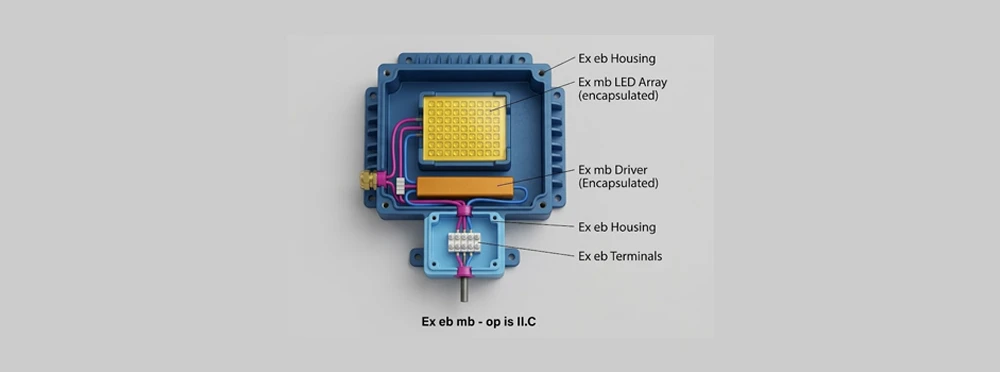
Modular designs incorporate individually encapsulated modules installed within a luminaire housing. This approach allows for module-level replacement rather than repair of individual components.
Key Features:
Serviceability: Encapsulated modules can be replaced at the end of their service life without requiring replacement of the entire luminaire.
Design Flexibility: Modular architecture enables independent optimization of electrical, thermal, and mechanical performance.
Combined Protection Concept (Ex eb + Ex mb):
Encapsulated modules (Ex mb) can be integrated within an Increased Safety (Ex eb) enclosure, achieving a compliant combined protection method.
Thermal Management: Potting materials such as epoxies or silicones can be selected to optimize heat dissipation and ensure compliance with temperature class requirements.
Optical Considerations: Optical performance is typically achieved through dedicated lens or diffuser systems, while encapsulation focuses on electrical protection.
Comparison Summary
| Feature | Integrated Encapsulation | Modular Encapsulation |
| Manufacturing | Most economical | Modular and complex |
| Maintenance | Non-serviceable assembly | Replaceable components |
| Primary Benefit | Minimal size and weight | Long-term serviceability |
| Protection Type | Primarily Ex mb | Combined Ex eb + Ex mb |