
- Industrial Lighting: From Lumens to Safety—The Power of Distribution
- Secondary Optics: The “Conductor” of Light
- IES Light Distribution Types
- Type I: The Go-To for Narrow, Linear Spaces
- Type III: The Expert for Side-Mounted Open Areas
- Type V: The “Workhorse” of Industrial & Hazardous Environments
- The Golden Rule of Selection: Let the Scene Dictate
- Wrap-Up: Distribution Is the “Precision Tool” of Industrial Lighting
Industrial Lighting: From Lumens to Safety—The Power of Distribution
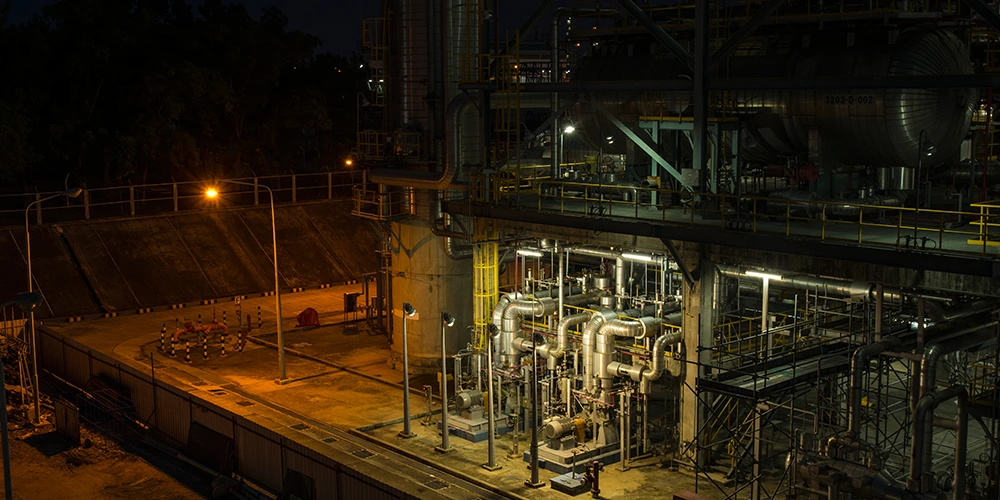
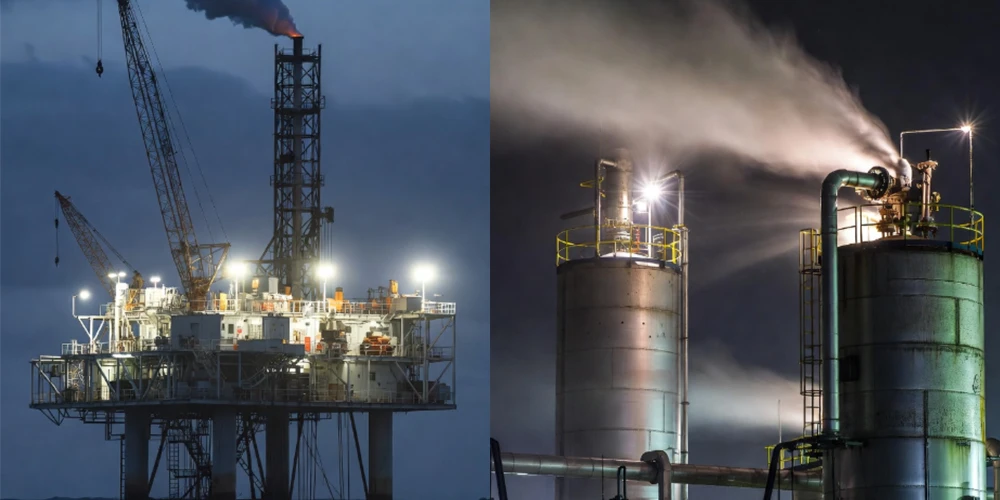
In industrial and hazardous environments—like corrosive chemical processing plants, high-bay power generation facilities, and vibration-intensive offshore drilling rigs—lighting is far more than a matter of “mounting a fixture and flipping a switch.” These spaces are defined by unforgiving conditions: explosive atmospheres (classified under ATEX/IECEx), extreme temperature swings, and layouts that mix tight walkways with towering equipment bays. In this context, lighting flaws aren’t just minor nuisances:
Glare from poorly directed fixtures can overwhelm workers’ vision during critical tasks—like adjusting pressure valves in a refinery or inspecting electrical connections in a power plant—leading to misjudgments, delayed reaction times, or even accidental contact with hazardous equipment.
Unintentional shadows (cast by pipes, machinery, or mismatched light spread) create blind spots: a technician might miss a leaking seal in a dim corner of a chemical storage area, or a rig worker could trip over a tool hidden in a shadowed deck gap.
Inconsistent illumination (bright hotspots next to dim zones) not only saps productivity by forcing eyes to constantly adjust— it can also fail to meet regulatory standards (e.g., OSHA’s minimum illuminance requirements for industrial work areas), exposing facilities to compliance penalties.
While lumen output is often the first metric cited when spec’ing industrial lighting, it only measures how much light is emitted—not where that light goes. This is where light distribution type emerges as the unsung backbone of effective hazardous-area lighting: it dictates how light spreads across the space, aligning with the environment’s geometry, mounting heights, and operational needs to turn raw lumen output into usable, safe, and compliant illumination.
Secondary Optics: The “Conductor” of Light
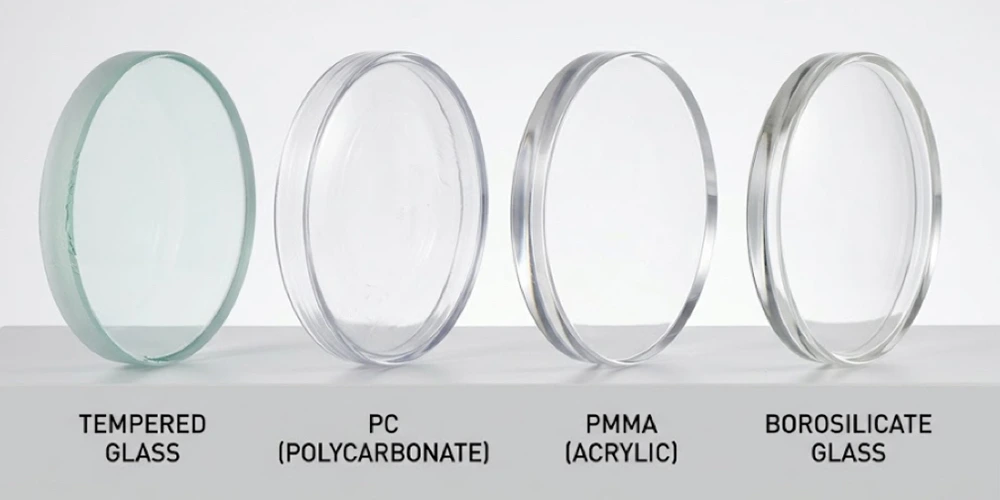
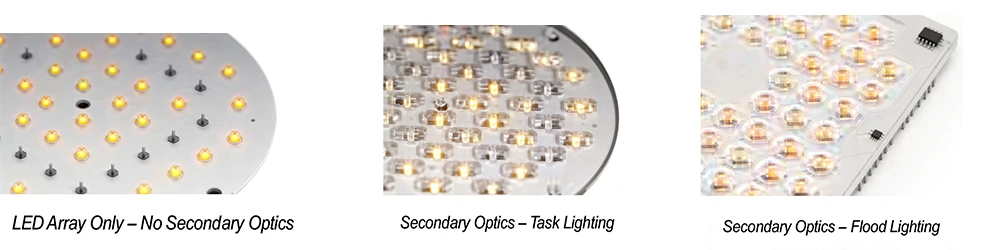
Many assume LED fixtures emit light uniformly by default—but in industrial settings, an LED array without secondary optics leads to unregulated light: either harsh glare in concentrated zones, or insufficient brightness in peripheral areas.
This is where secondary optics systems act as the “conductor” of light: custom-engineered lenses or reflectors redirect LED output to target exactly where light is needed:
- Task Lighting optics: Concentrate light on work zones to boost localized illuminance;
- Flood Lighting optics: Diffuse light evenly across open areas to minimize shadows.
Secondary optics turn “undirected emission” into “precision projection”—the foundation of “high-quality illumination” in industrial/hazardous spaces.
IES Light Distribution Types
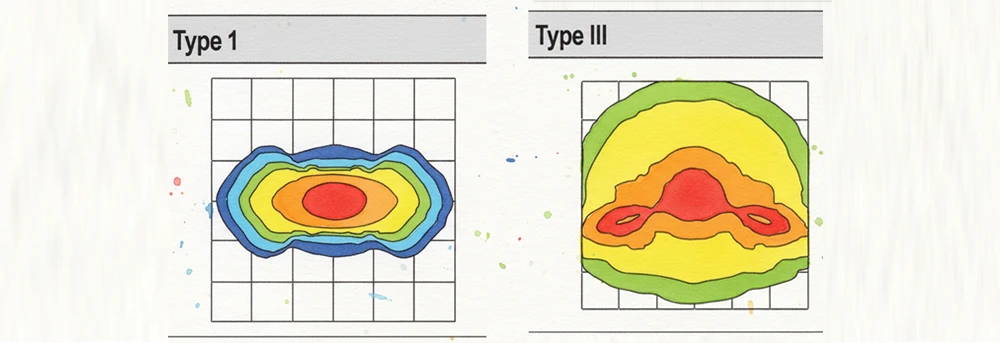
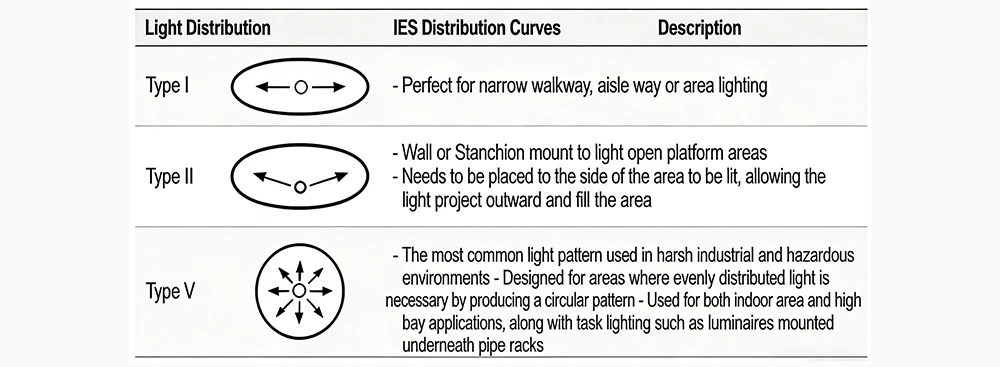
Defined by the Illuminating Engineering Society (IESNA), standard light distribution types are the universal language of industrial lighting specification. Leveraging general industrial lighting solutions, we break down the 3 core types:
Type I: The Go-To for Narrow, Linear Spaces
- Distribution Curve: Elongated oval, with light focused in a narrow, band-like pattern;
- Ideal Applications: Narrow walkways, aisles, and compact linear work zones;
- Key Benefit: Eliminates light waste outside the target corridor, delivering focused illuminance where critical paths lie.
Type III: The Expert for Side-Mounted Open Areas
- Distribution Curve: Light projects outward from the fixture’s mounting side (unilateral or bilateral diffusion);
- Ideal Applications: Open platforms (e.g., rig decks), wall-adjacent zones, and stanchion-side-mounted lighting;
- Key Benefit: Eliminates the need for central fixture placement—side mounting alone covers target areas, aligning with industrial equipment layouts.
Type V: The “Workhorse” of Industrial & Hazardous Environments
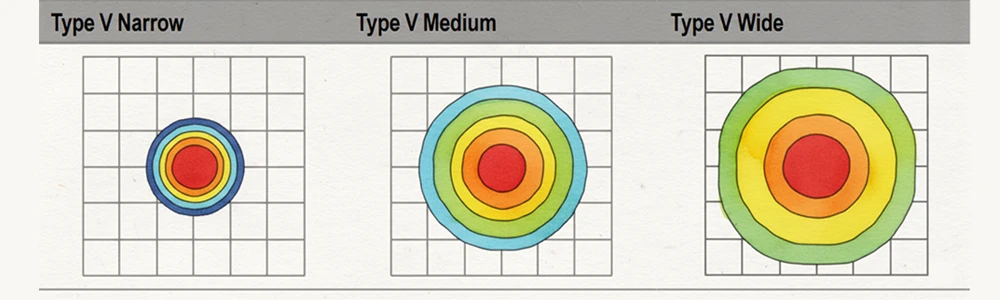
This is the most widely used distribution type in harsh environments, characterized by symmetric circular light spread—with three subtypes (Narrow, Medium, Wide):
- Distribution Curve: Symmetric circular pattern; subtypes vary by diffusion range (narrow = concentrated, wide = broad coverage);
- Ideal Applications:
I. Narrow: High-mount areas (e.g., pipe rack overheads), where focused light ensures ground-level illuminance;
II. Medium: Standard workshops and equipment zones;
III. Wide: Large open spaces (e.g., power plant bays);
- Key Benefit: Uniform circular distribution minimizes shadows—making it the “default” for complex settings like chemical plants.
The Golden Rule of Selection: Let the Scene Dictate
In industrial/hazardous lighting, distribution selection hinges on mounting location + space geometry:
- For narrow corridors: Choose Type I (banded distribution for targeted coverage);
- For side-mounted open platforms: Choose Type III (outward projection from the fixture);
- For large bays or overhead pipe racks: Choose Type V (select Narrow/Medium/Wide based on mounting height).
Wrap-Up: Distribution Is the “Precision Tool” of Industrial Lighting
In industrial/hazardous environments (ATEX/CSA Ex zones, extreme temps, complex layouts), "enough lumens" ≠ compliant, safe lighting. Light distribution is key—it turns raw lumens into targeted, shadow-free illumination, cutting energy waste and solving glare/blind spots.
AGC, your explosion-proof lighting specialist, integrates precision distribution with reliability:
- Secondary optics (lenses/reflectors) for focused light;
- Full IES core types: Type I (narrow spaces), Type III (side-mounted open areas), Type V (Narrow/Medium/Wide for diverse scenarios);
- Flexible color temperature & RGB-Amber configurations.
Should you be interested, please feel free to reach out at info@agcled.com. We are more than happy to deliver professional explosion-proof lighting solutions for you!