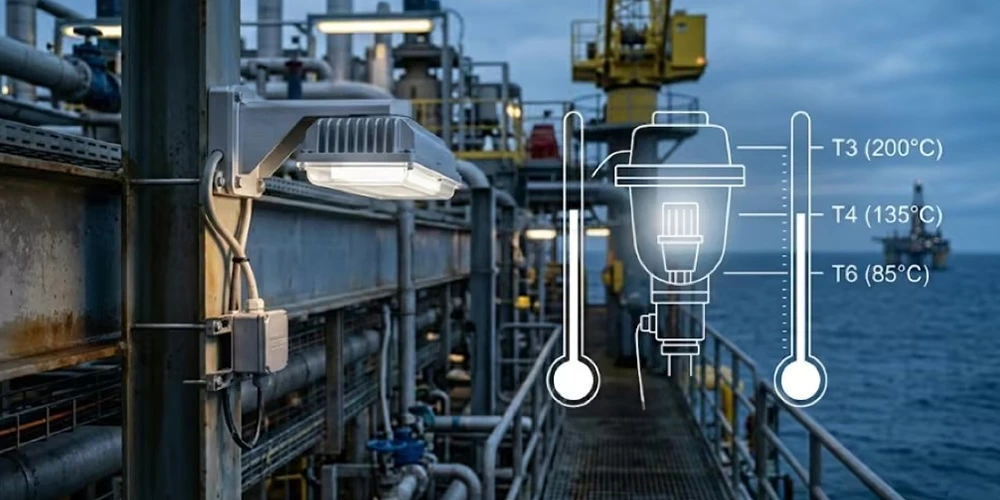
Working in oil and gas, petrochemical facilities, offshore platforms, or chemical processing zones means operating around potentially explosive atmospheres. For explosion‑proof lighting, protection against ignition is not only about structural integrity—it also depends heavily on surface temperature. A fixture that runs too hot can ignite flammable gases or vapors on its own, even with a certified explosion‑proof enclosure. That is why temperature class, often shortened to T‑class, is a defining factor in choosing safe, compliant, and practical explosion‑proof lighting.
Among the full range of T1 to T6, T3, T4, and T6 are the most widely specified for industrial and offshore hazardous locations. This guide explains these three classes in straightforward professional terms, helping you match the right temperature rating to real working conditions without overengineering or under‑specifying.
Temperature classes set the maximum allowed surface temperature for electrical equipment in explosive environments. The rule is simple and universal: the higher the T‑class number, the lower the maximum surface temperature, and the more stringent the safety level. The goal is to ensure the fixture’s surface always stays below the auto‑ignition temperature of any flammable material present in the area. Misjudging this rating can lead to fire risk, code violations, and compromised safety.
Understanding T3, T4, and T6 Temperature Classes
T3 is the most common rating for general heavy industrial hazardous areas where flammable materials have relatively high ignition temperatures.
With a maximum surface temperature of 200°C, T3 fixtures suit environments dominated by diesel, kerosene, heavy fuel oils, and typical petroleum vapors. They are widely used in refineries, pump stations, tank farms, and general process zones where high‑power illumination is needed without extreme thermal restrictions. This class offers a practical balance between performance and safety for standard industrial hazard scenarios.
T4, limited to 135°C, represents the middle ground and is the most versatile temperature class across many hazardous sites.
It is designed for environments with solvents, alcohols, and chemical vapors that ignite at lower temperatures. Facilities such as chemical plants, pharmaceutical production, printing and coating lines, solvent recovery areas, and general Zone 1 and Zone 2 hazardous workshops commonly require T4. It provides a stronger safety buffer than T3 while remaining cost‑effective for most medium‑risk applications, making it a default choice for many engineered lighting solutions.
T6 is the highest safety level among standard industrial ratings, capping surface temperature at just 85°C.
It is reserved for the most sensitive environments where gases or chemicals ignite at extremely low temperatures, including carbon disulfide and other volatile substances. T6 is mandatory in Zone 0 and high‑risk Zone 1 areas, critical process modules, offshore wellhead zones, and locations exposed to hydrogen sulfide or similar low‑ignition materials. While T6 comes with a higher equipment cost, its ultra‑low surface temperature removes nearly all ignition risk and is non‑negotiable for life‑safety and high‑hazard applications.
How to Choose Between T3, T4, and T6
Selecting the right temperature class is not about choosing the highest rating available—it is about matching the fixture to the actual hazard level, gas type, and operating environment.
Start by identifying the flammable gases, vapors, or dusts on site and their auto‑ignition temperatures. Materials that ignite above 200°C typically allow T3. Those that ignite between 135°C and 200°C require T4. Substances that ignite below 135°C need T6.
Next, consider the hazardous zone classification: Zone 2 areas often accept T3 or T4, Zone 1 usually requires T4 or T6, and Zone 0 almost always demands T6.
You should also account for ambient conditions. High temperatures, enclosed spaces, poor ventilation, and direct sunlight can reduce heat dissipation and raise surface temperatures. In such cases, you may need to upgrade to a higher T‑class to maintain safe operation. Over‑specifying can increase unnecessary costs, while under‑specifying creates immediate safety risks and non‑compliance. The best approach is to select the minimum safe T‑class supported by your site’s hazard assessment.
Practical Selection Considerations Beyond Temperature Class
While temperature class is critical, real‑world performance depends on design and build quality that supports stable thermal behavior. LED explosion‑proof fixtures are strongly preferred because they run inherently cooler than conventional lamps, making T4 and T6 ratings easier to achieve without sacrificing efficiency or lifespan.
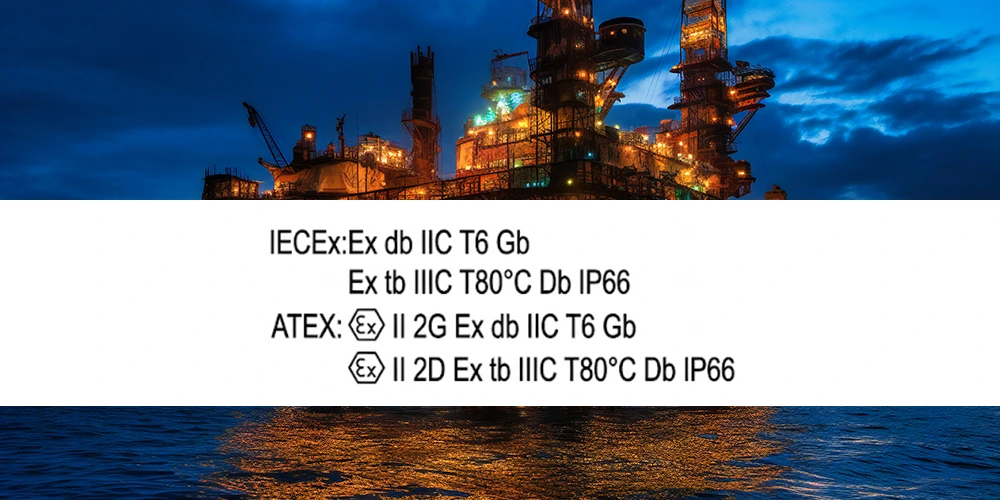
Always verify that fixtures carry valid certifications such as IECEx, ATEX, or local hazardous area standards, with clear marking of temperature class. Thermal management design matters too—quality fixtures use optimized heat sinks, thermal isolation, and protective circuits to keep surface temperatures within rated limits even under continuous operation.
For offshore and marine environments, corrosion resistance directly affects long‑term thermal safety. Rust, material degradation, and damaged seals reduce heat dissipation over time, so combining the correct T‑class with appropriate marine‑grade corrosion protection ensures reliable performance throughout the fixture’s service life.
Final Thoughts
Temperature class selection is a foundational part of explosion‑proof lighting safety. T3, T4, and T6 each serve distinct hazard levels, and choosing correctly protects workers, maintains compliance, reduces liability, and optimizes operational costs. T3 supports standard industrial hazards, T4 covers most chemical and solvent environments, and T6 delivers the highest safety for extreme low‑ignition materials.
By basing your choice on actual site conditions, gas properties, and zone classification, you can implement a lighting system that is safe, reliable, and fit for purpose.