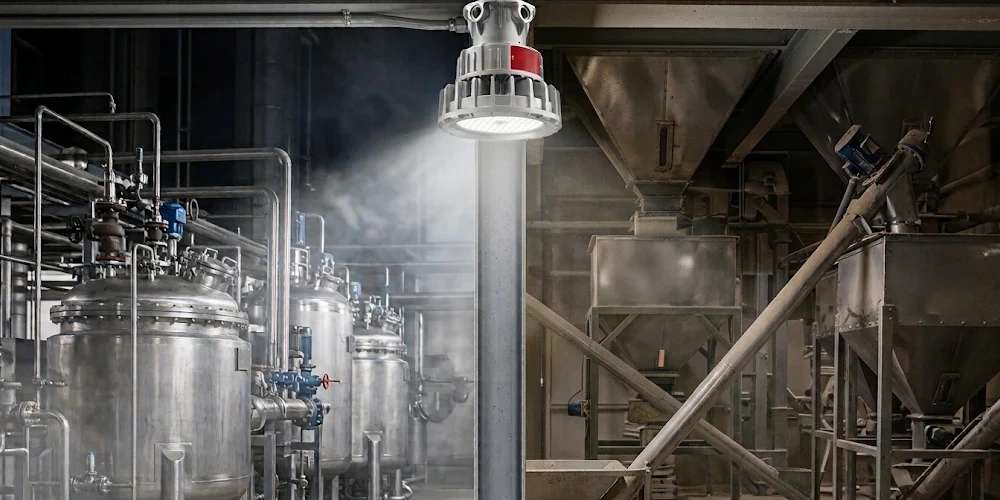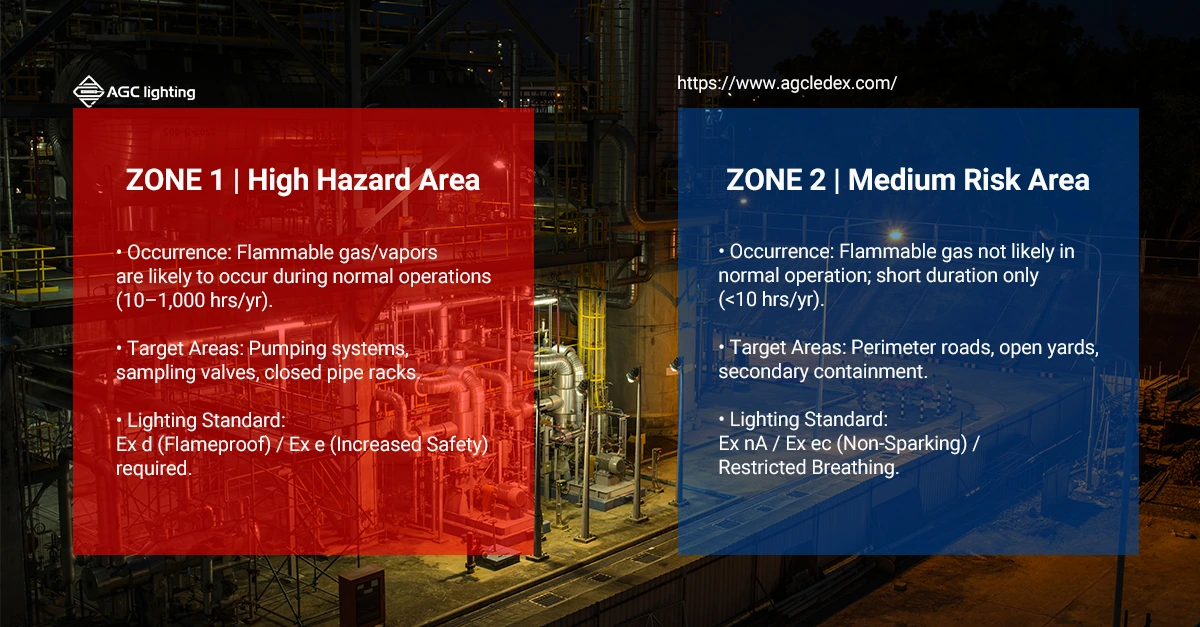

Ex d or flameproof lighting uses the flameproof enclosure method of explosion protection. But an Ex d (explosion-proof) fixture does not keep flammable gas out.
In reality, Ex d enclosures are not hermetically sealed, and flammable vapors eventually enter the fixture. Instead of preventing gas ingress, an Ex d fixture contains an internal ignition and cools the escaping gases before they reach the outside atmosphere.
This is critical for selecting the right fixtures for Zone 1 or C1D1 locations and preventing costly maintenance errors in the field.
Why Flammable Gas Enters an Explosion-Proof Fixture
Flammable gas enters an Ex d housing through a physical process called thermal breathing.
When an LED fixture operates, internal components generate heat, causing the air inside the enclosure to expand and push outward through microscopic tolerances in the housing joints.
When the fixture is switched off, or ambient temperatures drop, the internal air cools and contracts.
This pressure differential draws surrounding air, along with any ambient flammable gas or vapor, back into the fixture.
Thermal breathing occurs across daily operating cycles in refineries, chemical plants, and offshore platforms, so we must assume an explosive atmosphere will eventually form inside the luminaire. If an internal electrical fault or component failure creates a spark, the fixture housing must stop that internal ignition from igniting the surrounding facility.
Does an Explosion-Proof Light Keep Flammable Gas Out?
No. A fixture housing warms up when it is energized and cools when it's switched off, so the air inside expands and contracts over time; that exchange draws in the surrounding atmosphere.
But for Ex d lighting, the principle is containment and non-transmission. The enclosure is therefore designed to contain the resulting pressure wave and to ensure that any gas that escapes has been cooled below the auto-ignition temperature of the external atmosphere.
IEC 60079-1 sets the construction and test requirements for flameproof enclosures, and it is read together with the general requirements in IEC 60079-0.
How the Flame Path Works?
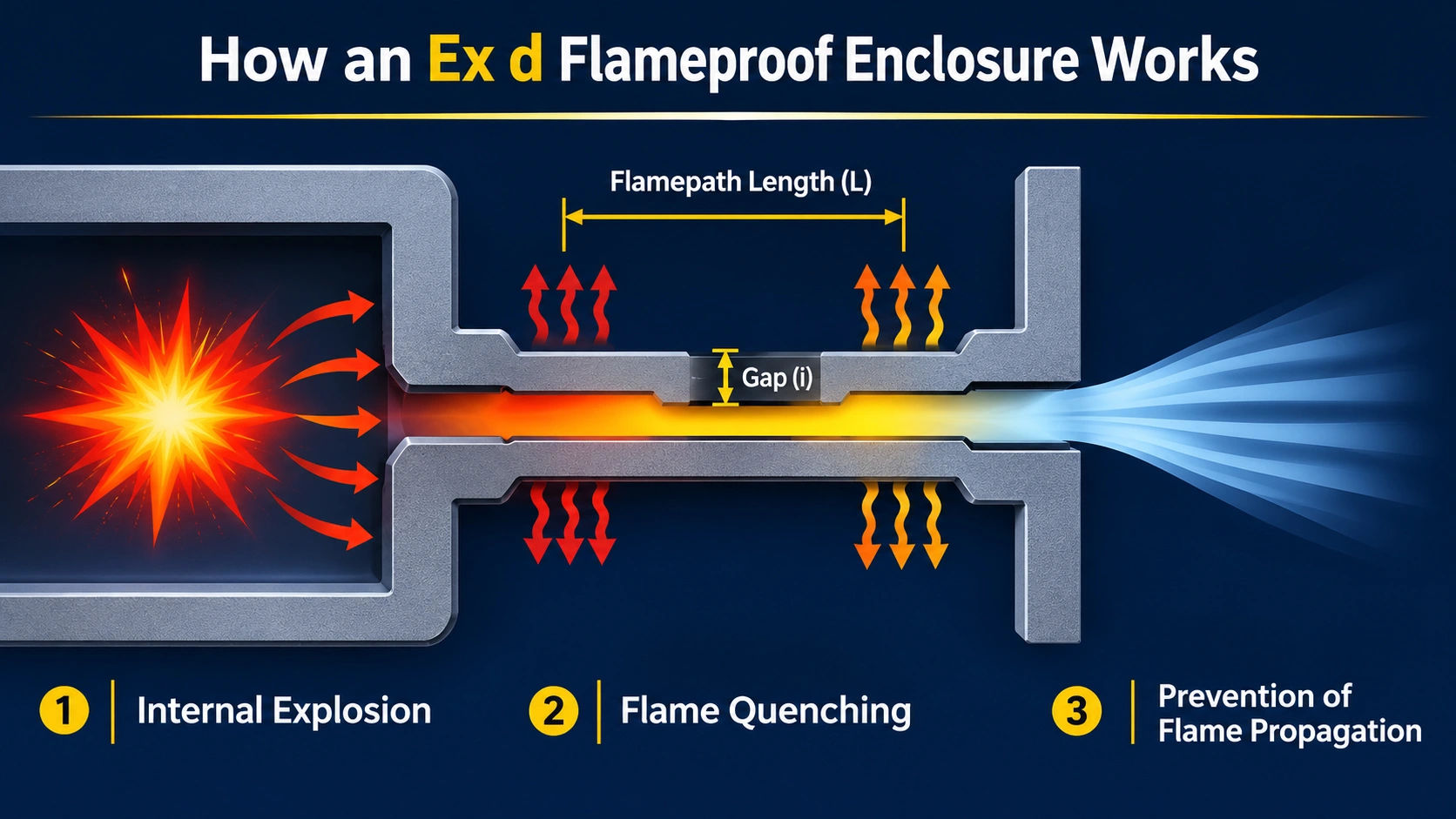
For Ex d lighting, the critical element is the flame path. It is the interface between two mating parts of the enclosure, most commonly the cover-to-body joint or a threaded entry.
An Ex-d flameproof enclosure prevents an external explosion through three actions:
- Pressure Containment: When vapor ignites inside the luminaire, the heavy cast housing absorbs and contains the resulting pressure wave without cracking, deforming, or blowing open.
- Controlled Venting: The expanding, superheated combustion gases are forced out of the enclosure through a specific, narrow machined interface known as the flame path.
- Thermal Quenching: As the hot gas travels through the tight metal-to-metal gap of the flame path, heat transfers rapidly from the gas into the surrounding metal housing. By the time the gas exits into the hazardous atmosphere, its temperature has dropped well below the auto-ignition temperature of the surrounding vapor.
Flame Path Joint Types and Gas Groups
Does every hazardous location require the exact same flame path dimensions?
No. Flame path geometry depends on both the mechanical design of the fixture and the volatility of the specific gases present on site.
Under international standards such as IECEx, ATEX, and UL 844, flameproof lights rely on two primary joint geometries:
- Threaded Joints: Commonly used on access covers, cable entries, and glass globe retainers. The spiral path forces escaping gas to travel a long distance around the threads, maximizing heat transfer into the housing wall.
- Spigot and Flanged Joints: Flat or cylindrical machined surfaces bolted together with a controlled, microscopic gap. The length of the path and the maximum allowable gap width determine how effectively the metal absorbs thermal energy.
A flame path engineered for propane or methane (Gas Group IIA) has wider allowable tolerances than one built for ethylene (Group IIB) or hydrogen and acetylene (Group IIC).
Hydrogen burns hotter and propagates faster than hydrocarbons, requiring longer flame paths and tighter machining tolerances so the escaping gas cools sufficiently before exiting.
How Material Selection and QC Protect Flame Path Integrity
A fraction of a millimeter separates safe thermal quenching from a flame breakthrough; Ex-d performance depends directly on metallurgy, machining precision, and quality control.
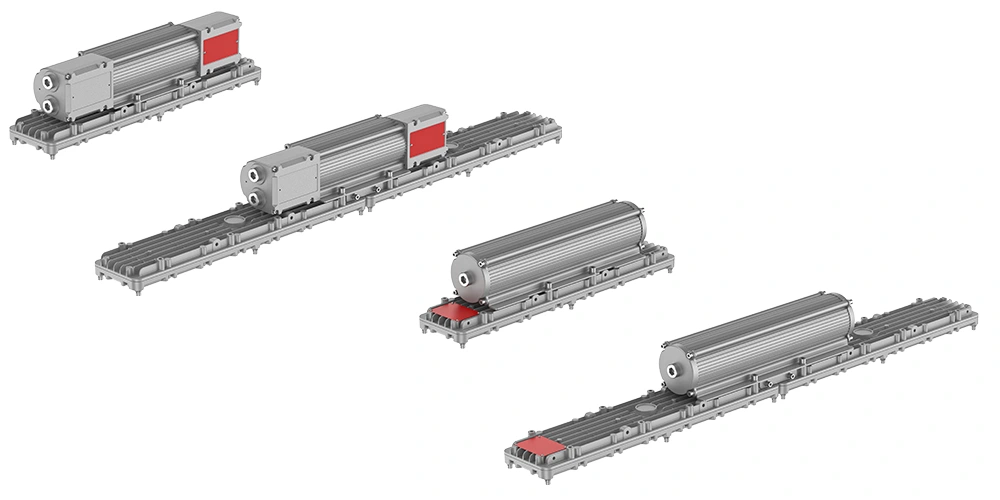
At AGC Lighting, we use copper-free aluminum for many of our Ex d enclosures, including the HA03 Victory series and the EJB series of junction boxes.
Copper-free aluminum provides the necessary thermal conductivity for effective flame-path cooling while offering better resistance to corrosion in marine and chemical environments than standard aluminum alloys. It is critical for chemical plants, wastewater treatment facilities, and offshore marine environments.
Holding flame path tolerances across mass production requires strict process control. AGC operates under ISO/IEC 80079-34 alongside ISO 9001, backed by an in-house testing laboratory accredited by both TUV and CSA. These facilities verify that castings, joints, and thermal profiles meet IECEx, ATEX, NEC, and CEC requirements before fixtures ship to the field.
Planning a Zone 1 or C1D1 lighting project? Share with our team. We can review your hazardous area layout, verify certification requirements (IECEx, ATEX, or UL 844), and provide photometric simulations for your site.