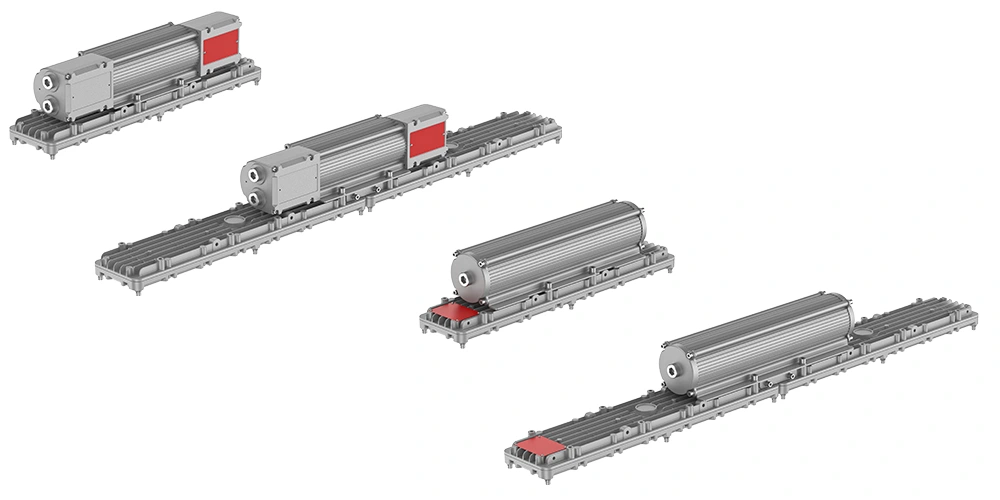

Can one explosion-proof light be used for both gas and dust hazardous locations? Yes, but only when the fixture is certified for both hazards.
This matters because some sites have both gas and dust hazards. Mining is a common example, with methane and coal dust present in the same operation. Other places like wastewater facilities can also have a mix.
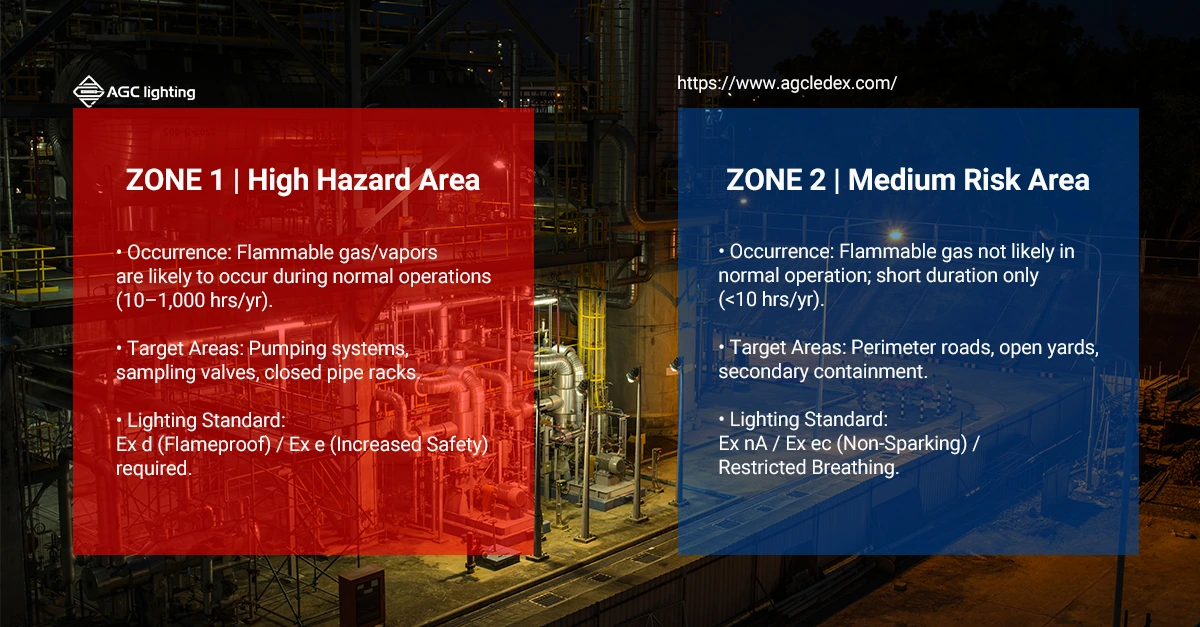
AGC offers multiple explosion-proof LED luminaires that are dual-rated for both gas (Class I / Zone 1–2 and dust (Class II / Zone 21–22) hazardous locations.
- Why Gas and Dust Require Different Protection Mechanisms
- Flammable Gas and Vapor Protection (Flamepath Containment)
- Combustible Dust Protection (Ingress Exclusion and Thermal Limits)
- How to Verify Dual Certification on a Fixture Nameplate
- Watch Out for the Dual T-Code Trap
- When Dual-Rated Fixtures Are Practical
Why Gas and Dust Require Different Protection Mechanisms
Flammable gases and combustible dusts ignite through different physical pathways, which is why international standards test and certify them separately.
Flammable Gas and Vapor Protection (Flamepath Containment)
In gas or vapor environments (NEC Class I or ATEX/IECEx Zone 1 and Zone 2), explosive atmospheres can seep inside an enclosure as the fixture heats up and cools down.
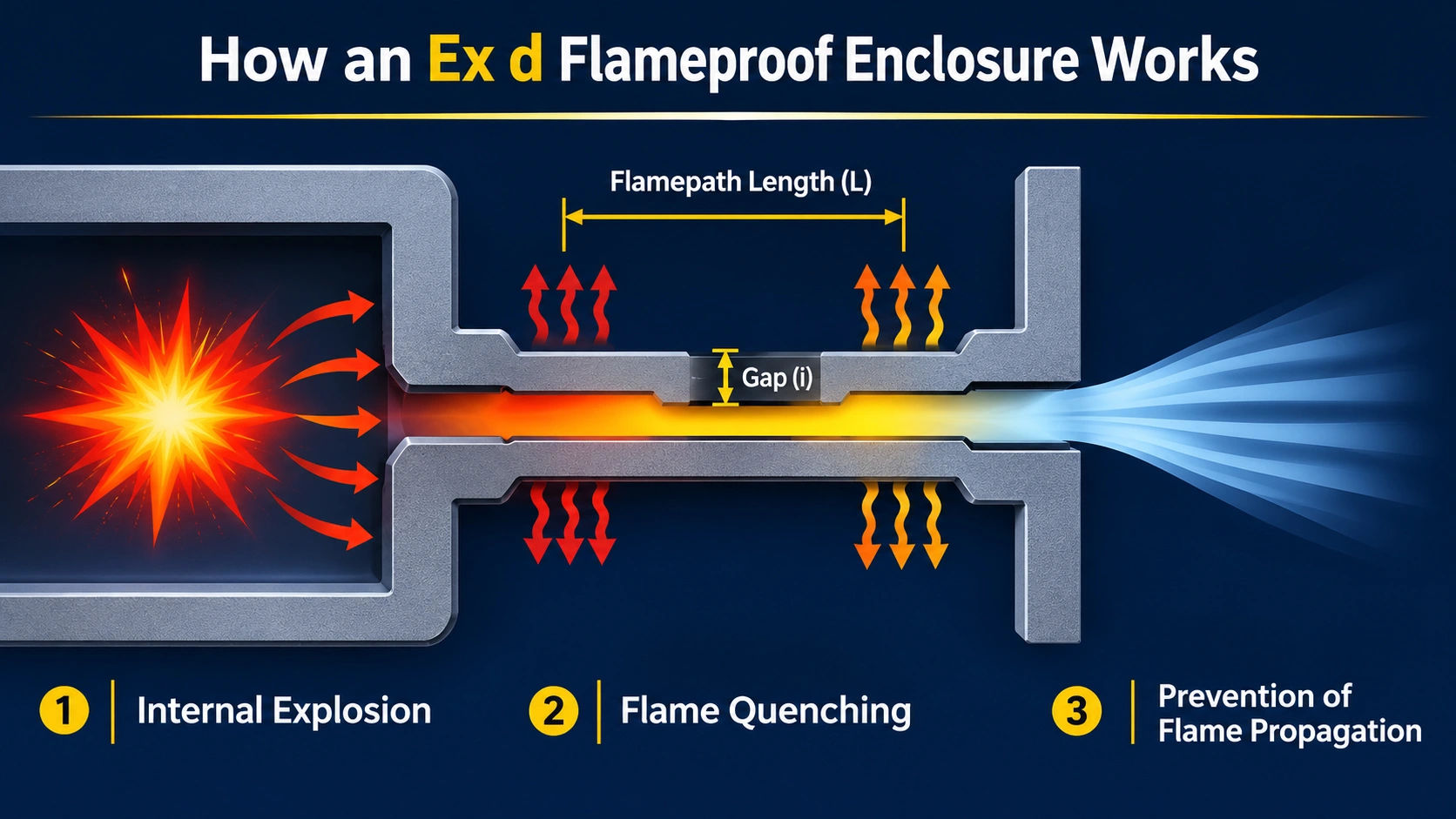
Explosion-proof (Ex d) luminaires do not try to keep gas out entirely. Instead, they use thick, copper-free aluminum housings and precision-machined threaded or flanged joints called flamepaths.
If an internal electrical arc ignites the gas inside the fixture, the housing contains the pressure, and the narrow flamepath cools the escaping gases below the ignition temperature of the surrounding atmosphere.
Combustible Dust Protection (Ingress Exclusion and Thermal Limits)
In dust environments (NEC Class II or ATEX/IECEx Zone 21 and Zone 22), the primary risk is not an internal pressure wave. The risk is dust entering the enclosure or accumulating as an insulating blanket on top of the fixture.
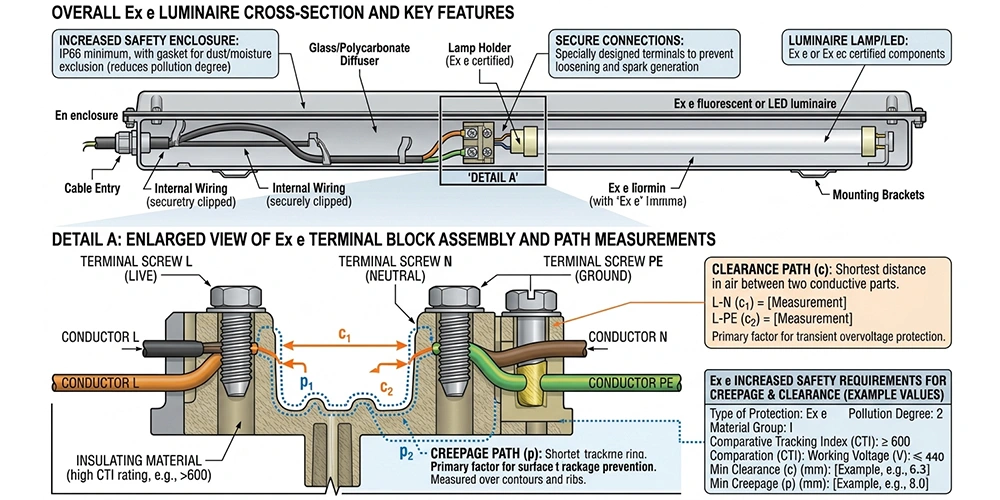
Dust-ignition-proof (Ex tb) fixtures rely on high ingress protection (IP66 or higher) to keep conductive or carbonaceous particles away from electronics, paired with strict outer surface temperature limits.
If a layer of grain, sugar, or metal dust settles on a luminaire that runs too hot, the trapped heat can cause the dust layer to smolder and ignite.
How to Verify Dual Certification on a Fixture Nameplate
To deploy one luminaire in both gas and dust zones, the product label and certificate must explicitly list approvals for both hazard classes.
Do not rely on general marketing descriptions like "hazardous location rated." Check the exact markings under the governing code for your region.
|
Certification System |
Gas Marking Required |
Dust Marking Required |
|
North America (NEC / CEC) |
Class I, Division 1 or 2 (Groups A, B, C, or D) |
Class II, Division 1 or 2 (Groups E, F, or G) |
|
International (ATEX / IECEx) |
Group II (IIA, IIB, or IIC) / Zone 1 or Zone 2 |
Group III (IIIA, IIIB, or IIIC) / Zone 21 or Zone 22 |
For example, our HA03 Victory can be used for both gas and dust hazardous areas.
The table below shows its relevant certifications and markings.
|
|
HA03 Victory |
|
Intended gas area |
Zone 1/Class I Div 1 |
|
Gas marking (IECEx) |
Ex db IIC T6/T5 Gb |
|
Dust marking (IECEx) |
Ex tb IIIC T80°C/T95°C Db IP66 |
|
NEC/CEC gas listing |
Class I, Division 1 and 2; Group B, C, D |
|
NEC/CEC dust listing |
Class II, Division 1 Group E, F, G; Div 2 Groups F, G; Class III |
|
Zone dust listing |
Zone 20, 21, 22 |
|
Enclosure rating |
IP66, IK10 |
Watch Out for the Dual T-Code Trap
A common mistake is checking only one Temperature Code (T-rating). Dual-certified luminaires frequently carry two different temperature limits: one for ambient gas ignition and a separate, stricter maximum surface temperature for dust layers.
For example, a luminaire might hold a T6 rating (85°C maximum surface temperature) for Class I gas environments, while its Class II dust rating specifies a maximum surface temperature of T80°C (or T4A / 120°C depending on the test standard and ambient temperature).
That means you should always verify that the fixture's dust surface temperature stays safely below the cloud and layer ignition temperatures of your specific dust group (such as Group E metal dusts, Group F coal/carbon dusts, or Group G grain/chemical dusts).
When Dual-Rated Fixtures Are Practical
Dual-rated fixtures require heavy explosion-proof housings in addition to dust-tight sealing. They are useful when:
- The area classification document shows both gas/vapor and combustible dust hazards in the same space or adjacent spaces that share the same lighting system.
- The facility wants fewer SKUs for inventory and maintenance.
- Process areas handle solvents or hydrocarbons near dust-generating operations (for example, certain chemical plants, food processing with both vapors and powders, or pulp-and-paper facilities).
They are not a substitute for matching the correct groups, Division or Zone, and temperature class. A dual-rated fixture that covers Group D gas but not the specific dust group present on site is still the wrong fixture.
One explosion-proof light can serve both gas and dust hazardous locations when it is dual-rated, and the full marking matches the area classification. The protection principles for gas and dust are different, so the listing must cover both.
If you are reviewing a mixed-hazard classification and need help matching dual-rated fixtures to the required groups and Zones, contact us with your area classification details.