
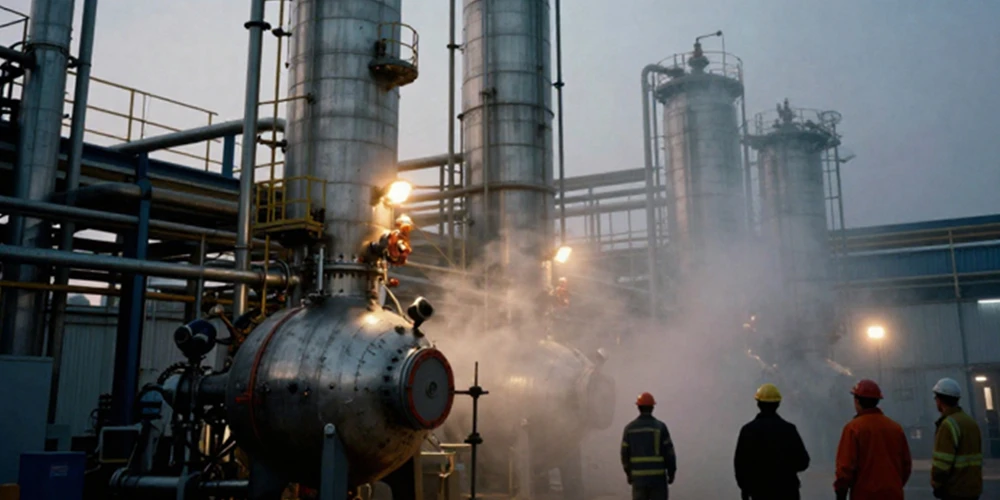
Imagine this scenario: a chemical plant reactor is operating under pressure; oil platform pumps are running continuously; a dust-filled grain silo is conveying cargo. Suddenly, the main power supply completely fails, plunging the site into immediate darkness. Ordinary explosion-proof lights have gone out, but the dangers persist: leaking flammable gases continue to spread, high-temperature equipment is cooling down, and workers are thrown into panic as they lose all visibility.
This is not a scene from a disaster film but a genuine crisis that many industrial sites may face. This is precisely why "explosion-proof lights with emergency backup" is no longer an "optional accessory" but rather a "vital safeguard for human life."
- Explosion Protection and Emergency Functionality: The Inevitable Integration of Dual Safety Logics
- Which High-Risk Environments Require It Most?
- How Does It Work?
- Regulations of Emergency Battery
- 1. U.S. Regulatory System: NFPA 101 and UL 924
- 2. European Regulatory System: EN 1838 and EN 60598-2-22
- Final Takeaway
Explosion Protection and Emergency Functionality: The Inevitable Integration of Dual Safety Logics
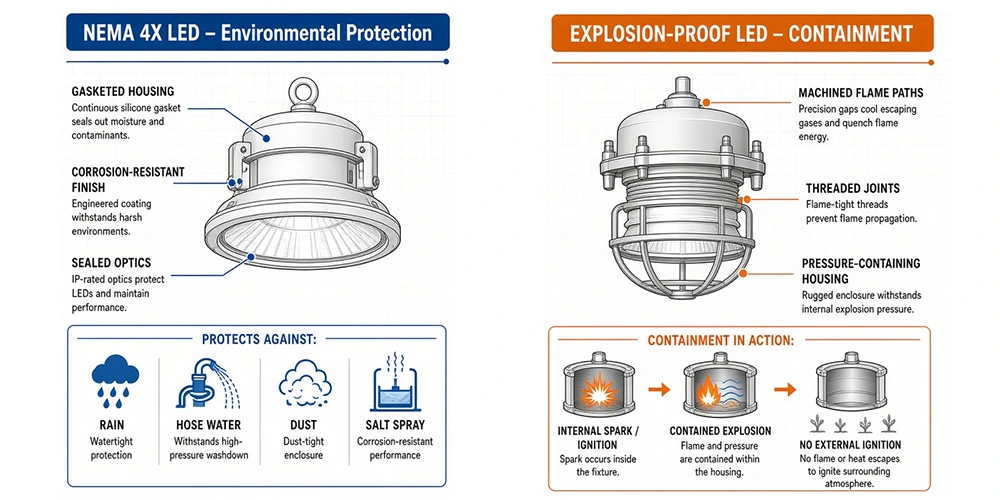
The core function of conventional explosion-proof lighting is “to prevent becoming an ignition source.” Through robust enclosures, flameproof gaps, intrinsically safe circuits, and other means, it ensures that even in the event of internal failure or the presence of external flammable and explosive mixtures, no explosion is triggered.
However, its design carries a critical prerequisite: a continuous main power supply. Once power is lost, its functionality ceases.
The core mission of emergency lighting, on the other hand, is “to provide visual assurance for evacuation and emergency response during power loss.” Its design emphasizes built-in batteries or independent circuits, enabling automatic activation after a main power failure to sustain critical illumination for a designated period.
Combining these two functionalities gives rise to the “explosion-proof emergency luminaire” — a device capable of serving as a “safe beacon that will not ignite” even in the most hazardous environments, and without reliance on grid power.
Which High-Risk Environments Require It Most?
1. Confined and Difficult-to-Evacuate Spaces Examples: underground mines, tunnels, ship hull compartments, and large petrochemical plant areas. After a main power failure, evacuation routes become complex. Without emergency lighting guidance, risks such as trampling, falls, or disorientation increase significantly.
2. Process-Interruption-Sensitive Continuous Operations Examples: chemical reaction workshops, oil and gas processing platforms. Sudden darkness can prevent the operation of critical valves and verification of safe status, potentially triggering cascading hazardous reactions. Emergency lighting provides essential visual support for implementing safe shutdown procedures.
3. Locations with Secondary Derivative Hazards Examples: areas with potential toxic gas leaks. Darkness severely delays both personnel evacuation and emergency response intervention. In such scenarios, emergency lighting functions as a critical tool in the race against time to save lives.
How Does It Work?
When reviewing product specifications, we often encounter descriptions such as: " Choice of LiFePO₄ or Ni-Cd battery for power backup, providing 9W for 90 minutes, 6W for 3 hours or 12W for 1.5 hours of emergency lighting."
As mentioned earlier, two main technical pathways currently dominate the market: traditional nickel-cadmium (Ni-Cd) batteries and high-performance lithium iron phosphate (LiFePO₄) batteries.
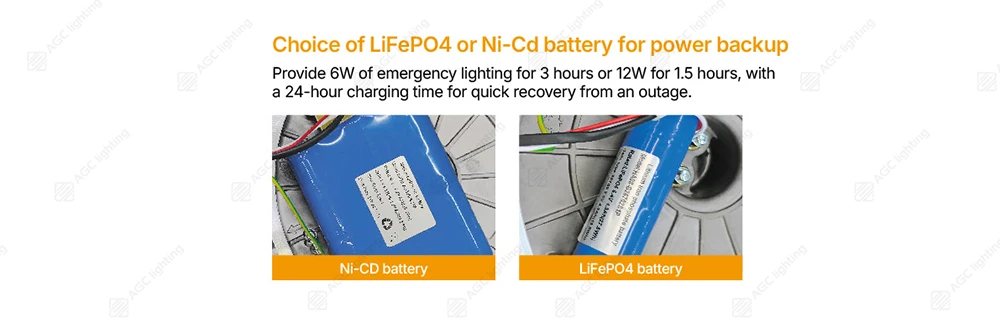
Nickel-cadmium (Ni-Cd) batteries represent the established traditional option. Their advantages include mature technology, low cost, and excellent cold-weather performance, making them reliable in extremely low temperatures. However, they have notable drawbacks: they suffer from a "memory effect," meaning capacity diminishes over time if not regularly fully discharged; they contain the heavy metal cadmium, raising environmental concerns; and they age rapidly inside the sealed, high-temperature enclosures typical of explosion-proof luminaires.
Lithium iron phosphate (LiFePO₄) batteries, in contrast, are the modern high-performance choice. They offer a significantly longer lifespan (capable of many more charge cycles than Ni-Cd) and exceptional heat resistance, making them ideally suited for the hot, confined operating environment of explosion-proof lights. With no memory effect, they can be recharged at any state without performance loss, ensuring reliable support for the full critical duration—such as 90 minutes—when needed. Although their upfront cost is higher, their extended service life without frequent replacement often makes them more cost‑effective in the long run.
Therefore, when selecting a battery, it is essential to evaluate the specific application conditions to choose the most suitable emergency power solution.
For more about the performance and lifespan of these two power sources, see our blog about the comparison of Ni-Cd vs. LiFePO4 for explosion-proof emergency lighting.
Regulations of Emergency Battery
Meanwhile, it is common to find U.S. standard products labeled with a "90-minute" rating, while European standard products differentiate between "1.5h" and "3h." These figures are not arbitrarily set—they are grounded in a rigorous framework of life safety logic and compliance systems.
1. U.S. Regulatory System: NFPA 101 and UL 924

In North America, the design principle for all emergency lighting originates from NFPA 101, Life Safety Code. Section 7.9.2.1 of this standard explicitly stipulates that emergency lighting must provide a duration of not less than 90 minutes:
"Emergency illumination shall be provided for a minimum of 1½ hours in the event of failure of normal lighting. Emergency lighting facilities shall be arranged to provide initial illumination that is not less than an average of 1 ft-candle (10.8 lux) and, at any point, not less than 0.1 ft-candle(1.1 lux), measured along the path of egress at floor level. Illumination levels shall be permitted to decline to not less than an average of 0.6 ft-candle (6.5 lux) and, at any point, not less than 0.06 ft-candle (0.65 lux) at the end of 1½ hours. The maximum-to-minimum illumination shall not exceed a ratio of 40 to 1." (NFPA 101, Section 7.9.2.1-7.9.2.1.3)
The corresponding hardware testing standard is UL 924. If the battery module of an explosion-proof light depletes at the 89th minute, it will fail to obtain UL certification, effectively barring its entry into the North American industrial market.
2. European Regulatory System: EN 1838 and EN 60598-2-22
The European standards for emergency lighting (and the underlying IEC framework) place greater emphasis on "risk-based flexibility."
According to EN 1838, emergency duration is classified into 1.5 hours and 3 hours, based on building usage and risk level. 1.5 hours serves as the baseline under international general standards, whereas 3 hours is commonly specified in the UK (per BS 5266) and for structurally complex underground facilities or offshore oil platforms.
Final Takeaway
Choosing emergency lighting is not a one-time solution—ongoing maintenance is essential. Emergency lights are "purchased for backup," but safety must never rely on chance.
- Enforce Mandatory Testing. Rigorously perform monthly functional checks and annual full-load discharge tests. Verify actual runtime (e.g., 90-min U.S. or 3-h EU standards) through practical testing to confirm battery State of Health (SOH).
- Implement Intelligent Monitoring. Utilize integrated Auto-Test functions and tri-color indicators for real-time status tracking. Immediately address any red‑light alerts (e.g., battery/charging faults) to prevent compromised operation.
- Execute Proactive Replacement Batteries degrade irreversibly over time. Replace LiFePO₄ or Ni-Cd batteries preventively upon reaching their design lifespan (typically 3-5 years for LiFePO₄), regardless of current functionality.
Safety tolerates no compromise. Only through disciplined, detail-focused maintenance can emergency lighting be trusted as the final beacon guiding personnel to safety.