

- Challenge
- Solution
- Advantages of LED Technology in Harsh and Hazardous Areas
- Calculating ROI for LED Fixtures
- Key Considerations for Estimating CapEx
- Key Considerations for Estimating OpEx
- Understanding ROI Calculations
- Debunking Common Myths About LED Lighting
- System-Level Replacement (Recommended for New Projects)
- Summary
Challenge
The adoption of LED technology in hazardous (Ex) environments is on a steady growth, yet its upfront investment typically exceeds that of conventional lighting solutions. This cost gap often becomes a key decision barrier for businesses when selecting lighting systems for high-risk areas.
Solution
While conventional lighting may appear more cost-competitive upfront, a full-lifecycle comparison reveals that LED technology delivers far greater value in terms of overall performance and investment returns. The long-term advantages of LEDs—from lower energy use to reduced maintenance needs—ultimately offset their higher initial cost, making them a more economically viable choice for hazardous environments.
Advantages of LED Technology in Harsh and Hazardous Areas
Compared with conventional lighting, LEDs offer distinct benefits tailored to the unique demands of Ex zones:
- Reduced energy usage (cuts long-term operational costs) - Enhanced energy efficiency (maximizes light output per watt)
- Instantaneous illumination (no warm-up time, critical for emergency scenarios) - Better resistance to vibration effects (ideal for offshore platforms, mines, and industrial sites)
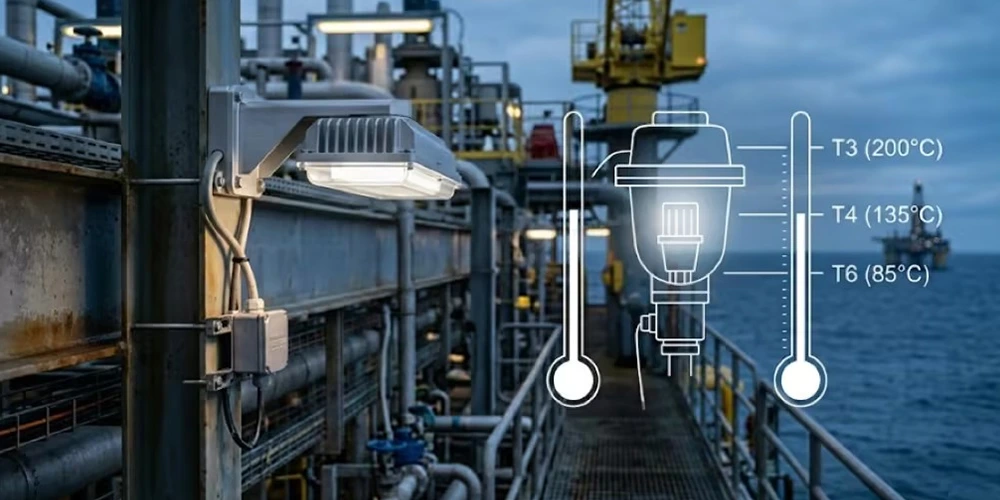
- Minimized heat emission (lowers fire risks in flammable environments)
- Precise control over light beam patterns (avoids light waste and targets critical areas)
- Lower maintenance requirements (varies by LED fixture design, but generally far less frequent than traditional lamps)
Furthermore, LEDs have a profound impact on return on investment (ROI). Though the upfront cost of LED installations is usually higher, calculating the total cost savings over the product’s lifespan reveals their true economic value. End users should also factor in additional benefits: reduced carbon footprint (aligning with environmental regulations), potential subsidies for LED adoption in some regions, long-term availability of spare parts, and improved brand image linked to energy efficiency.
Calculating ROI for LED Fixtures
Before initiating any project or deciding to switch from conventional lighting to LEDs, it is essential to assess the expected Return on Investment (ROI). This calculation requires analyzing two core cost components: upfront costs (Capital Expenditure, CapEx) and operational expenses (Operational Expenditure, OpEx).
Key Considerations for Estimating CapEx
To calculate upfront costs accurately, include the following:
- Expenses for removing or replacing existing conventional fixtures
- Time required to install or upgrade the current lighting system
- Purchase cost of new LED fixtures
- Labor hours needed to replace conventional products with LEDs (note: Ex zone projects typically require 2 installers per task)
- Hourly rate of installation personnel
- Additional costs (e.g., rental fees for scaffolding or elevators, if necessary; downtime expenses for facility shutdowns during replacement)
- Tax refunds or government subsidies for LED adoption
When evaluating CapEx, it is critical to compare LEDs against the most advanced conventional alternatives available. For existing systems, this may mean replacing only the lamp (rather than the entire fixture) to keep conventional setups operational—ensuring a fair cost baseline.
Key Considerations for Estimating OpEx
Operational costs depend on the following factors:
- Power consumption of conventional systems (including both light source and ballast)
- Power consumption of LED systems (including light source and control gear)
- Cost of replacing conventional light sources (e.g., frequent bulb changes for HID lamps)
- Time required to replace conventional light sources
- Additional operational costs (e.g., scaffolding rental, facility downtime for maintenance)
- Energy cost per kilowatt-hour (kWh)
- Annual operating hours of the fixtures
Understanding ROI Calculations
When comparing conventional and LED lighting, many only consider the light source’s lifespan—but LEDs outperform traditional lamps by a wide margin here. The critical question for ROI becomes: How many times would a conventional light source need to be replaced before an LED reaches the end of its useful life?
Lighting system costs can be calculated as a function of operational time (t), using the following formula: Cost (t) = Number of fixtures × [CapEx + Energy (t) + Maintenance (t)]
Where:
CapEx (upfront investment) = Quantity of fixtures × (Product cost + Installation cost) + Additional costs – Subsidies
- Installation cost = Installation time × Installer hourly rate × Number of installers
- Additional costs = Expenses for scaffolding/elevator rental, facility shutdowns, etc.
- Subsidies = Tax refunds or government grants for LED adoption
Energy (t) (energy costs over time) = Power consumption × Operational time (t) × Energy cost per kWh ÷ 1000
- Power consumption = Fixture’s rated power (in watts)
- Operational time = Total hours the fixture is in use
- Energy cost per kWh = Local electricity rate
Maintenance (t) (maintenance costs over time) = If operational time (t) > n × Lifespan of conventional light source, then Maintenance (t) = n × (Cost of spare parts + Installation time × Installer hourly rate × Number of installers)
- n = Number of times conventional light sources need replacement
- Lifespan = Rated lifespan of the conventional light source
Debunking Common Myths About LED Lighting
Myth 1: Conventional and LED fixtures have identical ballast/control gear lifespans, requiring replacement at the same frequency.
Fact: This is not always true. As LED fixtures gain rapid acceptance in the Ex market and more suppliers enter the space, control gear performance varies widely. Leading industry bodies—including Lighting Europe (the European Association of Lighting Manufacturers, visit LightingEurope.org) and ZVEI (the German Electrical Association’s Lighting Division, visit ZVEI.org)—recommend that manufacturers disclose control gear lifespans for LED fixtures in datasheets or public documents, in line with the IEC 62722 standard. This ensures transparency and helps users make informed decisions.
Myth 2: The lifespan of LED light sources is defined the same way as conventional ones.
Fact: The IEC 62722 standard provides a clear definition for LED luminaire lifespan, but this differs from how conventional light source lifespans are calculated. While traditional lamp lifespans follow consistent assumptions across manufacturers, LEDs use varied terminology: “system life,” “rated life,” L70, L70B10, L80, etc.—some even claiming lifespans exceeding 20–30 years of continuous use. Lighting Europe has issued guidelines to standardize LED lifespan comparisons, specifying statistical assumptions and capping maximum rated hours at 100,000.
Note: The examples in this paper use two IECEx-certified LED fixtures: HA06 linear LED fixtures for hazardous areas and HA04 power floodlight series for hazardous areas. Eaton has integrated Lighting Europe’s guidelines into the datasheets for both product lines.
Myth 3: LED lifespan remains constant across all temperature ranges.
Fact: LED lifespan is closely tied to the ambient temperature of the application. Unlike conventional lamps, LEDs are sensitive to heat and cold—their performance and longevity will decline if used outside their rated temperature range. For example, an LED rated for -40°C to 65°C may fail prematurely in a -50°C arctic warehouse unless specifically optimized for ultra-low temperatures.
System-Level Replacement (Recommended for New Projects)
Previous methods focus on operational savings, but system-level calculations consider the full infrastructure—critical for new projects. Reducing LED fixture count also reduces the need for supporting components, leading to additional savings.
System-Level Benefits:
- Fewer fixtures → fewer cable glands, distribution panels, feeders, and breakers.
- Lighter LED fixtures reduce structural load (critical for offshore construction).
- Lower total circuit load allows smaller cable diameters and less copper usage.
Other factors (e.g., inrush current) must be evaluated with end users to align with design guidelines (e.g., plastic vs. stainless steel panels, B-type breaker characteristics)—these details impact total cost savings.
Summary
LED fixtures reduce total costs compared to conventional technology when evaluated over their full operational lifespan. To unlock their full potential:
- Use lighting design to tailor LED solutions to specific applications (avoid 1:1 replacement limits).
- For new projects, include system-level savings (cables, panels, breakers) to lower CapEx and enhance ROI.
- Leverage LED's lightweight design and low power consumption to optimize infrastructure and reduce long-term costs.