
In scenarios such as electrical equipment installation, industrial wiring, and commercial building power supply, "safety and compliance" is always an insurmountable red line. In North America (the United States + Canada), the two major standards—NEC and CEC—are like the "traffic rules" for electrical safety. They define the design, installation, and maintenance guidelines for electrical systems, directly affecting personnel safety, stable equipment operation, and even a product’s ability to enter the North American market.
For electrical engineers, construction professionals, equipment manufacturers, or ordinary people who need to understand North American electrical specifications, what exactly are NEC and CEC? What are their core requirements? And what are the differences between them? This article will break down these two standards with easy-to-understand language and practical scenarios, helping you quickly grasp the key information.
I. Standard Origin: The "Background" and Positioning of NEC and CEC
The birth of electrical standards stems from the need to avoid safety accidents. After the popularization of electrical applications in North America in the late 19th century, fires and electric shock accidents caused by irregular wiring and mismatched equipment occurred frequently. NEC and CEC were gradually formed against this backdrop, becoming the "authoritative guidelines" in the regional electrical field.
1. NEC: The "Basic Code" for Electrical Safety in the United States
Full Name: National Electrical Code
Formulating Organization: National Fire Protection Association (NFPA)
Birth and Development: The first version was released in 1897, aiming to unify electrical installation standards across the United States and reduce fire hazards. Since then, it has been updated every 3 years (the latest version is 2023, which superseded the 2020 edition). The 2026 edition is released in Jan 2026, featuring textual reorganizations to modernize the code structure and enhance usability for the 2029 edition. Updated content consistently incorporates new technologies (e.g., new energy power supply, intelligent electrical equipment) and practical safety cases.
Core Positioning: The most authoritative voluntary electrical safety standard in the United States (Note: "Voluntary" does not mean negligible. Although NFPA does not enforce it, all U.S. states and cities incorporate it into local laws and regulations, making it a mandatory compliance requirement. However, enforcement of specific editions may vary by state or even municipality (e.g., Chicago, New York City) due to local legislative processes—some may adopt non-latest editions. It is critical to verify the enforced edition with local jurisdictions. For example, California, Texas, and other states require commercial buildings to comply with NEC standards.
Scope of Application: Covers most public and private premises' electrical installations, including residential buildings, commercial buildings, industrial facilities, and public facilities. It applies to scenarios such as household socket installation, lamp wiring, factory high-voltage equipment layout, and new energy vehicle charging pile installation.
Exclusions: Does not apply to electrical installations on ships, railway rolling stock, aircraft, or automotive vehicles (excluding mobile homes and recreational vehicles).
2. CEC: The "Mandatory Standard" in Canada’s Electrical Field
Full Name: Canadian Electrical Code
Birth and Development: First released in 1927, 30 years later than the NEC. It draws on the core framework of the NEC but has been adjusted to align with Canada’s climate, geographical environment (such as electrical protection in cold regions), and local laws and regulations. The update cycle is also 3 years, with the latest version being 2026.
Core Positioning: A mandatory electrical standard for the Canadian federal government and all provinces. Any electrical installation or equipment sales conducted in Canada must comply with CEC requirements; otherwise, fines, work stoppages, or failure to pass building acceptance may result.
Scope of Application: Similar to the NEC, it covers all electrical scenarios, including residential, commercial, industrial, and agricultural fields. It specifically strengthens requirements for Canada’s cold climate (such as antifreeze and anti-condensation design for outdoor electrical equipment) and bilingual (English/French) labeling requirements.
Chapter Coordination: The NEC includes 9 enforceable chapters (Chapters 1-9). Chapters 5-8 (covering special occupancies, equipment, conditions, and communication systems) can modify requirements in Chapters 1-4. Notably, Chapter 8 (Communications Systems) was restructured in the 2026 edition and is no longer independent—it must comply with the general provisions of Chapters 1-4.
II. Core Content Analysis: What Do the Two Standards Regulate?
The core goal of both NEC and CEC is to "prevent electrical fires and electric shock accidents," but specific requirements are refined based on regional characteristics. Below are the "key control points" easiest for ordinary people to understand:
1. Core Requirements of the NEC (Simplified Version)
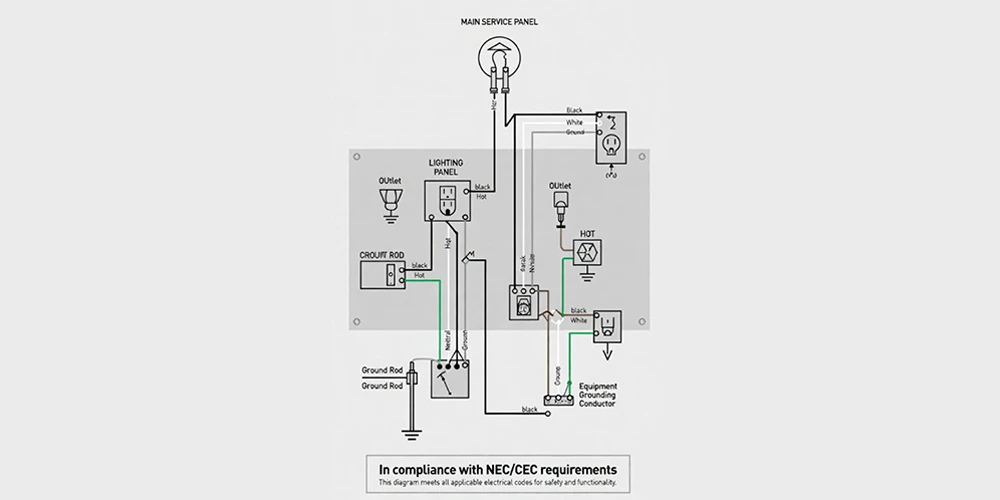
- Wiring Specifications: For example, "Wires of different voltages cannot be installed in the same conduit," and "Wires must be protected with sleeves when passing through walls" to avoid wire wear and short circuits.
- Equipment Certification: Electrical equipment connected to the power grid (such as sockets, switches, and lamps) must pass certifications like UL (Underwriters Laboratories) to ensure quality compliance.
- Overload and Short Circuit Protection: Circuits must be equipped with circuit breakers and fuses. Once the current is too high (e.g., an electrical short circuit), the power can be automatically cut off to prevent fires.
- Grounding and Equipotential Bonding: All metal electrical equipment (such as refrigerators, air conditioners, and industrial machine tools) must be grounded to allow leakage current to dissipate safely and avoid electric shock to the human body.
- Special Scene Enhancement: For example, in humid environments such as basements and bathrooms, electrical equipment with "qualified waterproof ratings" must be used, and wiring must be kept away from water sources.
2. Core Requirements of the CEC (Simplified Version)
- Consistent Basic Requirements with NEC: Core principles such as wiring, grounding, and overload protection are consistent with the NEC, avoiding the need for cross-border practitioners to adapt repeatedly.
- Climate Adaptation Adjustments: Outdoor electrical equipment must meet "low-temperature operation requirements" (e.g., no failure at -40°C). For example, charging piles and outdoor lighting in northern Canada need to have antifreeze designs.
- Energy Efficiency Requirements: Pays more attention to energy conservation than the NEC—for example, it mandates that electrical equipment (such as motors and transformers) meet specific energy efficiency levels to reduce energy waste.
- Bilingual Labeling: Equipment manuals and warning signs must be in both English and French to adapt to Canada’s bilingual environment.
- Special Specifications for Agricultural Scenarios: Canada has a well-developed agricultural sector, so the CEC specifically adds "electrical installation requirements for farms" (such as power supply for agricultural machinery and wiring for barn lighting) to prevent safety hazards in dusty and humid environments.
III. NEC vs. CEC: Key Similarities, Differences, and Application Scenarios
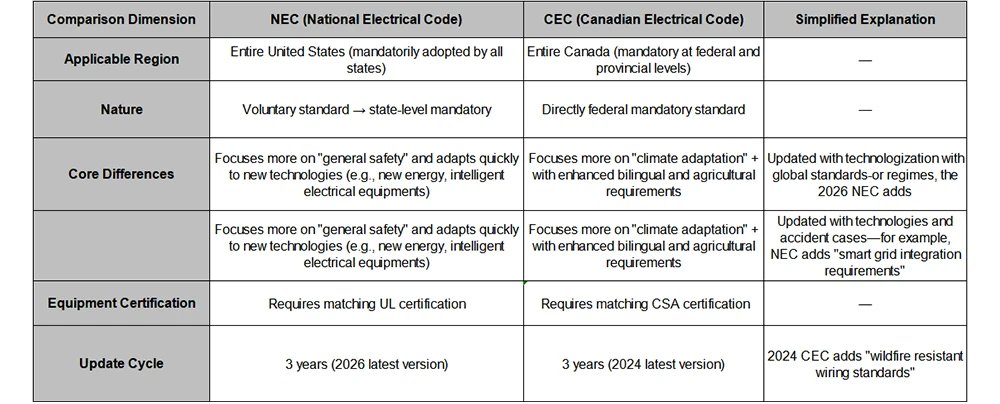
Many people confuse the two, but the core differences lie in "applicable regions" and "detailed adaptations." The table below makes it clear at a glance:
IV. Why Is Compliance with NEC/CEC Mandatory?
Whether for enterprises or individuals, complying with these two standards is not an "additional burden" but a "safety guarantee + compliance prerequisite":
1. Avoid Safety Accidents
The core cause of electrical accidents is mostly "non-compliant operations"—such as wire overload and poor grounding. All requirements of NEC and CEC are formulated based on "accident lessons": For example, the NEC stipulates that "the maximum current-carrying capacity of a 1mm² copper conductor shall not exceed 15A" to prevent wires from overheating and catching fire; the CEC requires that "the grounding resistance of equipment in humid environments ≤ 5Ω" to avoid electric shock from leakage.
Additionally, non-compliance with the latest NEC edition may lead to serious gaps in electrical safety for citizens and fail to protect first responders and workers from preventable dangers (per NFPA Fire & Life Safety Policy Institute research).
2. Smoothly Enter the North American Market
If an enterprise wants to sell electrical equipment (such as lamps, sockets, and industrial controllers) to the United States or Canada, it must prove that the product meets NEC/CEC requirements and pass corresponding UL/CSA certifications—otherwise, it may be detained by customs or even face legal proceedings.
3. Pass Building/Project Acceptance
In North America, the electrical part is a "top priority" for building and factory acceptance: If the wiring does not comply with NEC/CEC, the building cannot obtain a use permit, and the factory cannot start operations, resulting in huge losses. For example, a commercial building in California, USA, was required to be fully reworked because the wiring in the bathroom did not have waterproof protection (violating NEC), delaying the project by 3 months.
4. Reduce Insurance Costs
North American insurance companies price based on electrical compliance: If a building or factory meets NEC/CEC standards, the insurance rate can be reduced by 10%-20%; on the contrary, non-compliance may lead to refusal of insurance or doubled premiums.
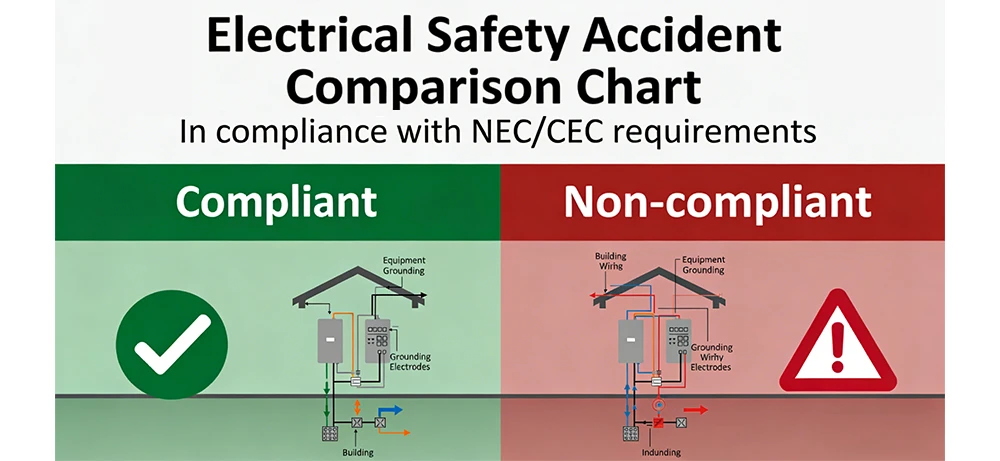
V. Conclusion: Standards Are the "Bottom Line" of Safety and the "Pass" to Compliance
As the "dual norms" in North America’s electrical field, NEC and CEC are essentially "exchanging experience for safety." They transform centuries of electrical accident lessons into actionable guidelines to protect personnel and property safety.
For electrical practitioners, mastering these two standards is an essential professional skill; for enterprises, compliance is the "stepping stone" to entering the North American market; for ordinary people, understanding these standards can also add a layer of safety awareness in daily electricity use (such as purchasing overseas properties or using imported electrical appliances).
With the development of technologies such as new energy and smart grids, NEC and CEC are constantly being updated—but the core of "safety first, compliance-based" will never change. If you need to learn more about compliance requirements for specific scenarios (such as industrial equipment installation or charging pile wiring), you can refer to the official websites of NFPA (NEC official) or CSA Group (CEC official) for authoritative information.