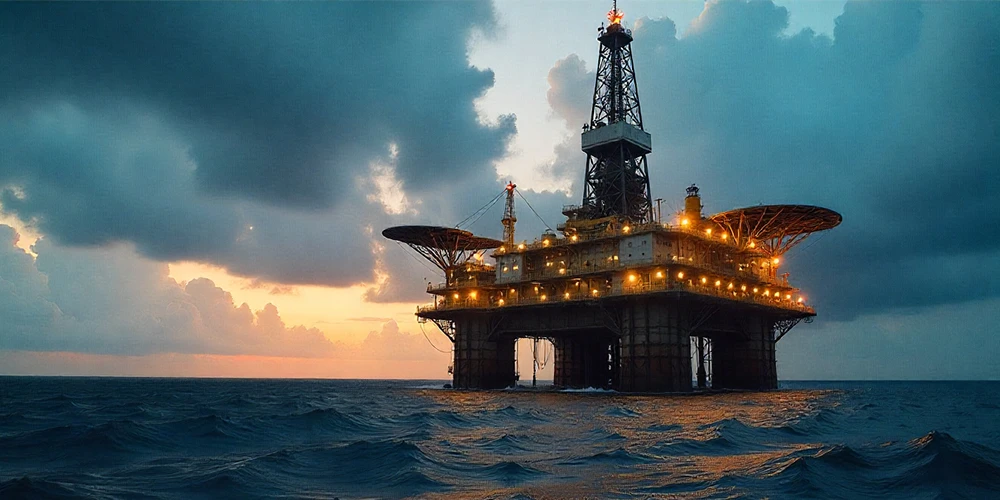

In the oil and gas industry, offshore drilling platforms are often referred to as "floating steel islands". These colossal structures operate year-round in deep-sea environments, facing some of the harshest conditions on Earth.
As the "eyes" of the platform, the lighting system is not only critical for production efficiency but serves as the primary line of defense for personnel safety.
As a professional supplier of explosion-proof lighting, we understand that in deep-sea environments, a single lamp failure can result in massive maintenance costs or significant safety risks. This article focuses on the application of offshore platform lighting, exploring the environmental challenges and identifying key features required when specifying luminaires.
- Core Challenges for Offshore Platform Lighting Systems
- 1. Extreme Salt Spray and Chemical Corrosion
- 2. Severe Explosive Gas Risks
- 3. Persistent High-Frequency Vibration and Mechanical Impact
- 4. Extreme Temperature Fluctuations
- 5. Photometric Interference and Ecological Constraints
- 6. High O&M Costs and Emergency Redundancy Needs
- Luminaire Selection Strategy
Core Challenges for Offshore Platform Lighting Systems
1. Extreme Salt Spray and Chemical Corrosion
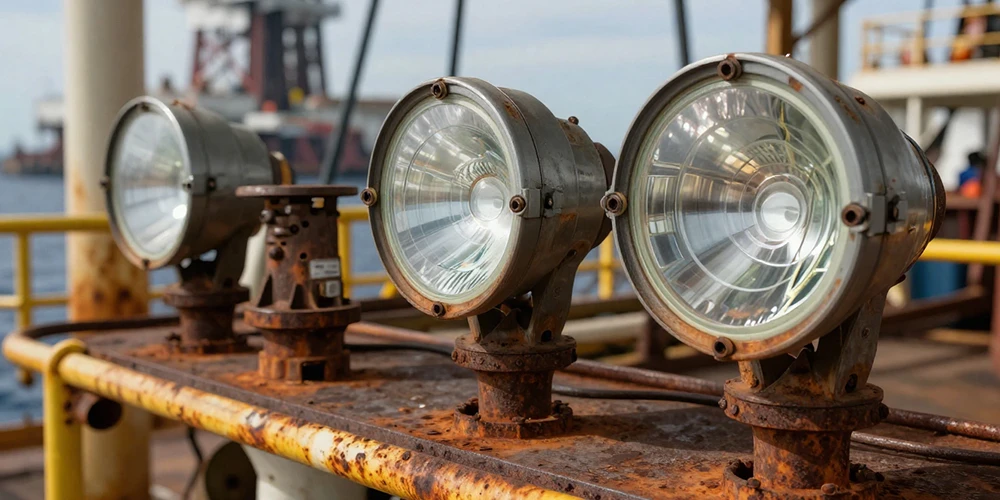
Offshore platforms are perpetually surrounded by high salt spray, high humidity, and highly alkaline environments. These conditions trigger severe electrochemical corrosion, causing the structural strength of ordinary metal materials to degrade rapidly. If the enclosure develops micropores or seals fail due to corrosion, internal circuitry becomes exposed to moist air, leading to electrical short circuits or systemic failure.
2. Severe Explosive Gas Risks
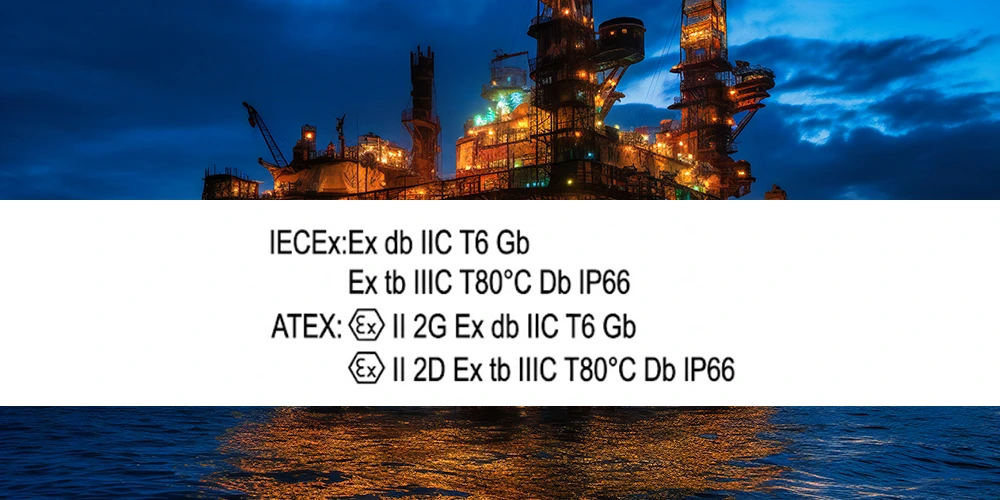
Flammable and explosive hydrocarbon gases are present at all times within drilling zones. As electrical equipment, a tiny spark from a switch, an arc caused by a circuit fault, or even heat accumulation on the luminaire's surface can ignite surrounding explosive mixtures. This necessitates that equipment maintains absolute physical isolation or energy limitation, even under extreme operating conditions.
3. Persistent High-Frequency Vibration and Mechanical Impact
The operation of heavy drilling equipment generates continuous structural vibration, compounded by instantaneous impacts from typhoons and giant waves. Small components in traditional light sources (such as filaments or brackets) are prone to fatigue fracture under sustained vibration. Furthermore, long-term physical shaking can loosen fasteners and shift sealing interfaces, increasing the risk of falling objects or ingress protection failure.
4. Extreme Temperature Fluctuations
Platform equipment must withstand vast temperature swings, from the frigid Arctic to the sweltering heat of tropical seas. Extreme cold can cause electronic component failure and material brittleness, while extreme heat leads to thermal stress accumulation in drivers, accelerating semiconductor aging and causing severe lumen depreciation or instantaneous burnout.
5. Photometric Interference and Ecological Constraints
Platforms feature high-density layouts with crowded equipment, often located in sensitive open-sea environments. Intense direct glare can create visual blind spots in narrow workspaces, threatening worker safety. Additionally, due to maritime navigation requirements and the phototaxis of marine life (such as migratory birds), excessive upward light or spectral shifts can interfere with navigational order and local ecosystems.
6. High O&M Costs and Emergency Redundancy Needs
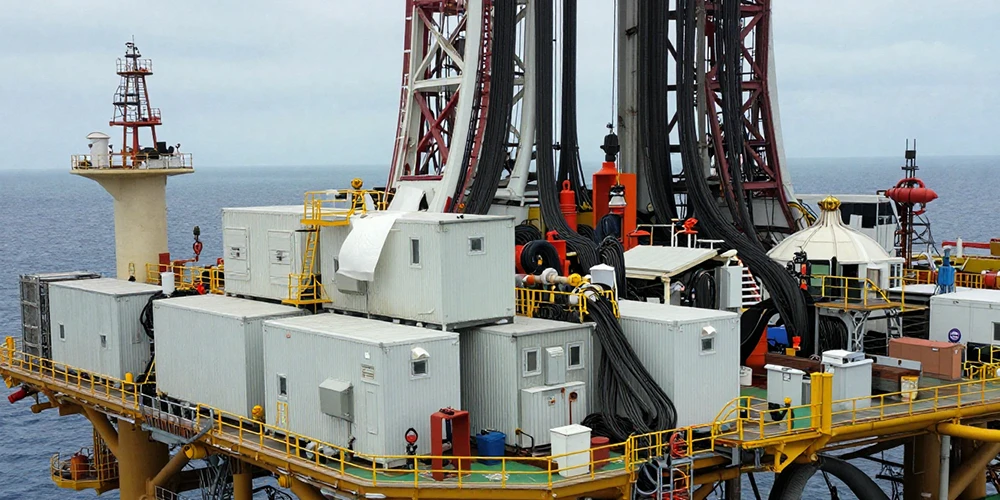
Remote offshore locations make even simple maintenance a logistical challenge involving high-risk work at heights. Low-reliability fixtures lead to exponential increases in Operation and Maintenance (O&M) costs. Critically, during "blackout" scenarios involving fire or total power loss, the lighting system must provide reliable directional guidance without external power, placing rigorous demands on self-powered redundancy.
Luminaire Selection Strategy
1. Core Technology: Selecting LED Luminaires
We consistently recommend LED technology for offshore applications due to several distinct advantages over traditional sources:
- Superior Vibration Resistance: As solid-state lighting (SSL), LEDs lack filaments or glass vacuum chambers. Chips are encapsulated directly onto the substrate, providing inherent resistance to shock and vibration.
- Reduced Maintenance Frequency: High-quality industrial LEDs offer an L70 lifespan of 60,000 to 100,000 hours. This means light sources rarely need replacement during the platform's service life. Reducing replacements by 80% directly correlates to an 80% reduction in fall risks and labor costs.
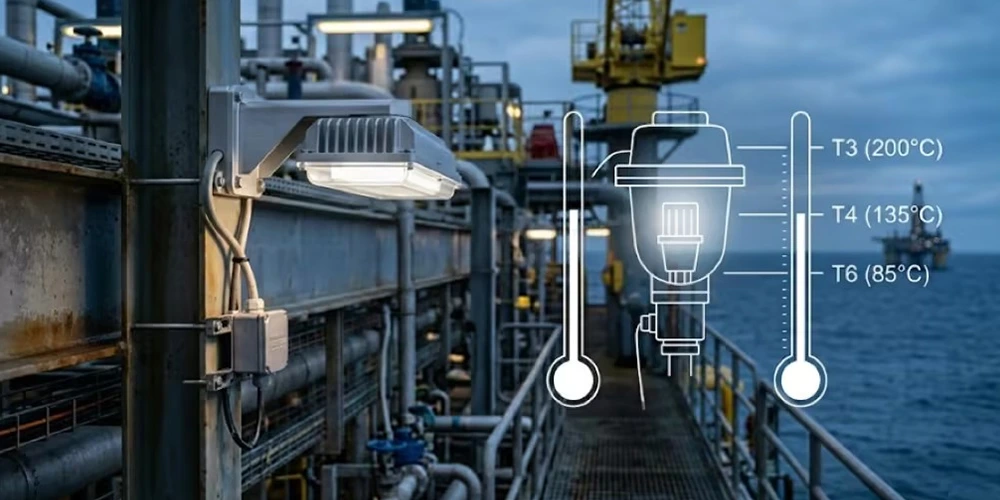
- Enhanced Safety and Thermal Management: LEDs feature high luminous efficacy; while the back generates heat, surface temperatures remain low, often meeting T5 or T6 temperature class ratings. Furthermore, LEDs are mercury-free, making them safer and more compliant with modern ESG standards.
- Instant Start and Voltage Tolerance: LEDs provide instantaneous illumination and support smart dimming. Professional drivers support wide voltage inputs (e.g., 100V-277V), remaining stable during the significant power load fluctuations common on platforms.
2. Environmental Adaptation: Corrosion-Resistant Materials
- Housing Materials: Use low-copper aluminum alloys (copper content < 0.4%) to prevent electrochemical corrosion, or 316L stainless steel for areas with extreme salt spray or chemical washdown.
- Surface Treatment: Enclosures must undergo high-strength epoxy powder coating and pass salt spray tests exceeding 1,000 hours (following UL1598A or European standards).
- Galvanic Corrosion Protection: Teflon washers or insulating coatings must be used at junctions of dissimilar metals (e.g., stainless steel screws and aluminum housings) to prevent contact corrosion.
3. Safety Redundancy: Emergency Lighting Modules
In the event of a total platform blackout, luminaires are the final line of safety.
- Emergency Duration: Per IMO and classification society (DNV/ABS/CCS) standards, emergency lighting for escape routes and critical areas typically requires ≥ 90 minutes.
- Battery Technology: Nickel-Metal Hydride (Ni-MH) or Lithium Iron Phosphate (LiFePO4) batteries are recommended for their high-temperature resistance and longer lifespans (5-8 years).
- Intelligent Monitoring: High-end models should feature self-test functions with status indicators to reduce manual inspection workloads.
4. Critical Ingress Protection and Pressure Equalization
- IP66/67 Rating: Ensures protection against heavy storms and powerful sea waves.
- Breather Drain: A vital "professional detail" for offshore lighting. Thermal expansion and contraction during operation create internal pressure differentials. An explosion-proof breather valve balances this pressure and drains condensation, preventing moisture accumulation that leads to short circuits.
5. Electrical Safety: Wide Voltage Drivers and Surge Protection
- Grid Resilience: Small platform grids are prone to frequency and voltage fluctuations; drivers should support 100V-277V wide input.
- Surge Protection Device (SPD): Due to lightning strikes and heavy motor switching, fixtures should include 6kV surge protection to prevent driver failure.
Offshore drilling platform lighting is a complex engineering discipline. It is about 24/7 operational continuity, guiding vessels home through storms, and—most importantly—the lives of every worker on board. At AGC, we are committed to illuminating the darkest waters with the safest light.