
Hazardous area classification under IEC 60079 and ATEX assigns Zones 0,1,2 for gases, vapors, and mists, and Zones 20,21,22 for combustible dusts. The number reflects how often an explosive atmosphere is expected.
The frequency drives the equipment category, protection concept, and temperature class required for any fixed or portable lighting.
Matching the exact Zone rating to the facility layout prevents catastrophic ignition events while ensuring you don’t overspend or over-engineer fixtures where lower-tier ratings suffice.
Frequency and duration determine a zone
A space doesn’t get classified as hazardous because a flammable substance is possible in theory. It’s classified based on how often an explosive concentration actually forms during normal operation, and for how long it persists when it does.
|
Gas/Vapor |
Dust |
Condition |
|
Zone 0 |
Zone 20 |
Explosive atmosphere present continuously, or for long periods |
|
Zone 1 |
Zone 21 |
Likely to occur during normal operation, occasionally |
|
Zone 2 |
Zone 22 |
Not likely during normal operation; if it occurs, only briefly |
How zone classification translates into lighting requirements
The zone determines the minimum Equipment Category and EPL (Equipment Protection Level). A lighting specification responds to the classification that’s already been determined.
Gas or dust group
For gas, IIA (least easily ignited, e.g., propane), IIB (ethylene), or IIC (hydrogen, acetylene, the most easily ignited).
A fixture rated IIC covers IIB and IIA applications, but a IIA-rated fixture cannot be used where IIC gases are present.
For dust, the equivalent groups are IIIA (combustible flyings), IIIB (non-conductive dust), and IIIC (conductive dust).
Temperature class (T-rating)
The maximum outer surface temperature of the fixture must never exceed the auto-ignition temperature of the target gas or dust layer.
Temperature class (T1-T6) must also match the ignition temperature of the specific gas or dust present. T1 allows up to 450°C while T6 caps the surface at 85°C. But a T6 fixture provides the highest safety margin, while T4 (≤135°C) is common for general lighting fixtures for industrial environments.
Equipment category and EPL
EPL indicates how the fixture is rated to perform. Ga/Gb/Gc for gas, Da/Db/Dc for dust. Ga/Da for the highest-risk zones, Gc/Dc for the lowest.
Category 1 (Ga/Da) may be used in any zone. Category 2 (Gb/Db) may be used in Zones 1/21 and 2/22. Category 3 (Gc/Dc) is restricted to Zones 2/22.
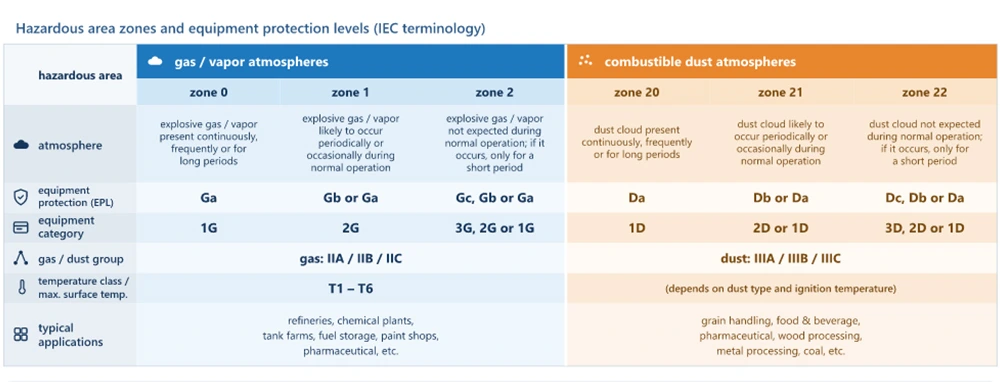
Gas and vapor zone (Zone 0,1,2)
These zones apply to operations handling flammable liquids, gases, or vapors, such as petrochemical refineries, offshore rigs, paint spray booths, and chemical storage facilities.
Zone 0: continuous hazard
Zone 0 covers spaces where an explosive atmosphere consisting of gas, vapor, or mist is present continuously, for long periods, or frequently. Typical guidance is more than 1,000 hours per year.
Examples are the vapor space inside a storage tank of flammable liquid, the interior of a process vessel, or a continuously venting pipeline.
Fixed lighting is rarely installed inside true Zone 0. When illumination is required, luminaires must meet EPL Ga / Category 1G. Common protection methods are intrinsic safety (Ex ia) or encapsulation (Ex ma).
Most industrial LED luminaires are not designed for Zone 0.
Zone 1: intermittent hazard
Zone 1 is where an explosive gas atmosphere is likely to occur in normal operation occasionally. Typical duration guidance is 10–1,000 hours per year.
This is the zone immediately around pump seals, sample points, relief valves, loading arms, and many process units in refineries and chemical plants.
Lighting must achieve at least EPL Gb / Category 2G. Flameproof (Ex d / Ex db), increased safety (Ex e / Ex eb), encapsulation (Ex m), and certain pressurized or powder-filled concepts are common.
Many ATEX/IECEx LED high-bay, linear, and floodlight families, like our HA08, HA03, HA11, HA06 Premium, and HA04 Premium, are certified for Zone 1 (and often dual-rated for Zone 21).
Zone 2: abnormal/rare hazard
Zone 2 means areas where an explosive gas atmosphere is not likely to occur in normal operation, and if it occurs, will exist only for a short period. If it appears, it lasts only a short time (typically less than 10 hours per year).
Areas around well-maintained flanges, pipe racks adjacent to Zone 1, or the outer perimeter of process units often fall here. The minimum requirement is EPL Gc / Category 3G. Non-sparking (Ex n / Ex nR), increased safety (Ex ec), and certain other concepts are accepted.
Zone 2 fixtures are generally lighter and less costly than Zone 1 equivalents, but they cannot be used where the classification is higher.
If you are looking for Zone 2 hazardous location lighting solutions, check out HA13, HA10, HA02, HA06 Supernova, and HA04.
Combustible dust zone (20, 21, 22)
Airborne organic and metallic dusts present severe explosion hazards, but they are often overlooked. Industries affected include grain elevators, flour mills, pharmaceuticals, woodworking, and metal recycling facilities.
Zone 20: continuous dust hazard
Zone 20 means the areas where an explosive atmosphere in the form of a cloud of combustible dust is present continuously, for long periods, or frequently (>1,000 hours per year).
Example locations are the interior of silos, hoppers, cyclones, and pneumatic conveying systems.
Fixed lighting is uncommon. When required, EPL Da / Category 1D equipment is mandatory, usually with protection by enclosure (Ex ta) that remains dust-tight even under fault conditions.
Zone 21: intermittent dust hazard
Zone 21 covers areas where an explosive dust cloud is likely to occur occasionally during normal routine operations (10 to 1,000 hours per year).
Bag-tipping stations, open conveyor transfer points, and areas near dust collection equipment frequently receive this classification.
The minimum is EPL Db / Category 2D. The dominant protection method for luminaires is a dust-tight enclosure (Ex tb) with IP6X sealing so that dust cannot reach hot surfaces or electrical parts. Surface temperature must stay below the ignition temperature of the dust layer and cloud.
Many Zone 1 gas-rated LED fixtures also carry Zone 21 dust certification.
Zone 22: abnormal dust hazard
Zone 22 is the spaces where an explosive dust atmosphere is unlikely during normal operation and persists only briefly if released (<10 hours per year), often due to minor seal leakage or accumulated dust layers.
Warehouses storing bagged product, areas surrounding sealed conveyors, and spaces where dust layers can accumulate but are cleaned regularly often fall into Zone 22.
EPL Dc / Category 3D is the minimum. Dust protection (Ex tc) and appropriate IP rating remain essential.
Can’t we just use the highest-rated fixture everywhere?
Usually, no.
A Zone 1, IIC, T6 fixture will physically work in Zone 2 space too, since higher-rated lighting covers lower zones. But over-specifying every fixture to the worst-case zone on site inflates both the capital cost and the long-term maintenance burden for zones that never needed that level of containment.
So that is why matching the fixture to the actual zone, not the most conservative zone on the property.
If your site has a hazardous-area classification drawing, share the zones and gas/dust groups with our team. Matching the exact marking string to the drawing is the fastest way to confirm the correct fixture family before ordering.