
Imagine a chemical plant at night. Vapors that could ignite with a single spark hang in some areas. Here, every component must be fail-safe, especially the lights. They need a shield that is not just strong, but inherently safe. This shield is often made from a material you might not expect: GRP, or Glass Reinforced Plastic. It's the unseen guardian making modern hazardous environments possible.
What is GRP?
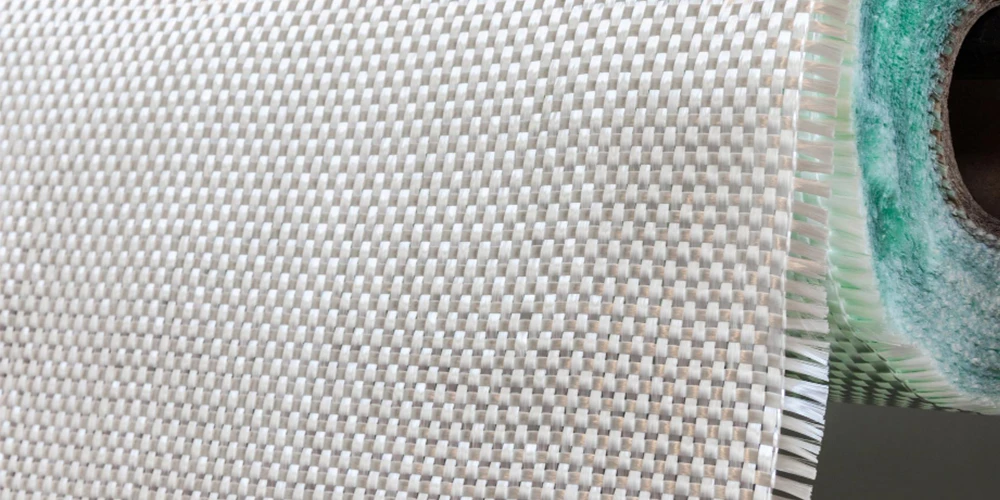
GRP isn't your everyday plastic. It's a composite material, a synergy of two components:
- Glass Fibers: Providing immense tensile strength, like the steel rebar in concrete.
- Polymer Resin: Binding the fibers together, protecting them, and giving the material its shape, akin to the cement matrix.
This combination creates a material that is lightweight yet extraordinarily strong and chemically inert. Unlike metal, it's a born insulator and doesn't corrode. For an environment where a speck of rust or a stray spark can spell disaster, these are not just advantages—they are prerequisites for life.
The Perfect Match for Extreme Environments
Hazardous locations like oil rigs, grain silos, paint booths, or pharmaceutical plants are defined by the presence of flammable gases, dusts, or vapors. A traditional metal light fixture here poses multiple risks: it can corrode, become dangerously hot, or generate impact sparks. GRP elegantly eliminates these threats.
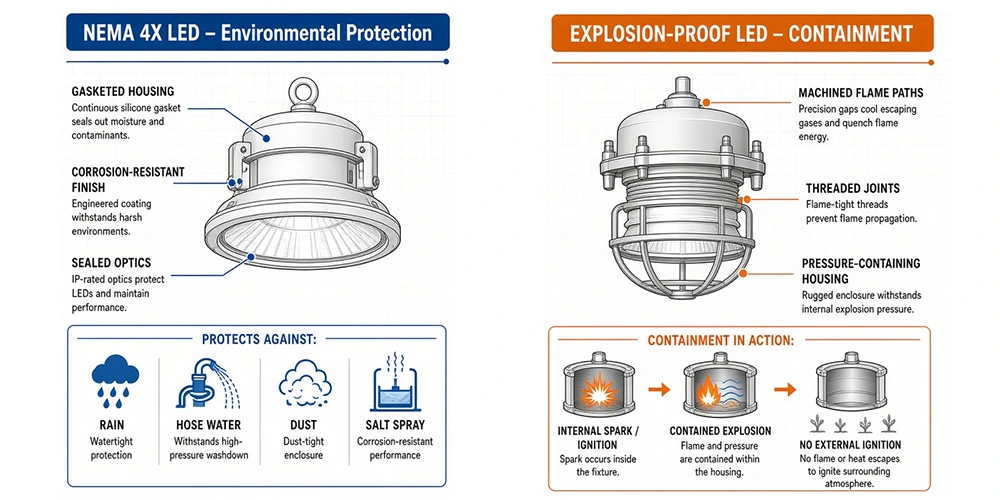
How a GRP Shell Makes a Light “Explosion-Proof”
The Spark-Free Guarantee: As a non-conductive, non-metallic material, GRP cannot produce mechanical or electrostatic sparks. This is its first and most critical line of defense, removing a primary ignition source at the material level.
The Corrosion Barrier: Where salt spray, chemical fumes, or constant humidity would eat away at aluminum or steel, a GRP housing remains completely unaffected. It doesn't rust, pit, or degrade, ensuring the integrity of the seal that keeps explosive elements out of the fixture for many years.
Strength Without the Weight: With a strength-to-weight ratio rivaling steel, GRP housings are exceptionally tough and impact-resistant yet incredibly light. This makes them easy to install, reduces stress on support structures, and ensures they can contain an internal explosion without rupturing—a core requirement of explosion-proof standards.
Built-In Insulation & Thermal Management: GRP is an excellent electrical insulator, enhancing safety. It also has low thermal conductivity, meaning less internal heat is transferred to the outside surface. This keeps the shell cooler, preventing it from becoming a hot surface that could ignite surrounding gases.
Beyond Safety: The Smart Engineering Choice
The benefits extend beyond pure safety into smart engineering:
- Design Freedom: GRP can be molded into complex, seamless shapes with integrated cooling fins, cable entries, and transparent sections, improving both function and aesthetics.
- Life-Cycle Champion: While the initial cost may be higher, a GRP fixture's near-zero maintenance, lack of need for painting or cathodic protection, and legendary longevity make it the most cost-effective solution over its lifetime.
In the silent, critical work of preventing industrial explosions, GRP plays a starring role. It’s more than just a casing; it’s a fundamentally safer material choice engineered for the most demanding places on Earth. The next time you see industrial lighting in a refinery or on an offshore platform, there’s a good chance its reliable, durable heart is beating inside a shell of Glass Reinforced Plastic—the true invisible hero of industrial safety.