
When you’re selecting LED lighting for high-risk, explosion-prone locations, you quickly realize there’s no room for guesswork, and certainly no one-size-fits-all solution. These areas demand fixtures that meet extreme compliance standards to ensure they won't trigger an ignition of flammable gases, vapors, or combustible dust.
Choosing the right light isn't just about making things bright; it's the critical step that guarantees worker safety and maintains regulatory compliance.
To find the perfect fixture, we need to look at three main criteria: the hazard level of your space, what you need the light to do, and how high it needs to be mounted.
- Understanding the Hazardous Area Classification
- Choosing the Fixture by Application and Height
- Task Lighting: Precision Illumination for Specific Jobs
- Low Bay/Area Lighting: Balanced Light for Mid-Height Spaces
- High Bay Lighting: Robust Illumination for Tall, Open Areas
- Flood Lighting: Broad Coverage for Large or Outdoor Areas
- Simplify Your Selection Process
Understanding the Hazardous Area Classification
The single most critical step in choosing explosion-proof lighting is accurately understanding the area's hazard classification. This is established by standards like ATEX, IECEx (Zones), or NEC/CEC (Divisions), which dictate which fixture is legally and safely suitable for installation.
Hazardous locations are categorized based on the type of flammable material present and the likelihood of it being present in an ignitable concentration.
|
Classification System |
Material Type |
Likelihood of Hazard |
|
ATEX/IECEx (Zones) |
Gas/Vapor/Mist |
Zone 0 (Continuous) Zone 1 (Likely) Zone 2 (Occasional)
|
|
Combustible Dust |
Zone 20 (Continuous) Zone 21 (Likely) Zone 22 (Occasional)
|
|
|
NEC/CEC (Divisions) |
Gas/Vapor/Mist (Class I) Dust (Class II) |
Division 1 (Continuous/Likely) Division 2 (Occasional/Abnormal)
|
For example, an area classified as Zone 0/Division 1 indicates a continuous or likely presence of the hazard, demanding the highest level of protection, while Zone 2/Division 2 indicates the hazard is only present under abnormal or occasional circumstances.
Choosing the Fixture by Application and Height
Once the safety standard is met, we choose the fixture based on its purpose and the geometry of the space.
Task Lighting: Precision Illumination for Specific Jobs
Task lighting provides focused brightness essential for detailed work where precision and safety are paramount.
Applications include reading complex gauges in chemical plants, inspecting critical valves on oil rigs, illuminating control panels, or lighting narrow access walkways. These units are typically mounted low, 3 meters (10 feet) or less, to deliver direct, localized, and glare-free illumination.
For hazardous applications, task lights require compact, robustly sealed designs to prevent ingress. Look for models with high IP ratings (IP66 or better) and specific low-level certifications like ATEX Zone 2 or IECEx Zone 22, suitable for areas with occasional, contained hazards.
Low Bay/Area Lighting: Balanced Light for Mid-Height Spaces
Low bay lighting is the appropriate solution for achieving broad, balanced illumination in medium-height work areas.
Common environments include small production rooms, maintenance workshops, wastewater treatment control areas, and chemical storage annexes. With a mounting height of up to 6 meters (20 feet), these fixtures typically deliver under 10,000 lumens, making them energy-efficient alternatives to 250W HID lights.
In hazardous settings, low bay lights must feature dust-tight, highly corrosion-resistant housings (316L stainless steel is a reliable material) to withstand corrosive substances. Compliance often requires certifications such as ATEX Zone 21 (for dust) or Zone 1 (for gases), which cover areas where hazards are more likely to be present.
High Bay Lighting: Robust Illumination for Tall, Open Areas
When illumination is needed for high-ceiling industrial facilities, high bay lighting is necessary. These fixtures are designed for spaces taller than 6 meters (20 feet).
Applications span large facilities like petrochemical production halls, warehouses storing flammable materials, foundries, or expansive wastewater treatment tanks. They must deliver high brightness, often exceeding 10,000 lumens, to evenly illuminate vast, high-ceilinged areas.
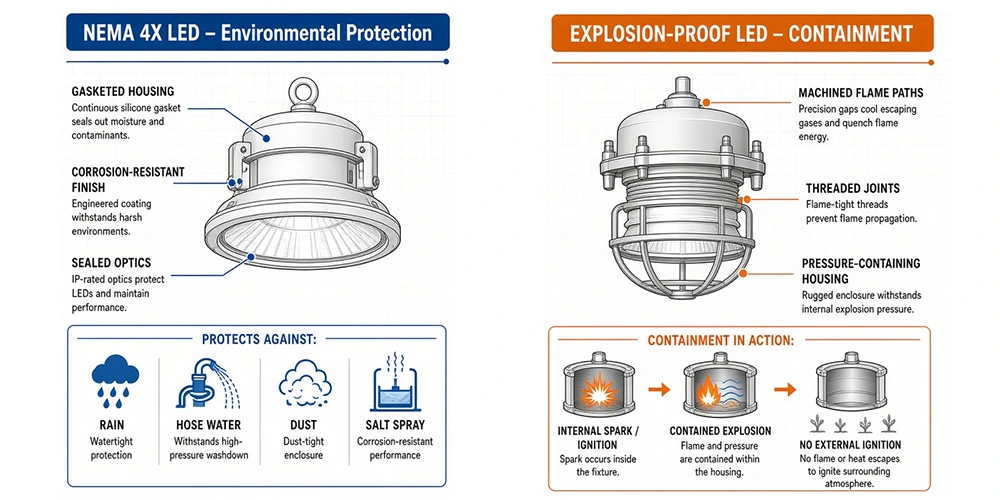
Explosion-proof high bays frequently utilize the Ex d (Flameproof) protection method. This means the heavy-duty enclosure is engineered to contain an internal explosion without allowing the flame or hot gases to escape and ignite the external atmosphere. Essential compliance is demonstrated through certifications such as IECEx Ex d IIC or UL 844, ensuring suitability for the most demanding hazardous environments, from solvent storage to coal mining.
Flood Lighting: Broad Coverage for Large or Outdoor Areas
Flood lighting offers high-intensity, wide-area illumination for exterior safety, security, and operational needs over long distances.
In hazardous locations, flood lights are essential for outdoor tank farms, chemical plant loading docks, refinery perimeter fences, and offshore drilling platforms. Mounted at 6 meters (20 feet) or more, they must withstand punishing external conditions.
Because of this outdoor exposure, technical requirements include IP67+ waterproof ratings and marine-grade corrosion resistance against saltwater and harsh weather. They are typically certified for outdoor gas hazards, such as ATEX Zone 2.
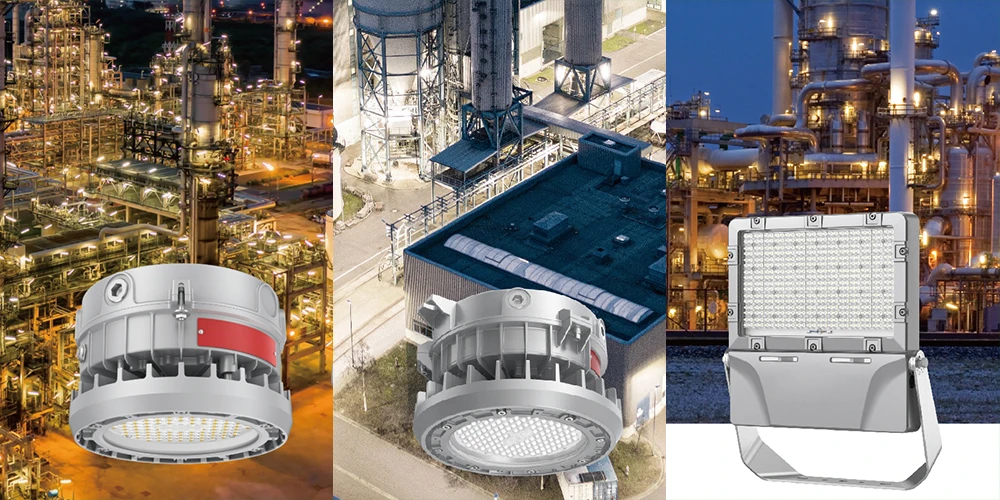
Simplify Your Selection Process
Choosing compliant lighting for hazardous environments is a systematic, hierarchical process:
- Safety Standard: Identify your area's Zone/Division and the required T-Rating.
- Purpose: Determine the fixture type needed: Focused Task, General Area, or High-Power Ambient.
- Physical Fit: Confirm the correct mounting height and total brightness required for the space.
Need help specifying the right light? Contact our specialists. We provide certified explosion-proof lighting solutions that meet your facility's exact regulatory requirements.