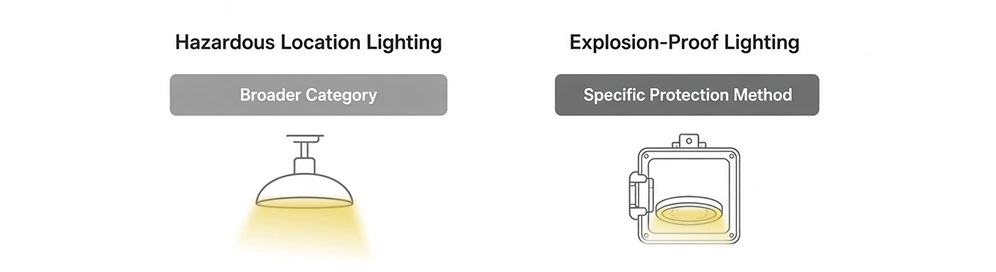

Hazardous location lighting sits at the intersection of two areas that regulators address separately: electrical product safety and workplace explosion prevention.
Because these requirements have developed through different national and regional regulatory systems, there is no single certification scheme that applies worldwide.
For hazardous location lighting, three regulatory frameworks appear most often on international industrial projects: ATEX and IECEx for markets that follow European or IEC-based requirements, and the North American system based on the NEC and CEC.
An explosion-proof or hazardous location light certified for one market is not automatically approved for use in another. The equipment must meet the applicable local requirements and, where required, carry the appropriate certification, listing, or approval for that jurisdiction.
Which scheme applies where?
When searching hazardous location lighting, you may come across terms such as IECEx, ATEX, UL 844, NEC, and CEC. These terms are often used together, but they do not all mean the same thing.
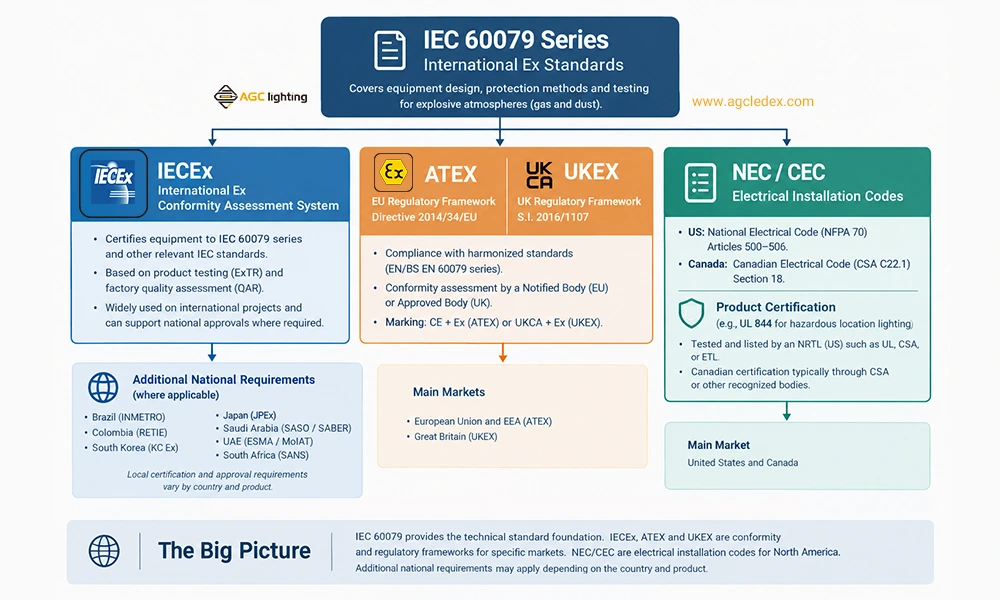
For practical purposes, most global projects can be organized around three major regulatory frameworks:
- ATEX for equipment placed on the EU market
- IECEx as an international conformity assessment system based on IEC standards
- NEC and CEC for electrical installations in the United States and Canada, with product certification typically provided through an accredited certification organization
The diagram below shows how these frameworks relate in the global market.
IECEx: International certification system
IECEx is an international conformity assessment system operated under the International Electrotechnical Commission. It certifies equipment against applicable IEC standards, including the IEC 60079 series for explosive atmospheres.
An IECEx Equipment Certificate of Conformity (CoC) is supported by an IECEx Test Report (ExTR) and a Quality Assessment Report (QAR). The ExTR covers the technical testing of the equipment, while the QAR addresses the manufacturer's quality system and production controls.
IECEx is widely used on international projects and provides a common technical basis for hazardous location equipment. However, an IECEx certificate does not automatically replace a national approval wherever local regulations require one.
One of the main advantages of IECEx is that its certification data can be used to support national certification. Under the IECEx rules, national certification bodies can accept IECEx ExTRs and QARs as part of a national approval process, although they may still need to assess local or national differences.
So, IECEx can make the path to multiple markets easier, but it does not mean that one IECEx certificate automatically provides legal approval everywhere.
ATEX: European Union
ATEX refers to the EU regulatory framework for equipment and protective systems intended for use in potentially explosive atmospheres. The main legislation for equipment is Directive 2014/34/EU.
For applicable products, manufacturers must demonstrate conformity with the directive's essential health and safety requirements. Harmonized standards, including the EN IEC 60079 series, are commonly used to demonstrate conformity.
Depending on the equipment category and conformity assessment route, a Notified Body may be involved. Products within the scope of the directive carry the CE marking and the specific explosion protection marking required by ATEX.
ATEX uses the Zone system for hazardous areas. For gas and vapor hazards, the familiar zones are Zone 0, Zone 1, and Zone 2. For combustible dust, they are Zone 20, Zone 21, and Zone 22. Equipment is also assigned an appropriate category and explosion protection marking.
If you want to sell hazardous location lighting into the EU, ATEX compliance is therefore a legal market-access requirement.
NEC and CEC: United States and Canada
In the United States, electrical installations are governed primarily by the National Electrical Code (NFPA 70), including Articles 500 through 506 for hazardous locations.
Canada uses the Canadian Electrical Code, including the hazardous location requirements in Section 18.
North American hazardous locations are commonly specified using the Class/Division system, although the NEC and CEC also recognize Zone classifications for certain applications.
For hazardous location lighting, product certification is a separate part of the compliance process.
In the United States, OSHA's Nationally Recognized Testing Laboratory (NRTL) program recognizes laboratories that can test and certify products to applicable standards. UL 844, for example, is the standard for electric lighting fixtures used in hazardous classified locations.
Depending on the market and product, certification may be provided by organizations such as UL, CSA, or Intertek, provided the certification is within the organization's recognized scope.
This is why an ATEX or IECEx certificate alone should not be assumed to provide the product approval needed for a typical NEC or CEC installation.
ATEX vs IECEx vs NEC/CEC
The important point is that these are not three interchangeable certificates.
ATEX tells whether applicable equipment meets the EU's legal requirements for the relevant product category.
IECEx provides an internationally recognized conformity assessment route based on IEC standards and can support national approvals where those are required.
NEC and CEC establish the electrical installation requirements in the United States and Canada, while product certification provides evidence that the equipment meets the applicable product safety requirements.
|
|
ATEX |
IECEx |
NEC/CEC |
|
Primary market |
European Union |
International projects and markets using or accepting IECEx |
United States and Canada |
|
Nature |
EU legal framework |
International conformity assessment system |
National electrical installation codes |
|
Main technical standards |
EN IEC 60079 series and other applicable harmonized standards |
IEC 60079 series and other applicable IEC standards |
UL, CSA and other applicable North American standards |
|
Hazardous area approach |
Zones (0/1/2 gas, 20/21/22 dust) + Categories |
Zones + Equipment Protection Levels (Ga/Gb/Gc, Da/Db/Dc) |
Class / Division (and Zone under Articles 505/506) |
|
Typical product conformity route |
ATEX conformity assessment, with Notified Body involvement where required |
IECEx CoC supported by ExTR and QAR |
Product listing/certification by an appropriately recognized certification organization |
|
Marking on a luminaire (example) |
II 2G Ex db IIC T6 Gb |
Ex db IIC T6 Gb |
Class I, Division 1, Groups C & D, T6 |
|
Legal role |
Required for applicable equipment placed on the EU market |
International certification system; local requirements may still apply |
Code requirements enforced by the applicable jurisdiction and AHJ |
Can I use one certification for a global project?
Not always.
This is one of the more common mistakes on multi-region projects: assuming that an IECEx-certified fixture can be installed anywhere because it has already been tested for explosion protection.
The technical testing may be closely related, but certification is tied to the regulatory requirements of the market where the product will be installed.
IECEx can simplify the process because its certification data can be used to support national approvals in countries that require additional local certification. But the receiving certification body may still need to address national differences or other local requirements.
The practical approach is simple: check the project specification, hazardous area classification, applicable electrical code, required product certification, and local AHJ requirements before selecting the fixture.
For global projects, it is often more efficient to work with a manufacturer that offers the required certifications on the same product family. Depending on the project, a hazardous location luminaire may be available with IECEx, ATEX, NEC/CEC, or multiple approvals.
At AGC Lighting, we provide hazardous location lighting solutions for different international markets. Whether your project requires Class I, Division 1 or Division 2, or Zone 1 or Zone 2 protection, we can help identify the appropriate lighting solution based on the project requirements.
Share your project requirements with our team, and get a suitable lighting solution.