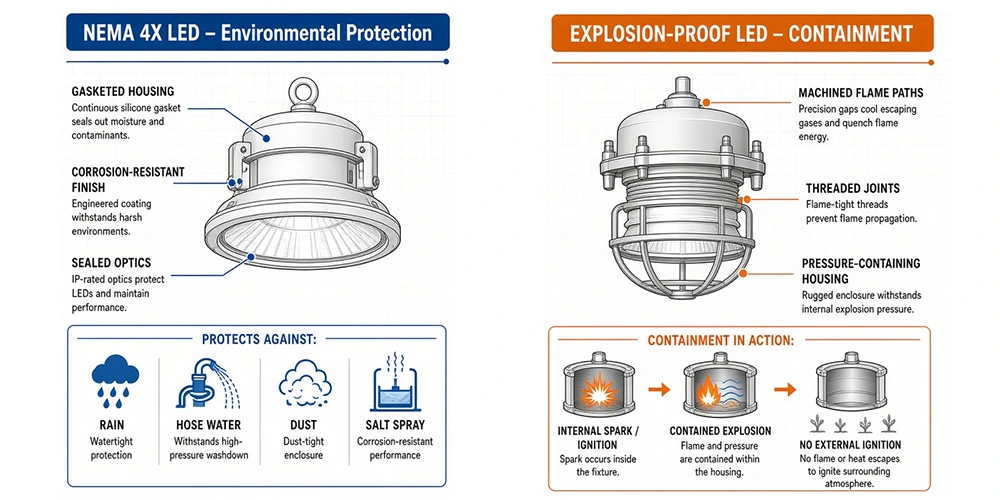

NEMA 4X does not, by itself, mean that an enclosure is explosion-proof.
NEMA 4X enclosures protect equipment from water, dust, and corrosion. They do not contain internal explosions or prevent ignition of surrounding flammable atmospheres. For hazardous locations with flammable gases, vapors, or combustible dust, different ratings, NEMA Type 7 or Type 9, are required under the National Electrical Code and related standards.
What Does NEMA 4X Mean?
The National Electrical Manufacturers Association (NEMA) defines enclosure types in the NEMA 250 standard. Type 4 and Type 4X are for indoor or outdoor use.
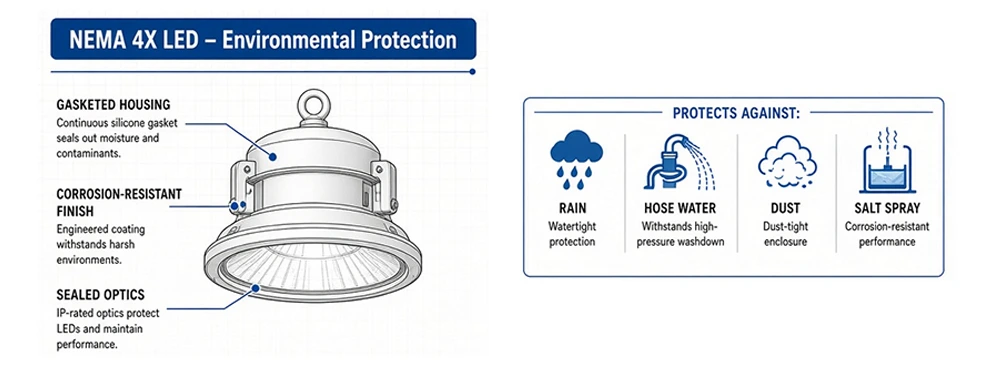
Type 4X provides protection against:
- Access to hazardous internal parts
- Windblown dust
- Rain, sleet, and snow
- Splashed water
- Hose-directed
- Corrosion
- External ice formation
The “X” is important. It indicates an additional level of corrosion protection compared with a standard Type 4 enclosure.
So, NEMA 4X is useful in environments where equipment may be exposed to moisture, washdown procedures, corrosive atmospheres, or other demanding environmental conditions.
But none of these requirements, by themselves, establish that an enclosure can safely contain an internal ignition event in a hazardous atmosphere.
That is the key distinction.
What Does Explosion-Proof Mean?
The name of “explosion-proof” is a little misleading.
It does not mean a light fixture can withstand an external blast, nor does it mean that internal electrical sparking is impossible. Rather, it means the fixture’s enclosure is engineered to contain an internal explosion and cool any escaping gases so they cannot ignite the surrounding hazardous atmosphere.
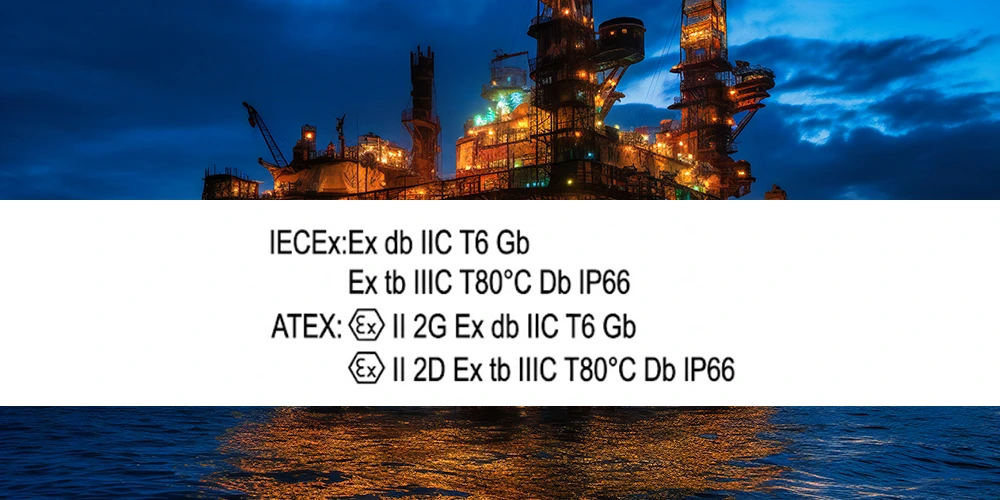
Because of this, explosion-proof is not simply a measure of how tightly sealed a fixture is; it is a specialized protection concept designed to control ignition risks in classified environments. Consequently, installing explosion-proof fixtures is legally mandated by safety codes, such as the NEC in North America and ATEX or IECEx internationally, in facilities with hazardous airborne hazards.
How Does Explosion-Proof Protection Work
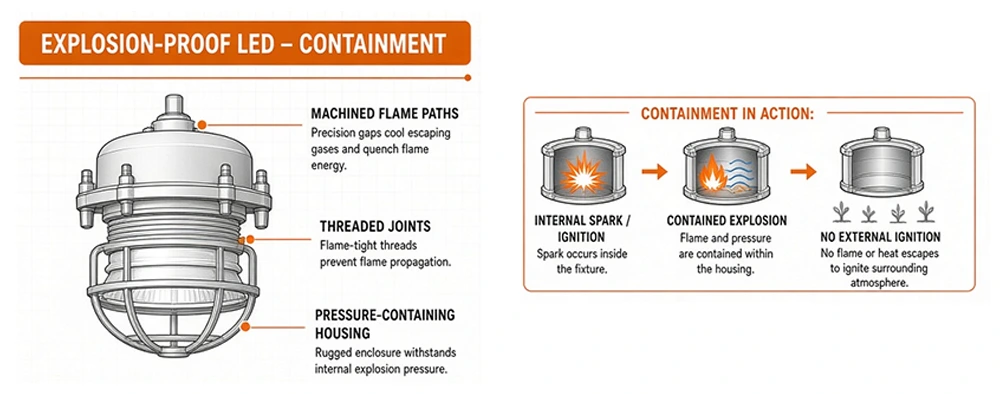
An explosion-proof enclosure does not prevent an internal explosion. It assumes one may occur and is engineered to survive it safely.
Key design features include:
- Robust construction capable of withstanding the pressure of an internal explosion.
- Flame paths, precisely machined joints, and threaded entries that cool escaping hot gases so they fall below the ignition temperature of the external atmosphere before they leave the enclosure.
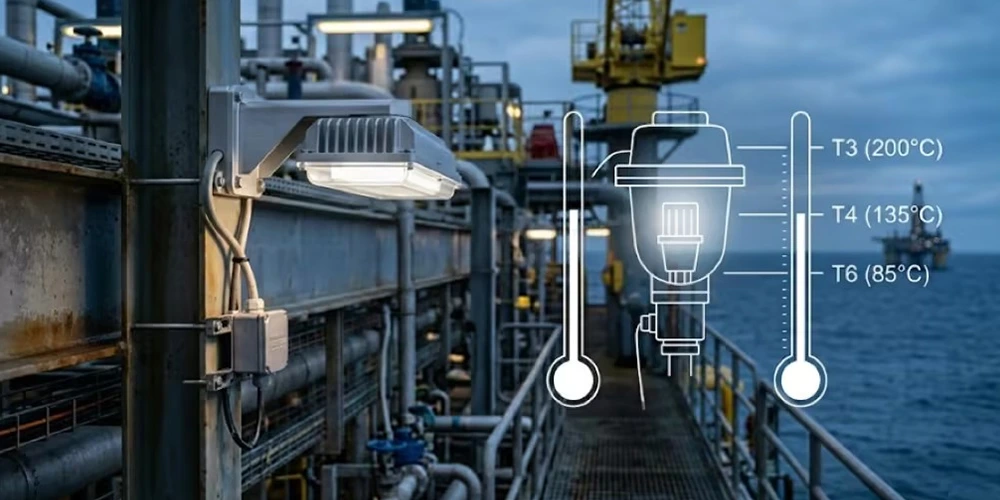
- Control of external surface temperature so it remains below the auto-ignition temperature of the surrounding flammable mixture.
NEMA 4X vs Explosion-Proof
|
Characteristic |
NEMA 4X |
Explosion-Proof |
|
Primary purpose |
Environmental enclosure protection |
Protection for hazardous locations |
|
Hazardous location approval |
Not implied |
Required for the applicable hazardous location |
|
Water protection |
Yes |
Depends on enclosure construction and rating |
|
Windblown dust production |
Yes |
Depends on applicable approval |
|
Corrosion protection |
Yes |
Not implied solely by “explosion-proof” |
|
Address ignition hazards |
No, no by itself |
Yes, when properly approved |
Common Misconceptions
NEMA 4X is heavy-duty, so it must be suitable for hazardous areas.
No. Environmental durability and explosion containment are separate performance requirements. A stainless-steel NEMA 4X enclosure can still allow an internal ignition to propagate if it is not designed and certified as explosion-proof.
Some products are labeled both NEMA 4X and explosion-proof.
Yes. Many hazardous-location products carry both an environmental rating and a hazardous-location certification.
Selecting the Right Protection for Lighting and Enclosures
For a hazardous-area lighting project, start with the area's classification and required certification, then match the fixture to those requirements.
AGC Lighting offers LED luminaires for both categories: standard industrial and outdoor fixtures with high IP ratings suitable for harsh non-classified environments, and dedicated explosion-proof / hazardous-location series certified to UL 844, ATEX, and IECEx.
If you have a project specification or hazardous-location classification, AGC's technical team can help identify the relevant product documentation and installation requirements.