
In hazardous locations such as oil refineries, chemical plants, offshore platforms and dusty workshops, the lens of an explosion-proof luminaire is far more than an optical component. It is an essential part of the flameproof structure that directly influences safety, stability and service life.
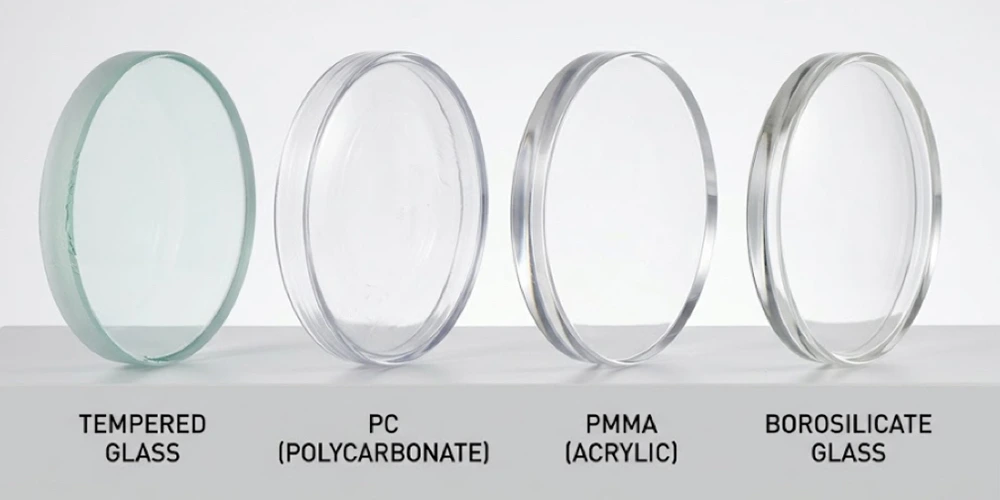
The four most common lens materials are tempered glass, PC, PMMA and borosilicate glass. Each material responds differently to heat, impact, corrosion and ultraviolet radiation, so the right choice must be based on real working conditions.
- Why Lens Material Matters for Explosion‑Proof Lighting
- Tempered Glass: The All‑Round Reliable Choice
- Borosilicate Glass: For Extreme High‑Temperature Environments
- PC (Polycarbonate): The Best for Impact Resistance
- PMMA (Acrylic): High Clarity for Indoor Low‑Risk Areas
- How to Select the Right Lens Material
Why Lens Material Matters for Explosion‑Proof Lighting
The lens plays a critical role in maintaining the performance and safety of explosion-proof lighting. It must provide reliable light transmittance, resist physical impact and environmental erosion, and help contain potential sparks or explosions inside the luminaire.
Unsuitable lens materials can quickly turn yellow, crack, soften, or become brittle, which not only reduces lighting efficiency but also compromises explosion-proof safety. Choosing the correct material ensures long‑term reliability and compliance in hazardous environments.
Tempered Glass: The All‑Round Reliable Choice
Tempered glass is widely used in explosion-proof lighting for industrial environments requiring high mechanical strength and impact resistance. It is significantly stronger than ordinary glass and provides excellent resistance to vibration and external impact.
In case of breakage, it shatters into small, relatively blunt pieces, improving safety. It also offers good light transmission and heat resistance, making it suitable for general industrial, chemical, and outdoor hazardous areas.
Borosilicate Glass: For Extreme High‑Temperature Environments
Borosilicate glass is specially designed for harsh conditions with high temperature and rapid thermal shock. It has an extremely low thermal expansion coefficient and outstanding heat resistance, making it ideal for furnace areas, boiler rooms, and high‑temperature production zones. It also provides superior chemical stability and corrosion resistance.
The only tradeoffs are higher cost and slightly lower impact resistance compared with tempered glass.
PC (Polycarbonate): The Best for Impact Resistance
PC is a tough engineering plastic known for its exceptional impact resistance. It is lightweight, easy to mold, and maintains good impact resistance at low temperatures. These properties make it suitable for areas with a high risk of mechanical impact or vibration, such as mechanical workshops and industrial processing facilities.
However, PC can be susceptible to certain chemicals and solvents, so chemical compatibility should be considered carefully.
Standard PC may also yellow and degrade after long-term outdoor UV exposure, while UV-stabilized grades provide improved weathering resistance. Its suitability for Zone 1 or Zone 2 applications depends on the specific material grade, luminaire design and explosion-proof certification.
PMMA (Acrylic): High Clarity for Indoor Low‑Risk Areas
PMMA offers excellent light transmittance and high optical clarity, making it suitable for precision optical structures such as lenses, covers and diffusers. It can provide a cost-effective solution for applications requiring clear lighting and can be molded into optical or diffused structures for uniform light distribution. PMMA also offers good UV and weather resistance, making it suitable for many indoor and outdoor lighting applications.
However, its heat resistance is lower than glass, and its chemical compatibility should be carefully checked when exposed to solvents or aggressive cleaning agents. For hazardous-area applications, its suitability depends on the specific material grade, luminaire design and applicable explosion-proof certification.
How to Select the Right Lens Material
The best lens material depends on actual site conditions, including temperature range, corrosion level, impact risk and whether the application is indoor or outdoor.
For most standard explosion‑proof lighting projects, tempered glass provides the best balance of safety, durability and cost.
High‑temperature sites require borosilicate glass. Impact‑prone Zone 2 areas can use PC, while indoor low‑risk locations are ideal for PMMA.
By understanding the characteristics of each material, you can avoid premature failure, reduce maintenance costs and ensure long-term safe operation in hazardous areas.
| Material | Hardness | Impact Resistance | Transparency | Heat Resistance |
| Tempered Glass | High | Medium | High | High |
| PC | Medium | High | High | Low |
| PMMA | Medium | Medium | High | Low |
| Borosilicate Glass | High | Low | High | Very High |