
When selecting and installing lighting for hazardous locations—such as oil & gas facilities, chemical plants, grain silos, or marine environments—the luminaire's nameplate is its most critical piece of documentation. It is the permanent, factory-applied "ID card" that certifies the product's suitability for specific dangerous conditions. Misinterpreting it can lead to catastrophic safety risks.
Using real examples from ACC Lighting's HA03 product nameplates (compliant with IECEx/ATEX and NEC/CEC standards), let's decode the essential information every explosion-proof luminaire nameplate must convey.
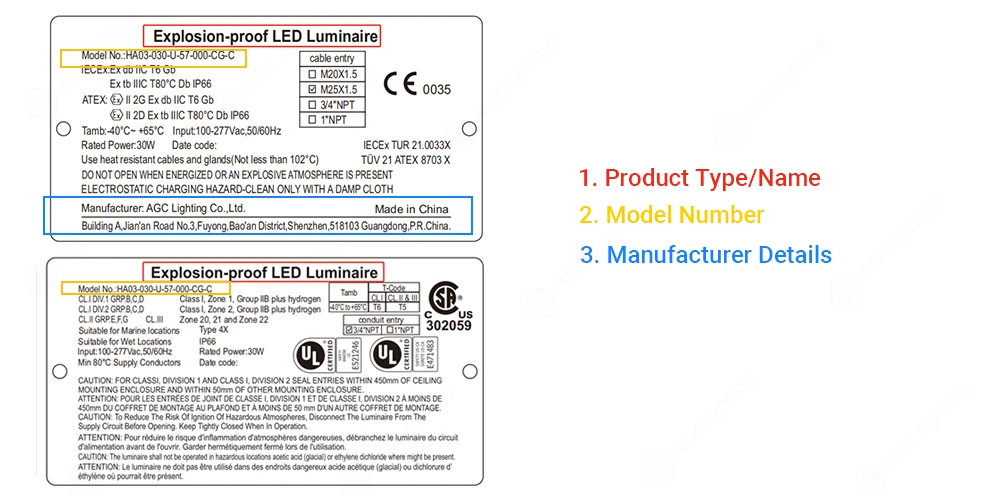
Core Product Identification
This basic information links the physical product to its technical specifications and the manufacturer.
- Product Type/Name: e.g., Explosion-proof LED Luminaire.
- Model Number: A unique identifier for the exact product variant (e.g., HA03-030-U-57-000-CG-C).
- Manufacturer Details: The responsible company's name and address (e.g., ACC Lighting Co., Ltd., Shenzhen, P. R. China). Please note that North American nameplates do not list manufacturer-related information directly.
Nameplate Components
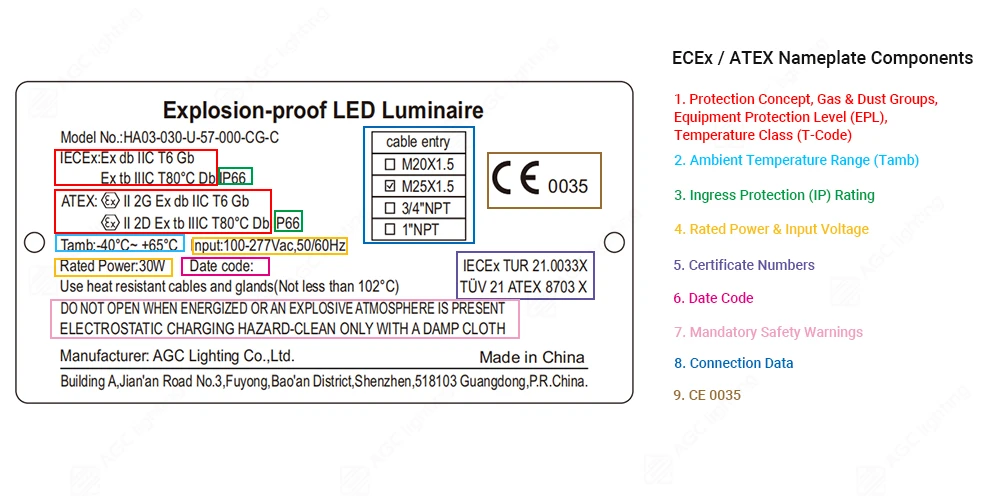
For IECEx / ATEX
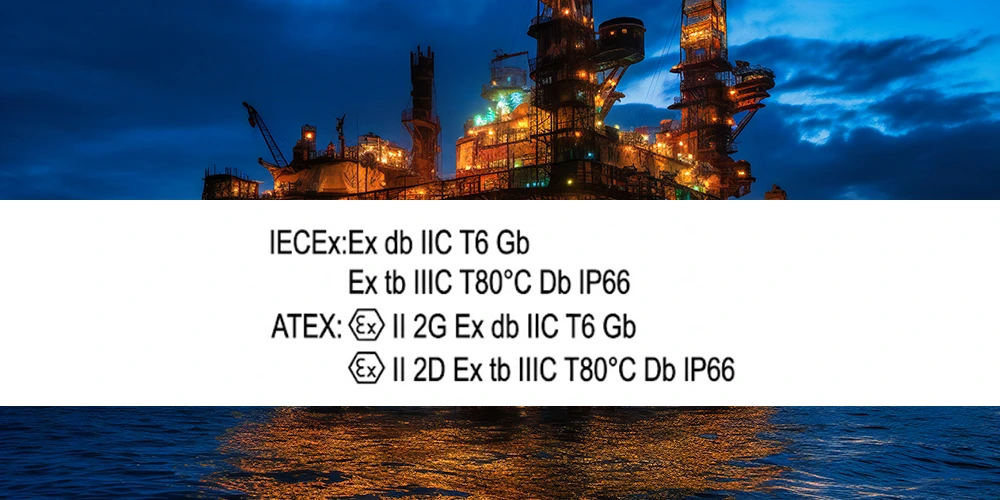
- Protection Concept: Symbols like Ex db (Flameproof enclosure) and Ex tb (Protection by enclosure) indicate the design strategy used to prevent ignition.
- Gas & Dust Groups: IIC signifies the highest level of safety for gas atmospheres (covering hydrogen, acetylene, etc.). IIIC is for conductive dusts.
- Equipment Protection Level (EPL): Gb (Equipment for Gas, high protection level) and Db (for Dust, high protection level) indicate a high level of security, suitable for zones where explosive atmospheres are frequently present.
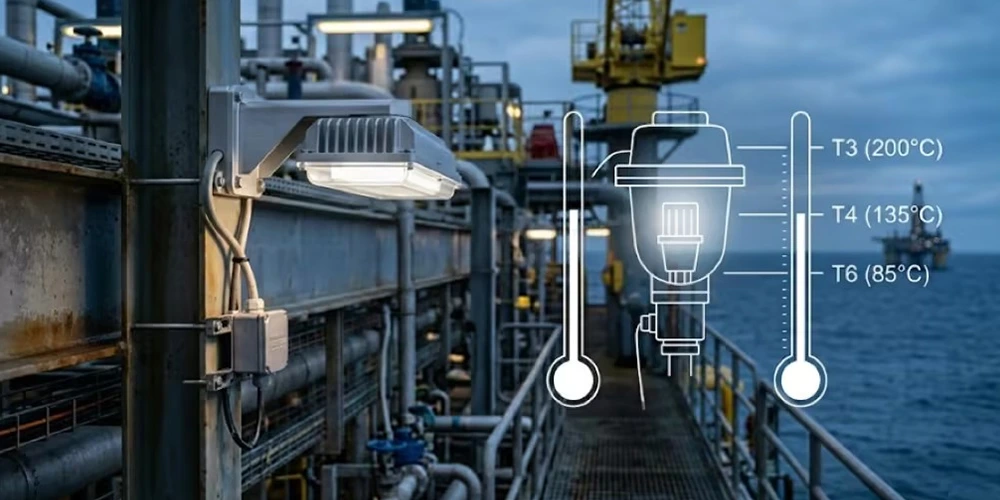
- Temperature Class (T-Code): e.g., T6. This indicates the maximum surface temperature the luminaire will reach under working conditions. It must be lower than the auto-ignition temperature of the surrounding gases or dusts. A T6 rating (≤85°C) is safer for more volatile substances than a T5 (≤100°C).
- Ambient Temperature Range (Tamb): e.g., -40℃ ~ +65℃.
- Ingress Protection (IP) Rating: e.g., IP66.An IP66 rating means a device is completely dust-tight (the first '6') and protected against powerful jets of water from any direction (the second '6'), making it ideal for harsh outdoor or washdown environments, but not for submersion.
- Rated Power & Input Voltage: e.g., 30W, 100-277Vac, 50/60Hz. Essential for correct electrical system design.
- Certificate Numbers: Unique numbers like IECEx TUR 21.0033X or TÜV 21 ATEX 8703 X allow authorities to verify the product's certification file with the issuing body (e.g., TÜV).
- Date Code: Identifies manufacturing date for traceability.
- Safety Warnings: Direct, non-negotiable commands.
- Mandatory Safety Warnings:
- The cardinal rule to prevent ignition.
- Prevents static discharge when cleaning.
- Connection Data: Lists acceptable cable/conduit entry thread sizes like M25x1.5, 3/4"NPT, or 1½"NPT.
- CE 0035: Under the ATEX system, the CE mark indicates compliance with EU safety regulations, while the code "0035" represents Notified Body responsible for certification of QAN (Quality Assurance Notification).
For NEC/CEC
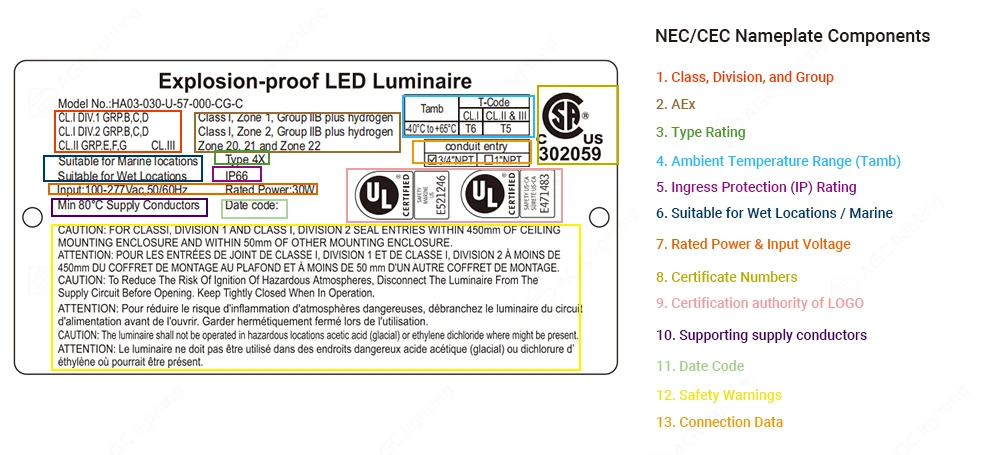
- Class, Division, and Group: This is the traditional North American classification.
- CL. I DIV. 1 GRP. B, C, D: Suitable for flammable gases/vapors (like hydrogen, ethylene, propane) in areas where hazard is present continuously or frequently.
- CL. II DIV. 1 GRP. E, F, G: Suitable for combustible dusts in hazardous concentrations.
- CL. III: Suitable for ignitable fibers or flyings.
- AEx: America Explosion-proof. This is the Americanized Zone System (NEC505, 506/CE18), which means the product meets both international and North American explosion-proof standards
- Type Rating: Type 4X indicates the enclosure is weatherproof and corrosion-resistant. In a word, Type 4X=IP66+corrosion-resistant
- Ambient Temperature Range (Tamb): e.g., -40℃ ~ +65℃.
- Ingress Protection (IP) Rating: IP66.An IP66 rating means a device is completely dust-tight (the first '6') and protected against powerful jets of water from any direction (the second '6'), making it ideal for harsh outdoor or washdown environments, but not for submersion.
- Suitable for Wet Locations / Marine: Explicit statements confirm use in rain, on docks, or on ships.
- Rated Power & Input Voltage: e.g., 30W, 100-277Vac, 50/60Hz. Essential for correct electrical system design.
- Certificate Numbers: Unique numbers like 302059 allow authorities to verify the product's certification file with the issuing body (e.g., CSA Group).
- Certification authority of LOGO. E471483 UL-specific certification number corresponding to the land-based explosion-proof safety standard for this product. E521246 is the UL specific certification number for this product's marine environment lighting fixture.
- Supporting supply conductors: Min 80℃ Supply Conductors denotes the minimum heat resistance temperature requirement for the supporting supply conductors of the luminaire.
- Date Code: Identifies manufacturing date for traceability.
- Safety Warnings: English and French. Direct, non-negotiable commands such as:
- Connection Data: Lists acceptable cable/conduit entry thread sizes like M25x1.5, 3/4"NPT, or 1½"NPT.
Read the Nameplate, Ensure Safety
An explosion-proof luminaire's nameplate is a dense summary of its engineering, testing, and legal compliance. It is the primary tool for engineers, safety officers, and electricians to:
- Verify the product matches the hazardous area classification (whether using Zone/EPL or Class/Division systems).
- Ensure it is certified by a recognized agency for the target market.
- Understand the equivalencies and differences between international and regional standards for global project consistency.
- Install and maintain it according to the manufacturer's mandated safe procedures.
Always cross-reference the nameplate information with the official certification documents and the local/national electrical codes. The small print on this metal tag is what stands between a safe installation and a potential ignition source. Never install a fixture with a missing, illegible, or inconsistent nameplate.
Key Comparison: IECEx/ATEX vs. NEC/CEC Markings
Understanding the differences in philosophy and notation between these two major systems is crucial for global projects. The same luminaire from ACC Lighting carries both, but they convey similar safety information in different "languages."