
In hazardous environments such as chemical processing plants, refineries, or combustible dust warehouses, lighting is about much more than mere visibility—it is a cornerstone of operational safety.
When selecting explosion-proof luminaires, facility managers often face a fundamental yet critical decision: Should I choose High Bay or Low Bay lighting?
Selecting the wrong fixture does more than just cause energy inefficiency and light pollution; in extreme cases, improper light distribution can create dark zones that mask potential safety hazards.
This article provides an in-depth analysis of the differences between high bay and low bay and offers a solution approach for making informed decisions in explosion-proof environments.
High Bay vs. Low Bay: Core Differences
1. Installation Height
This is the simplest and most fundamental criterion for distinguishing between the two.
High Bay: Engineered for heights exceeding 20 feet (6m+). These are the workhorses of large-scale chemical plants and high-ceiling warehouses.
Low bay: Ideally suited for ceilings between 12 to 20 feet (approx. 3.5 - 6m). These are common in pump rooms, laboratories, or under-canopy walkways where the goal is a soft, uniform glow without excessive glare in a confined space.
When it comes to height, maintenance factors must be taken into consideration. High Bay fixtures installed above 20 feet typically require scaffolding or scissor lifts for access.
At these heights, selecting a company like AGC—equipped with long-life drivers and superior thermal management—is critical. After all, the cost of labor and equipment for a single replacement often exceeds the price of the fixture itself.
2. Beam Angle
Explosion-proof luminaires must not only withstand explosions but also effectively control light distribution.
High Bay: Due to their elevated mounting height, these fixtures typically employ narrow- or medium-angle beam distributions (e.g., 60° or 90°) to ensure sufficient illuminance on the ground. Utilizing specialized reflectors or lenses, they concentrate light into a focused beam, directing it downward to minimize light loss in the upper airspace.
Low Bay: With a lower mounting height, a narrow beam would create harsh, localized "hotspots" on the work surface. Therefore, low bay luminaires generally feature wide-angle beam distributions (≥120°) . Their objective is to deliver more uniform and softened illumination, significantly reducing glare for workers in close proximity.
3. Light Output
Considerations for high bay or low bay lights start with system lumen output.
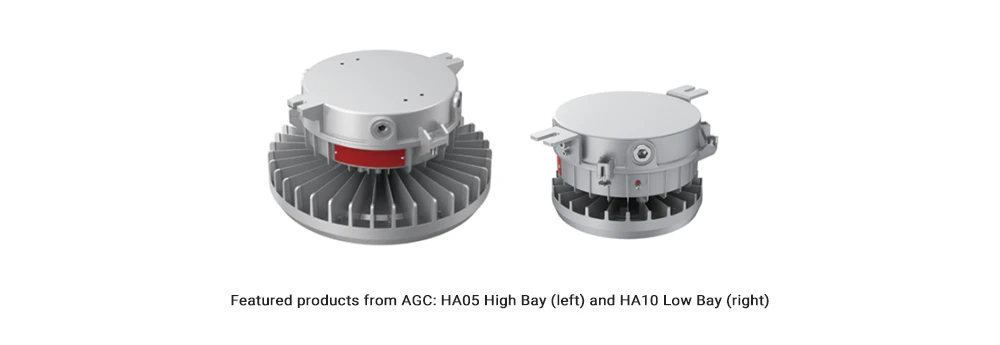
High Bay: Typically featuring a power range of 100W to over 300W, these fixtures often deliver a luminous flux exceeding 14,000 lumens. The AGC HA05 lamp can reach a maximum power of 240 watts, around 33600 lm.
Low Bay: Generally operating within a power range of 30W to 100W, low bay fixtures produce a luminous flux typically between 5,000 and 14,000 lumens. At this lower mounting height, excessively high lumen output can lead to visual fatigue for workers. AGC's HA10 is a low-bay lamp with a power range of 30W to 75W.
High Bay or Low Bay for Hazardous Sites
The choice between low bay and high bay explosion-proof LED lighting ultimately comes down to a balance of installation height, required illuminance, and the specific visual requirement in your work environment.
Whether you need precision optics for high ceilings or glare-free comfort for lower spaces, AGC’s lighting range is built to meet all your specific bay lighting requirements.
If you are standing at the base of a 10-meter refining tower or managing a high-ceiling chemical warehouse, the HA05 is your powerhouse. With output up to 240W, it’s built to pierce through the vastness of large industrial halls, ensuring that every corner of the workshop floor meets safety lux levels.
On the other hand, if you’re lighting a gas station canopy, a compact pump room, or a narrow walkway, the HA10 is the "small but mighty" answer.
Visit our website now to browse our comprehensive explosion-proof lighting catalogue!