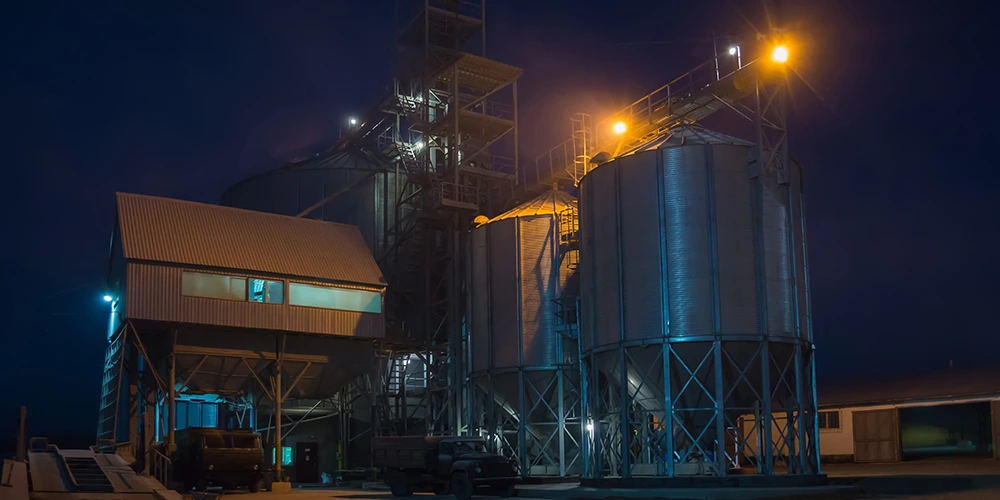
Most people still associate explosion-proof lighting primarily with oil refineries and chemical plants filled with flammable gases. This is incomplete. Serious explosion hazards can also exist in industries that handle materials such as grain, flour, starch, animal feed, and wood.
The risk comes from combustible dust.
Industry and research data commonly place the minimum explosible concentration for many agricultural dusts between roughly 20 and 65 g/m³, with values around 40–50 g/m³ frequently referenced for grain and flour dusts.
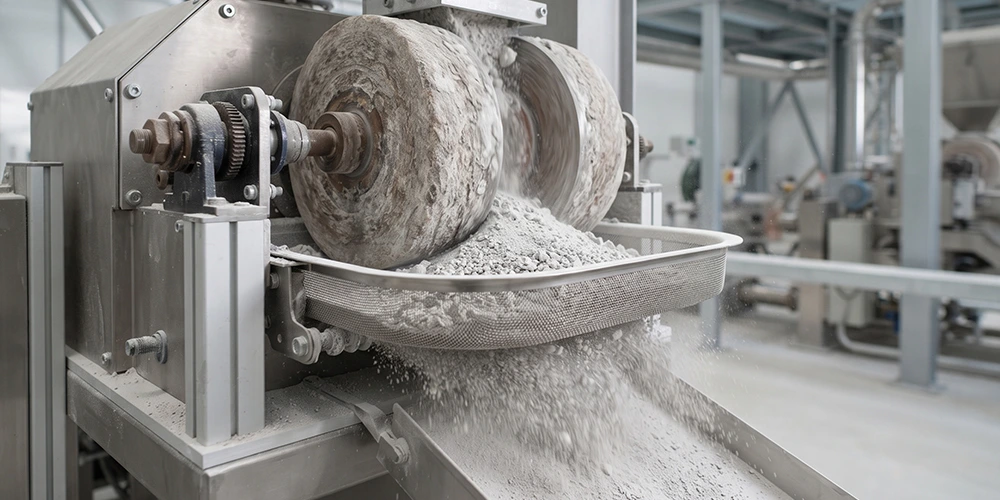
When fine particles become suspended in air at a sufficient concentration and encounter an effective ignition source, they can ignite rapidly and, under suitable conditions, cause an explosion. Dust accumulated on lighting surfaces can create additional hazards if it becomes airborne during an incident.
So, hazardous location lighting with smooth, non-accumulating geometry, dust-tight construction, and appropriate temperature ratings is critical for safety in these environments.
What Makes Combustible Dust So Dangerous?
Many materials that appear relatively harmless in bulk form can become combustible or explosive when processed into fine particles.
Such as:
- Agricultural products: Grain, corn, wheat, and other cereal products.
- Food processing materials: Flour, sugar, starch, and powdered food ingredients.
- Animal Feed: Feed ingredients and finely ground agricultural materials.
- Other industrial materials: Wood dust, paper dust, certain plastics, and combustible metal powders.
The U.S. Occupational Safety and Health Administration (OSHA) identifies five elements associated with combustible dust explosions: combustible dust, oxygen, and ignition source, sufficient dust dispersion and concentration, and confinement. This is commonly described as the dust explosion pentagon.
An important concern is secondary explosions. An initial explosion can disturb settled dust, releasing additional combustible material into the air. If that dust ignites, the resulting explosion may be more destructive than the first.
This is why dust control and routine housekeeping are important parts of a broader explosion prevention strategy.
Why Dust Accumulation Matters When Selecting Lighting?
Because dust can create interconnected risk around lighting fixtures.
First, accumulated deposits may conceal or contribute to combustible material buildup on equipment surfaces. If disturbed, this dust can become airborne and form an explosive atmosphere.
Second, a layer of dust on a lighting fixture can affect heat dissipation. Depending on the fixture design, operating conditions, and dust properties, the layer may contribute to elevated surface temperatures. If the temperature becomes sufficient to ignite the dust under the relevant conditions, the fixture can become an ignition hazard.
Third, the environment itself may be demanding. Grain handling, milling, and feed processing can expose luminaires to airborne particles, vibration, moisture, and frequent cleaning.
Hazardous-Area Classification and Dust Protection
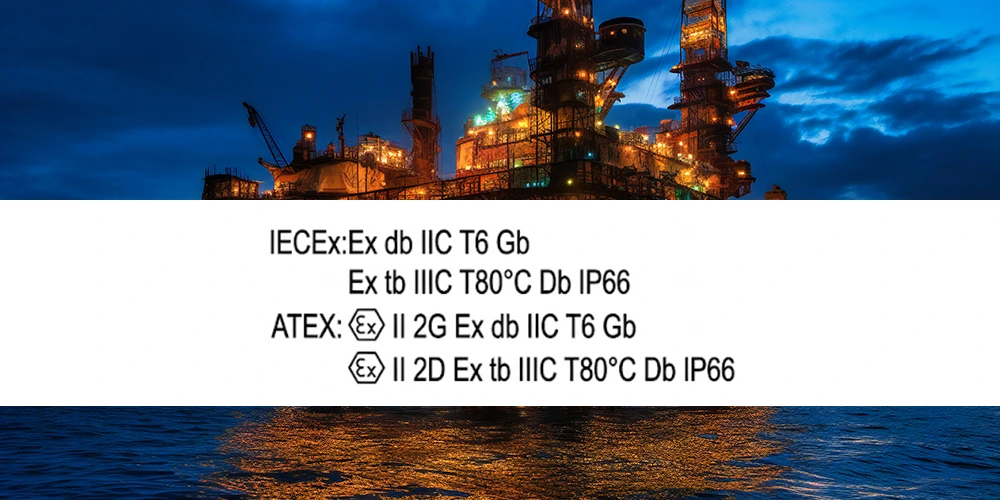
Internationally, the IEC framework provides standards for electrical equipment used in explosive atmospheres. IEC 60079 addresses equipment protected by enclosures and surface temperature limitation for use in explosive dust atmospheres.
Under the IEC/ATEX Zone system, dust hazardous areas are generally classified as follows:
|
Zone |
Description |
|
Zone 20 |
An explosive dust atmosphere is present continuously, for long periods or frequently. |
|
Zone 21 |
An explosive dust atmosphere is likely to occur occasionally during normal operation. |
|
Zone 22 |
An explosive dust atmosphere is not likely to occur during normal operation, or occurs only infrequently and for short periods. |
In Europe, ATEX Directive 2014/34/EU governs equipment and protective systems intended for use in potentially explosive atmospheres. IECEx provides an international certification scheme for equipment used in explosive atmospheres.
North America uses different hazardous-location classification and certification frameworks, including Class II designations for combustible dust.
Normally, the interiors of elevators, transfer points, and milling areas are often Zone 21 or Class II, Division 1; peripheral zones may be Zone 22 or Class II, Division 2.
Not every facility that handles powder or grain requires the same types of lighting. The correct specification depends on where and how an explosive dust atmosphere may occur.
What Should You Look for in Lighting for Combustible-Dust Environments?
Except for the certification for the intended hazardous areas, there are three considerations that deserve particular attention: surface temperature, dust ingress protection, and design and maintenance.
Surface temperature
The lighting fixture must be suitable for the ignition characteristics of the specific dust and for the conditions in which it will operate.
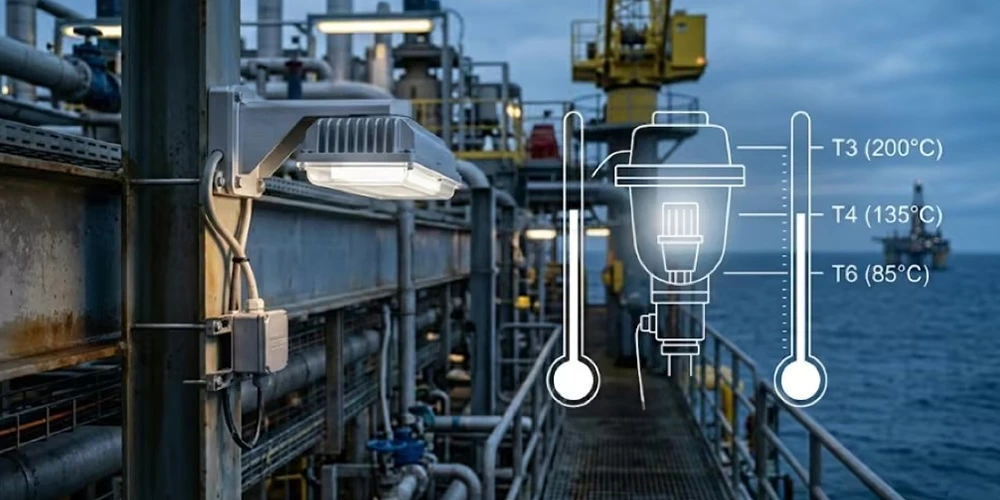
Normally, surface temperatures like T4A (120 °C) or T5 (100 °C) keep the fixture well below typical cloud and layer ignition points for agricultural dusts.
A lower surface temperature can provide a greater safety margin, but a temperature rating should never be selected in isolation from the actual hazard assessment.
Dust ingress protection
Dust entering a lighting fixture can affect its electrical and optical components and may compromise the protection on which safe operation depends.
A dust-ignition-proof / Ex t or IP66 enclosure prevents dust from entering the optical and electrical compartments.
However, IP6X indicates dust-tight protection under the relevant IP test requirements, but it is not an explosion-protection certification. The lighting fixture used in a hazardous dust area must meet the applicable explosion-protection requirements in addition to any necessary ingress protection rating.
Design and maintenance
A smooth, accessible lighting design can make inspection and cleaning easier and may help reduce dust accumulation.
But no light shape can eliminate the need for appropriate dust management. The objective is to select a lighting fixture that suits the environment and can be maintained in accordance with the instructions.