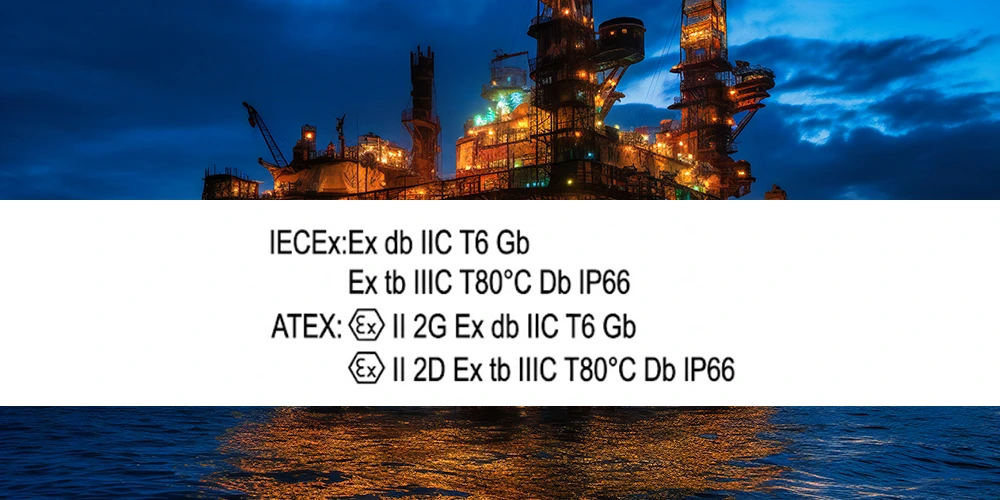

While ATEX and IECEx both rely on the international IEC 60079 standards, their markings serve different regulatory functions and contain distinct mechanical safety instructions.
If the marking does not match the zone classification, ambient temperature, and substance group on site, the installation is non-compliant, regardless of how robust the fixture looks or how attractive the price is.
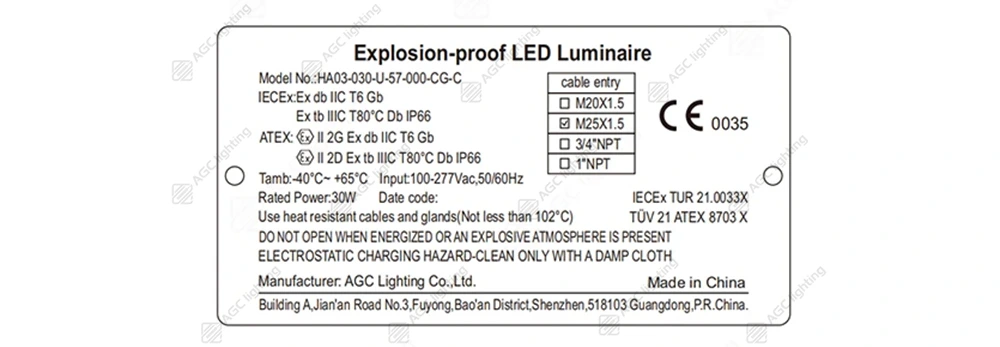
To understand how these markings work in the field, we will show you how to read the full ATEX and IECEx marking on explosion-proof LED lights, using the real nameplate from our HA03 series.
- What Is Printed on IECEx and ATEX Markings?
- How to Read IECEx Marking?
- Explosion Protection Concepts (db and tb)
- Hazard Media Groups (IIC and IIIC)
- Thermal Ratings (T6 and T80°C)
- Equipment Protection Levels: Gb and Db
- Ingress Protection (IP66)
- What Does ATEX Marking Add?
- CE Mark and Notified Body Number
- The Community Hexagon Symbol
- Equipment Group (II)
- Equipment Categories (2G and 2D)
- How Do You Verify the Certificate?
What Is Printed on IECEx and ATEX Markings?
Below is the certified rating plate stamped onto the housing of our HA03 explosion-proof light. This plate displays two certification bodies: ATEX for statutory compliance in the European Union, and IECEx for international mutual recognition.
Protection concept, gas group, temperature class, and production level are printed on the markings. Each segment answers a different site question, so let’s check them separately.
How to Read IECEx Marking?

Explosion Protection Concepts (db and tb)
Flameproof Enclosure: Ex db
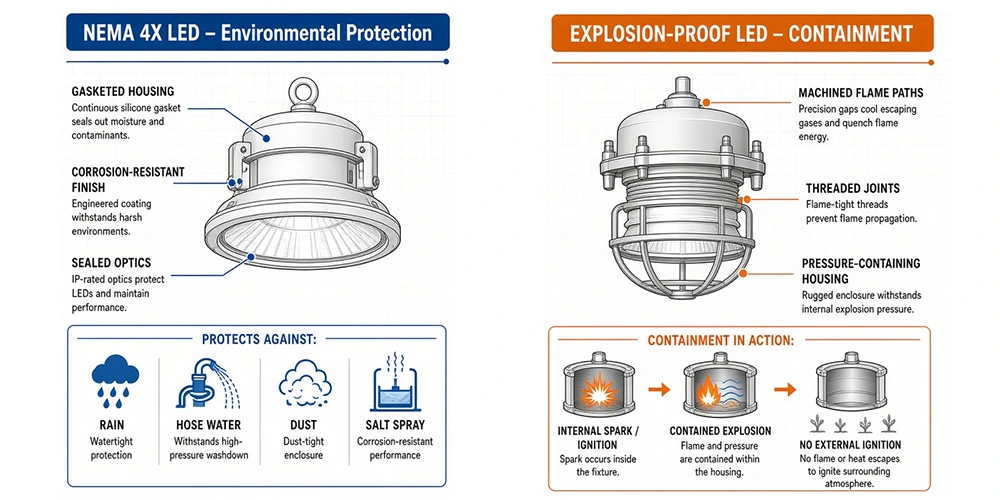
The luminaire's heavy cast housing is a flameproof enclosure. If flammable vapor enters the fixture and an internal electrical spark causes an explosion, the housing contains the mechanical pressure.
Machined flame paths along the threaded covers and joints cool escaping combustion gases below the ignition temperature of the surrounding atmosphere before they reach the outside air.
Protection by Enclosure: Ex tb
For combustible dust, containment is not the objective; exclusion is. The Ex tb method relies on precision continuous elastomeric gaskets and threaded seals to prevent explosive dust from contacting internal hot electronics.
Hazard Media Groups (IIC and IIIC)
Industrial gases are classified by their ignition energy and flame propagation speeds:
- Group IIA: Propane, butane (high ignition energy, easy to contain).
- Group IIB: Ethylene, town gas (moderate ignition energy).
- Group IIC: Hydrogen, acetylene, carbon disulfide (lowest ignition energy, highest flame speed).
A rating of IIC is the most stringent gas classification. Because gas groups are backward-compatible, an IIC certified light can safely be installed in IIB and IIA environments.
Combustible dusts are grouped by particle size and electrical conductivity:
- Group IIIA: Combustible flyings (e.g., cotton fibers, lint).
- Group IIIB: Non-conductive dusts (e.g., grain, flour, wood dust).
- Group IIIC: Conductive dusts with electrical resistivity equal to or less than 10^3Ωm (e.g., carbon black, coal dust, aluminum powder).
The HA03 carries a IIIC rating, making it suitable for conductive dust atmospheres as well as non-conductive and fibrous locations.
Thermal Ratings (T6 and T80°C)
Industrial LED luminaires dissipate heat through their outer metal housing. If the fixture surface temperature exceeds the auto-ignition point of surrounding vapors or dust layers, an explosion will occur without any spark.
- Gas Rating (T6): The maximum surface temperature of the enclosure will not exceed 85°C under worst-case electrical and ambient conditions. This represents the safest standard rating on the market.
- Dust Rating (T80°C): For dust atmospheres, standard practice under IEC 60079-31 requires stating the exact maximum surface temperature in degrees Celsius rather than a generic T-class. Under maximum load, this fixture's exterior will not exceed 80°C.
Equipment Protection Levels: Gb and Db
EPL codes define the protection level independent of the installation zone:
- Gb: High protection level for gas equipment. Remains safe during normal operation and anticipated operational faults. Suitable for Zone 1.
- Db: High protection level for dust atmospheres. Safe during normal operation and frequent disturbances. Suitable for Zone 21.
Ingress Protection (IP66)
Rated to IEC 60529, IP66 indicates:
- First digit (6): Completely dust-tight. No ingress of dust under vacuum test conditions.
- Second digit (6): Protected against heavy seas or powerful water jets (100 kPa pressure at 100 liters per minute) from any direction.
What Does ATEX Marking Add?

CE Mark and Notified Body Number
The CE mark confirms the luminaire complies with all applicable European Union directives. The four-digit number 0035 identifies the Notified Body responsible for auditing the factory's quality assurance system (ATEX Quality Assurance Notification, or QAN).
The Community Hexagon Symbol
This hexagonal mark is the mandatory symbol denoting equipment engineered for explosive atmospheres under European Directive 2014/34/EU.
Equipment Group (II)
Explosion-proof equipment is separated into two primary installation groups:
- Group I: Underground mining applications susceptible to firedamp (methane) and coal dust.
- Group II: Surface industrial applications, including refineries, chemical processing plants, offshore platforms, grain elevators, and paint spray facilities.
The HA03 is certified for Group II surface facilities.
Equipment Categories (2G and 2D)
The category defines the level of operational safety and directly governs which hazardous zone the light may enter:
- II 2G (Gas): Category 2 equipment provides a high level of protection.
It is certified for areas where explosive gas atmospheres are likely to occur in normal operation (Zone 1). By regulatory hierarchy, Category 2G equipment is also permitted in Zone 2.
- II 2D (Dust): Certified for areas where combustible dust clouds or layers are likely to occur in normal operation (Zone 21). It is also permitted in Zone 22.
Because the HA03 carries both 2G and 2D markings, it is a dual-rated fixture qualified for both combustible gas and combustible dust zones.
How Do You Verify the Certificate?
The marking is only as good as the certificate behind it.
For IECEx, enter the certificate number in the official IECEx online database (iecex-certs.com) and confirm the status is “In Force.”
For ATEX, the Notified Body number next to the CE mark identifies the organization that audited the quality system.
For more details, check our previous post about Explosion-proof Certification Verification Methods.
Need assistance validating lighting schedules against your hazardous area classification drawings?
Contact us for a complete plan review, thread verification, and photometric layout.