
Offshore platforms operate in an extremely harsh marine environment, with constant salt spray, high humidity, corrosive industrial fumes and persistent vibration being daily challenges. For explosion-proof luminaires used here, corrosion resistance is just as critical as explosion protection performance, it directly determines the service life of the luminaires, the safety of on-site operations, and the long-term maintenance costs of enterprises.
The C1 to C5 corrosion resistance ratings are the universal standard for evaluating the anti-corrosion capability of industrial explosion-proof luminaires, and there is a dedicated marine-grade C5 rating for offshore marine scenarios. This guide explains these ratings in plain language, clarifies the suitable rating for each area of an offshore platform and shares practical selection considerations, with no obscure professional jargon, so every reader can get clear and useful procurement insights.
What Are C1-C5 Corrosion Resistance Ratings?
The C1 to C5 corrosion ratings are a global grading system that defines the corrosive intensity of a working environment and the corresponding anti-corrosion protection level required for industrial equipment such as explosion-proof luminaires. The core rule is simple: the higher the rating number, the stronger the luminaire’s anti-corrosion ability.
For offshore applications, the C5 rating is divided into two types that cannot be confused: C5 is the marine-specific grade, optimized for the salt spray and marine atmospheric erosion unique to offshore environments.
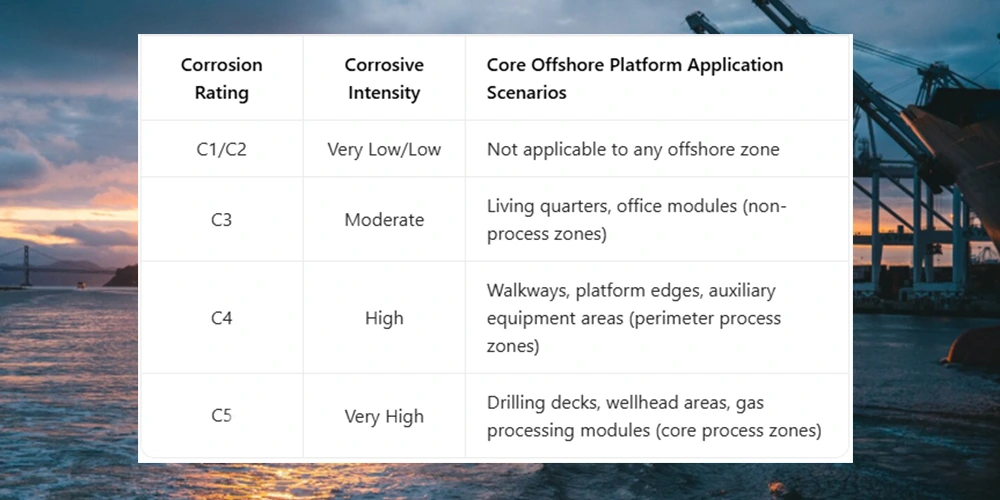
Most of the C1-C5 ratings are not suitable for offshore platforms; only three grades meet the basic marine anti-corrosion requirements, while C1 and C2 are completely inapplicable—they are designed for dry, low-corrosion indoor land areas and will rust and fail rapidly when exposed to marine salt spray.
The following table clearly lists the corrosion ratings relevant to offshore platforms and their core application scenarios, eliminating complex parameter descriptions for easy quick reference:
How to Select the Right Corrosion Rating for Different Offshore Platform Zones
An offshore platform is not a homogeneous environment, and the corrosive intensity varies greatly between different functional areas. Blindly choosing the C5 rating for all zones will lead to unnecessary procurement cost increases, while choosing a low rating for high-corrosion core areas will cause frequent luminaire failure, increased maintenance workload and even potential safety hazards due to damaged explosion-proof structures.
The most scientific selection method is to match the corrosion resistance rating to the actual environmental conditions of the installation zone.
For the non-process zones such as living quarters and office modules on offshore platforms, the environment is relatively mild—there is only light salt spray exposure, the humidity is artificially controlled, and there is no contact with corrosive industrial fumes. For these areas, C3 is the most cost-effective choice, and its moderate anti-corrosion performance is fully sufficient to meet long-term use requirements without over-investment.
Perimeter process zones including platform walkways, edge areas and auxiliary equipment zones face more severe conditions, with continuous moderate salt spray, high natural humidity and mild equipment vibration, and occasional light exposure to industrial fumes. C4 is the ideal rating for these areas, providing strong enough anti-corrosion performance to resist daily marine wear and tear, and effectively preventing luminaire rust and seal damage caused by the environment.
Core process zones such as drilling decks, wellhead areas and gas processing modules bear the most extreme marine corrosion on the entire platform. These areas are exposed to constant high-concentration salt spray, high humidity and corrosive fumes such as H₂S and CO₂ for a long time, accompanied by strong vibration from equipment operation, and even occasional seawater splashing. For these zones, C5 is a mandatory choice—it is the only rating specially engineered for offshore extreme corrosive conditions, and can effectively prevent catastrophic corrosion of luminaires, ensuring that the explosion-proof safety performance remains intact for a long time.

Key Practical Considerations for Offshore Explosion-Proof Luminaire Selection
The C1-C5 rating is the basic standard for evaluating the anti-corrosion performance of explosion-proof luminaires, but even if the rating is matched, the luminaire will still underperform or fail early in the marine environment if it lacks targeted design and material selection for offshore scenarios. Several key details directly determine the real-world durability and reliability of the luminaire on offshore platforms.
Prioritize luminaires with 316L stainless steel housings. This material has excellent resistance to salt spray and pitting corrosion, and can remain intact for a long time in the marine environment. Ordinary aluminum alloys or low-grade steel will rust and deform quickly when exposed to salt spray, and even damage the explosion-proof structure of the luminaire.
For seal components, FKM or FFKM rubber seals are the best choice—these materials are specially formulated for marine corrosion resistance, and will not harden, crack, or rot due to long-term contact with salt spray and high humidity, unlike ordinary rubber seals that lose their sealing performance in a short time.
Anti-condensation design is a non-negotiable feature for offshore explosion-proof luminaires. The high humidity on offshore platforms easily causes internal condensation of luminaires, which is an invisible killer of internal electrical circuits and components, and may even lead to short circuits and equipment failure. Luminaires with built-in breathing valves or removable desiccant packs can effectively balance internal and external air pressure and absorb moisture, avoiding water buildup inside the luminaire and ensuring the stable operation of internal components.
Avoid luminaires with exposed metal fasteners such as bolts and screws. These parts are easy to rust in the marine environment, and even seize up over time, making subsequent maintenance and inspection work difficult. Recessed stainless steel fasteners are a more suitable choice—they not only have strong anti-corrosion performance, but also remain easy to disassemble and assemble, which is convenient for on-site routine maintenance.
Core Takeaways for Offshore Platform Explosion-Proof Luminaire Selection
For explosion-proof luminaires used on offshore platforms, corrosion resistance is closely linked to operational safety and cost efficiency. Cutting corners on anti-corrosion performance will not only lead to frequent luminaire replacement and increased maintenance costs, but also may cause damage to the explosion-proof structure due to corrosion, bringing serious safety hazards to on-site operations.
The most basic and important rule is to never use C1 or C2 rated luminaires on offshore platforms—they are not designed for any marine environment and will fail rapidly. The core selection principle is to match the rating to the zone: C3 for living and office non-process zones, C4 for perimeter process zones such as walkways, and C5 for all core process zones with extreme corrosion conditions.
Beyond the rating itself, it is necessary to focus on the marine-specific design details of the luminaire: 316L stainless steel housing, FKM/FFKM seals and anti-condensation functions are the three key points that ensure the luminaire can perform stably in the real offshore environment. There is no need to be a corrosion engineering expert to choose the right explosion-proof luminaire—following these simple and practical guidelines can help enterprises avoid procurement pitfalls, reduce long-term operation and maintenance costs, and ensure consistent and safe lighting for all offshore operations.
AGC Lighting’s C3, C4 and C5 series explosion-proof luminaires are all custom-designed for the unique challenges of offshore platform environments, integrating reliable explosion-proof performance with marine-grade anti-corrosion design in every component and process. If you are unsure how to match the right corrosion rating or luminaire model to the different zones of your offshore platform, our technical team is ready to provide free, customized product recommendations and solutions tailored to your specific operational needs.