
In the field of industrial lighting, particularly in LED luminaire design for Hazardous Locations, "Power adjustable" functionality has become a core feature for enhancing project flexibility and reducing inventory pressure. To meet diverse global industry standards and field maintenance practices, AGC Lighting utilizes two mainstream power adjustment terminals across its product lines: Plug-in and DIP Switch.
This article provides an in-depth analysis of the differences between these two technologies across three dimensions: hardware structure, operational workflow, and environmental adaptability.
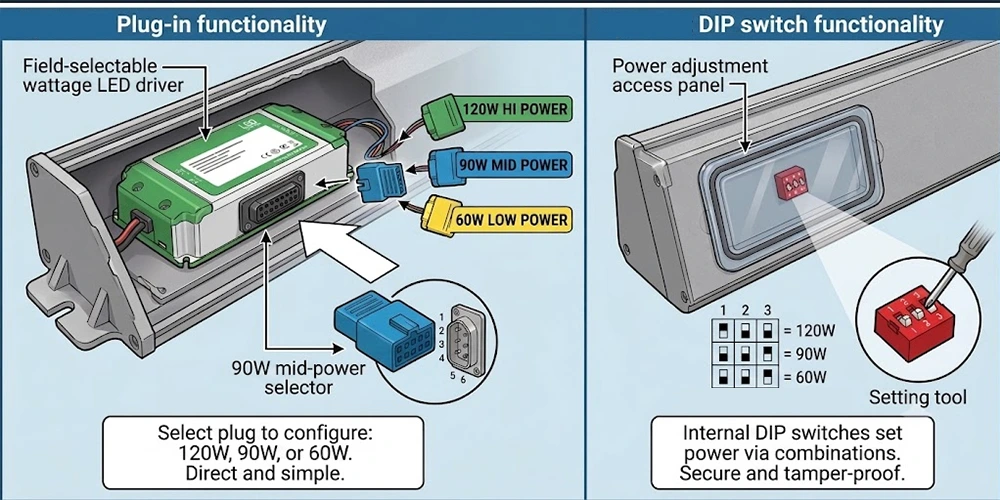
Differences in Hardware Structure and Circuit Principles
Although the ultimate goal of both is to alter the output current of the LED driver, they are distinct in their physical implementation.
Plug-in Linker: This solution utilizes a set of physical jumper links. Different resistance circuits are preset in parallel on the PCB, and a specific power setting is activated by connecting a white plug (Linker) equipped with a locking mechanism. This design transforms the power setting into a "hardware-locked" state, ensuring extremely direct electrical connections.
DIP Switch: This solution employs a highly reliable 3-level sliding switch. The switch integrates complex internal contact logic, switching internal circuits through the physical displacement of the sliders. This design highly integrates multiple levels into a single modular component, offering a more modern industrial aesthetic.
Differences in Field Operational Workflow
In the actual installation and commissioning process of explosion-proof luminaires, the interaction methods of the two are distinctly different.
Plug-in: Physical Positioning Adjustment
Operational Process: Installers need to pull out the plug with lead wires and re-insert it into the socket aligned with the silkscreen markings (e.g., 100%, 75%, 50%).
Tactile Feedback: It features a distinct mechanical "click" or locking sensation, ensuring the plug is fully seated. This "unplug and re-insert" action provides a high level of visual and tactile confirmation, effectively preventing contact risks caused by incomplete switching.
DIP Switch: One-Touch Rapid Adjustment
Operational Process: There is no need to remove any parts; the black slider is simply toggled left or right to the corresponding scale using a fingertip or a small commissioning tool.
Efficiency Performance: In large-scale project sites requiring the batch adjustment of hundreds of luminaires, the operational speed advantage of the sliding switch is significant, and there is no concern about losing small plug-in accessories during the process.
Analysis of Environmental Adaptability and Application Scenarios
As a professional supplier of explosion-proof lighting, we apply these two types of terminals to different product series based on the characteristics of various industrial environments:
Scenario A: Extreme Vibration and Impact Environments
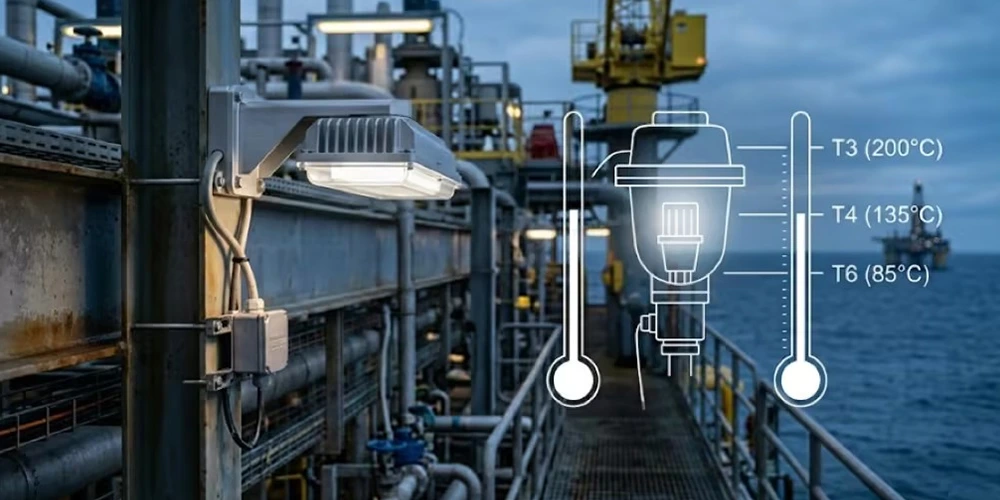
In environments such as offshore drilling platforms and large vibrating screeners, equipment faces continuous high-frequency vibration. The Plug-in terminal, with its physical connection featuring a locking buckle, demonstrates exceptional reliability. Since it has no sliding contacts, it maintains absolute stability of the current signal even under long-term vibration.
Scenario B: High-Frequency Commissioning and Standardized Warehousing
In standardized warehousing projects in North America or Europe, customers often need to rapidly fine-tune power on-site based on actual illuminance requirements. The integrated design of the DIP Switch terminal allows non-technical personnel to complete large-scale gear switching in a short time, significantly reducing labor costs.
Diverse Choices to Meet Global Customer Needs
At AGC Lighting, we do not define which terminal is "better," as every design is engineered to solve specific field challenges.
Balance of Reliability and Efficiency: By offering both "Plug-in" and "DIP Switch" solutions, we have found the ideal balance between the absolute mechanical stability required for heavy industrial sites and the high-efficiency operation and maintenance sought by modern logistics projects.
Precise Matching of Application Scenarios: For hazardous locations facing extreme vibration, the hardware locking mechanism of the plug-in terminal provides a stronger safety guarantee. Conversely, for standardized warehousing requiring rapid response to illuminance requirements, the DIP switch terminal significantly reduces labor costs and operational difficulty.
Empowering Global Customers: This differentiated technical application not only enhances the field adaptability of our products but also helps global customers effectively reduce inventory pressure and achieve more sustainable industrial lighting solutions through flexible power adjustment functions.