
When the primary power fails, emergency lighting isn't just a convenience—it's a critical life safety system. It guides occupants to safety, allows for orderly shutdowns of equipment, and prevents panic in critical moments. However, not all emergency lighting fixtures are created equal. Selecting the right one involves more than just picking a light; it's about choosing a reliable safety component tailored to your specific environment.
This guide will walk you through the key considerations to ensure you select an emergency lighting fixture that meets codes, suits your application, and delivers reliable performance when it matters most.
Understanding Your Core Needs: The Three Key Questions
Before comparing products, define your requirements by answering these questions:
1. What is the Application Environment?
Is it a standard commercial office, a humid warehouse, a refrigerated cold storage, or a hazardous area with flammable gases or dusts (like a paint booth or grain silo)? The environment dictates the required Ingress Protection (IP) rating and potentially an explosion-proof certification.
2. What is its Primary Function?
Emergency lighting serves two main purposes:
Escape Route Lighting: Illuminates corridors, stairwells, and exits to ensure safe egress. This is often governed by strict minimum illuminance levels (e.g., 1 lux on the centerline of an escape route).
Standby / Safety Lighting: Provides minimal light in high-risk work areas to allow for safe shutdown procedures and prevent accidents during a blackout.
3. What are the Local Regulations & Certifications?
Compliance is non-negotiable. Key standards include:
- UL 924 (USA & Canada): The benchmark for emergency lighting and power equipment.
- EN 60598-2-22 (Europe & International): Specific safety standard for emergency luminaires.
- Local Building & Fire Codes: Always consult the latest national and local codes for duration requirements illumination levels, and testing protocols.
Key Selection Criteria: Beyond Basic Lumens
Once your needs are clear, evaluate fixtures on these critical parameters:
| Criterion | What to Look For & Why |
| Light Type & Efficacy | Modern LEDs are the unequivocal choice. They offer instant start, superior energy efficiency, long lifetime, and excellent vibration resistance compared to fluorescent or halogen options. |
| Battery Technology & Runtime | Lithium Iron Phosphate (LiFePO4) batteries are becoming the standard for their safety, long cycle life (2000+ cycles), stability, and excellent performance across a wide temperature range. Ensure the fixture meets the mandated 90-minute runtime at the required light output after a full charge. |
| Operational Mode |
Non-Maintained: Lights only during power failure. Common for escape routes. Maintained: Can be used as normal lighting and stays on during failure. Essential for cinemas, theaters, or venues where sudden darkness is dangerous. Sustained: Combines two separate driver—one for normal AC power, one for emergency DC power—within a single housing. |
| Durability & Protection | Check the IP (Ingress Protection) rating (e.g., IP66 for dust-tight and jet water resistance) and IK (Impact Protection) rating. |
Special Consideration: Emergency Lighting for Hazardous Areas
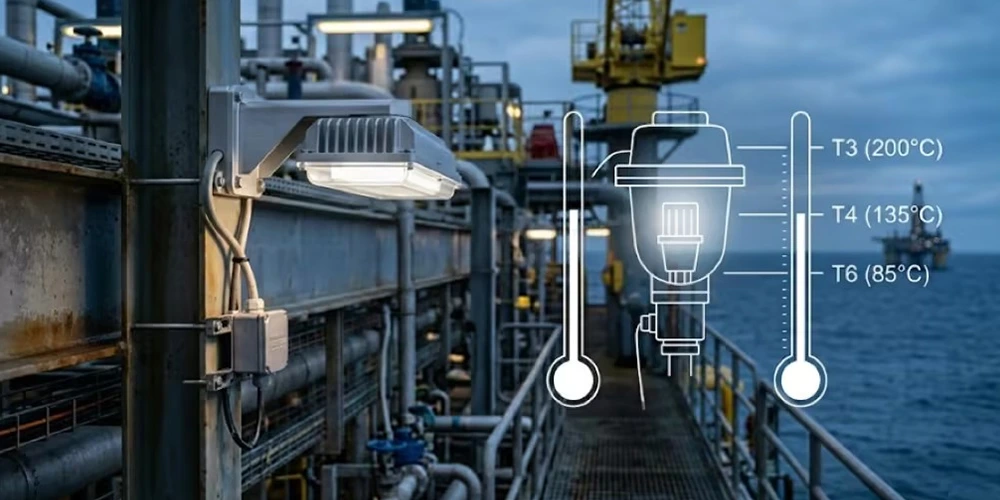
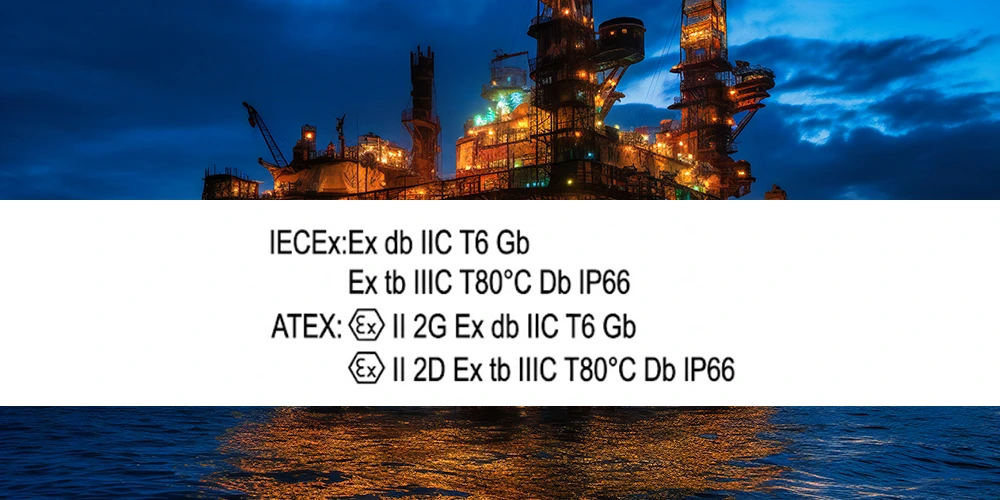
In locations with explosive atmospheres (classified as Zones 1, 2, 21, 22 or Divisions 1, 2), the emergency fixture must carry the same explosion-proof certification (e.g., ATEX, IECEx, UL 844) as your standard lighting. It becomes a dual-purpose luminaire that operates daily as a standard light and automatically switches to its emergency battery mode during a power outage. Key features here include:
- Certified explosion-proof enclosure (e.g., Ex d, Ex de).
- Intrinsically safe or explosion-proof battery compartment.
- Thermal management designed to keep surface temperatures within the certified T-rating.
A Simple 4-Step Selection Checklist
- Define & Classify: Pinpoint the location, its function (escape/standby), and any environmental hazards.
- Verify Compliance: Confirm the fixture holds the necessary safety certifications and explosion-proof marks if needed.
- Specify Performance: Determine required brightness (lumens/lux), runtime (90+ min), battery type (LiFePO4), and protection ratings (IP66).
- Plan for Lifecycle: Opt for high-quality LEDs with long warranties, consider self-test functionality to reduce operational costs, and ensure ease of maintenance.
Selecting the right emergency lighting is an investment in safety and risk mitigation. By taking a systematic approach that prioritizes environmental suitability, regulatory compliance, and technical performance, you secure not just a product, but a reliable guardian for your people and assets in an emergency.
Need help specifying emergency lighting for a complex or hazardous environment? Contact our lighting specialists for a consultation tailored to your project's specific codes and challenges.