
- Surge Protection ≠ Lightning Protection—What Are the Core Differences?
- Explosion-Proof Light Drivers: Why Must 6kV Surge Protection Be Achieved?
- Core Design Points of Explosion-Proof Drivers for 6kV Surge Protection Technology
- 1. Protection Topology: Common-Mode + Differential-Mode Dual Protection
- 2. Component Selection: Balancing Stability and Weather Resistance
- 3. PCB Layout: Preventing Surge Energy from Intruding into the Core Circuit
- 4. Coordination with Explosion-Proof Structure
- 3 Key Judgment Standards for Surge Protection of Explosion-Proof Lights
- 1. Confirm the Test Standard for Surge Protection
- 2. Check Whether Certifications Include Surge Protection Tests
- 3. Check Protection Redundancy in High-Temperature and Humid Environments
- Surge Protection Is the "Invisible Shield" of Explosion-Proof Safety
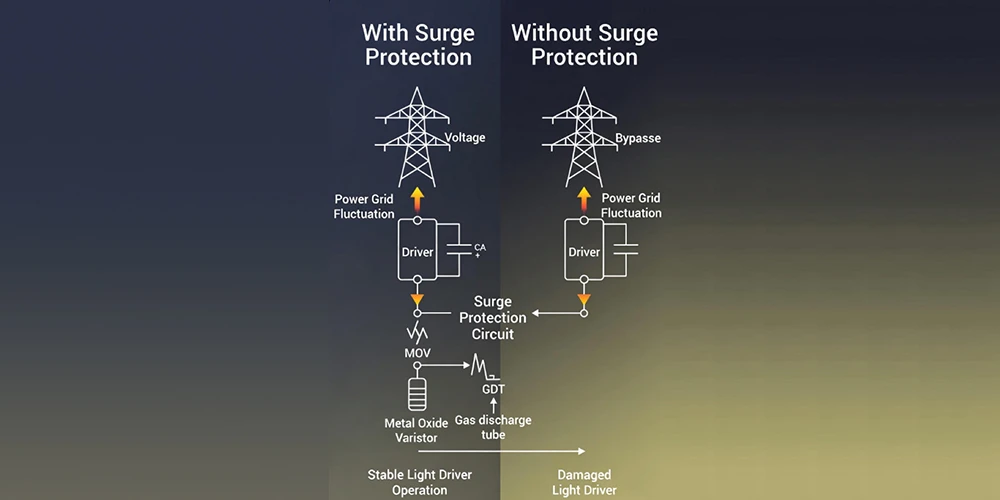
In explosion-proof environments (such as chemical plants, gas stations, and dust workshops), the safe operation of explosion-proof lights relies not only on the explosion-proof structure of the housing and temperature control but also on the "surge protection capability" of their core component—the driver power supply, which is an indispensable safety bottom line. However, there is a common misunderstanding in the industry: equating "surge protection" with "lightning protection," assuming that basic lightning protection functions are sufficient to address risks.
In fact, surge sources in industrial scenarios are far more than just lightning. Grid operations, equipment start-stop, electromagnetic interference, and other factors can all generate transient high-voltage surges.
As the core surge protection threshold for industrial-grade explosion-proof equipment, 6kV directly determines the stability of the driver power supply and the safety redundancy of the lights. For explosion-proof equipment practitioners, engineering and technical personnel, or purchasers, clarifying the difference between surge protection and lightning protection, and understanding the technical logic of 6kV protection, is crucial for selecting compliant products and avoiding safety risks. This article will use plain language to dissect the 6kV surge protection technology for explosion-proof light drivers, helping you understand its core value and design key points.
Surge Protection ≠ Lightning Protection—What Are the Core Differences?
When discussing the protection performance of explosion-proof lights, "surge protection" and "lightning protection" are often confused, but they differ essentially in coverage and protection objects—lightning protection is only a "subset" of surge protection, while industrial explosion-proof scenarios require full-dimensional surge protection.
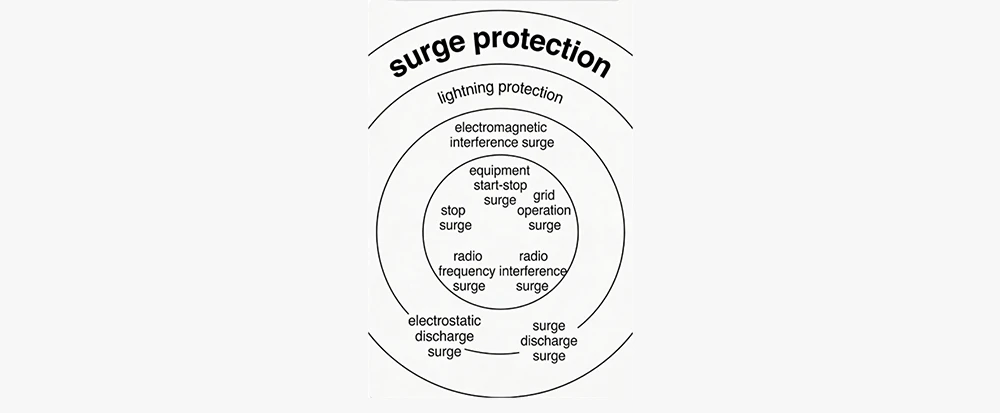
First, we need to clarify two core concepts: a surge refers to an instantaneous peak voltage/current in a circuit, which has an extremely short duration (microsecond level) but enormous energy, enough to break down electronic components; lightning surge is only one type of surge, generated by lightning striking lines or induction, with a peak value of up to several hundred kilovolts but a low occurrence probability.
In industrial explosion-proof environments, more common surges come from "internal grid disturbances": for example, the start-stop of high-power equipment (such as frequency converters, motors) in factories can cause sudden changes in grid voltage, generating transient surges of 2-6kV; switching operations of power distribution systems can also trigger operational surges; even electromagnetic coupling between lines and electrostatic discharge can form low-peak but high-frequency surge impacts.
Although these "non-lightning surges" have lower peaks than lightning, they occur extremely frequently. Long-term accumulation will gradually wear out the components of the driver power supply, eventually leading to driver damage—in explosion-proof environments, short circuits or breakdowns of the driver board may generate electric sparks or local high temperatures, directly becoming ignition sources for flammable gases and dust, and triggering safety accidents.
According to the international standard IEC 61000-4-5 (Electromagnetic Compatibility - Surge Immunity Test), electrical equipment in industrial environments must withstand at least 4kV differential-mode and 6kV common-mode surge impacts. As high-safety-grade products, explosion-proof equipment must meet the surge protection requirements of 6kV and above. This threshold is set based on the most extreme internal surge peaks in industrial scenarios, ensuring the stable operation of the driver power supply under frequent disturbances. Simply put, "lightning protection" can only handle occasional lightning surges, while "6kV surge protection" covers all possible surge risks in industrial environments, serving as the "basic safety configuration" for explosion-proof light drivers.
Explosion-Proof Light Drivers: Why Must 6kV Surge Protection Be Achieved?
The core difference between explosion-proof lights and ordinary industrial lights lies in "safety redundancy"—the damage of ordinary light drivers at most causes light failure, while the damage of explosion-proof light drivers may directly trigger safety accidents. The setting of the 6kV surge protection threshold is not an arbitrary industry agreement but is based on the risk characteristics of explosion-proof scenarios and mandatory requirements of international standards, serving as the "lifeblood" to ensure driver safety.
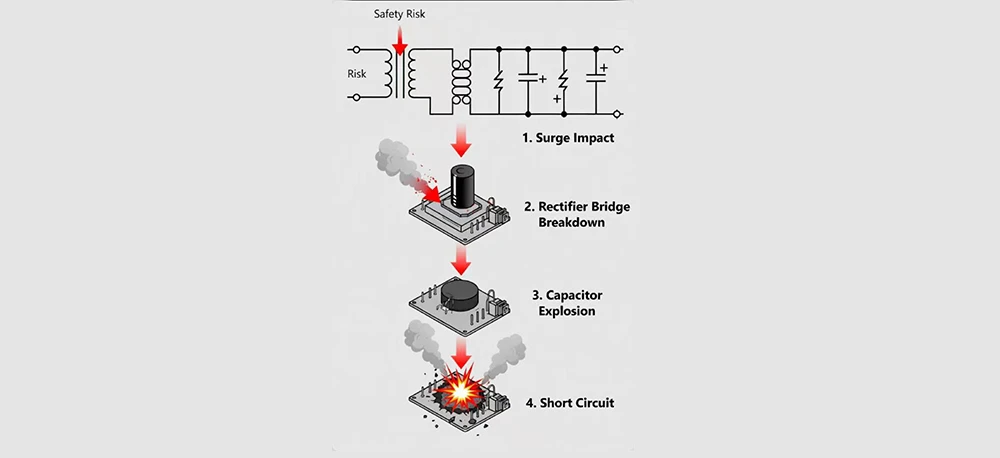
First, from the core requirement of explosion-proof safety, the driver power supply of explosion-proof lights must meet the requirement of "no ignition source under fault conditions." The rectifier bridges, MOS tubes, capacitors, and other components on the driver board usually have a voltage withstand value between 2-4 kV. Once hit by a surge voltage exceeding the withstand value, the components will be instantly broken down, causing short circuits or local discharges. The generated electric sparks can reach hundreds of degrees Celsius, enough to ignite surrounding flammable gases (such as methane, hydrogen) or flammable dust (such as flour, coal dust). The core function of the 6kV surge protection circuit is to discharge excess energy before the surge voltage reaches the withstand limit of the components, ensuring that the core circuit of the driver board is not impacted.
Second, 6kV is the "extreme surge peak" in industrial scenarios. According to research data from the International Electrotechnical Commission (IEC), more than 95% of internal surge peaks in industrial power grids are concentrated between 2-6 kV. Among them, in workshops with dense equipment such as frequency converters and motors, surge peaks often approach 6kV. If the surge protection of the explosion-proof light driver is lower than 6kV, it means that effective protection cannot be provided under extreme working conditions, and the probability of driver damage will increase significantly. In addition, the service life of explosion-proof lights is usually 5-10 years. Long-term exposure to frequent low-peak surges, even if not directly broken down, will accelerate component aging, shorten driver life, and increase later maintenance risks and safety hazards.
Finally, international explosion-proof standards (such as IEC 60079, ATEX 2014/34/EU) clearly require that the power supply components of explosion-proof electrical equipment must pass surge immunity tests, among which the test level for industrial environment equipment is not lower than 6kV (common-mode). If the product fails to meet this requirement, it cannot pass explosion-proof certification, let alone be used in hazardous environments. For enterprises, using explosion-proof lights that do not meet surge protection standards not only faces compliance risks but may also cause safety accidents due to equipment failures, resulting in irreparable losses.
Core Design Points of Explosion-Proof Drivers for 6kV Surge Protection Technology
6kV surge protection cannot be achieved by simply adding a lightning protection component but requires systematic design from multiple dimensions, such as topology structure, component selection, PCB layout, and explosion-proof coordination. It is necessary to ensure the rapid discharge of surge energy without affecting the explosion-proof performance and operational stability of the lights.
1. Protection Topology: Common-Mode + Differential-Mode Dual Protection
Industrial surges are divided into "common-mode surges" (surges between two live wires and the ground wire) and "differential-mode surges" (surges between live wires). Both may occur simultaneously, so explosion-proof drivers must adopt a "common-mode + differential-mode" dual protection topology. The core design logic is: parallel protection components at the input end of the driver power supply. When the surge voltage exceeds the set threshold, the components conduct quickly, discharging the surge current to the ground or consuming it through a short-circuit path, preventing it from entering the subsequent rectification, filtering, and inverter circuits.
For example, parallel gas discharge tubes and varistors (common-mode protection) between live wires and the ground wire, and parallel TVS diodes (differential-mode protection) between live wires: gas discharge tubes are responsible for discharging high-energy surges (such as lightning-induced surges), varistors quickly respond to medium and low-energy surges (such as grid operation surges), and TVS diodes accurately intercept high-frequency low-energy surges. The three cooperate to form "gradient protection," ensuring that surges of 6kV and below can be effectively absorbed.
2. Component Selection: Balancing Stability and Weather Resistance
The quality of protection components directly determines the reliability of surge protection, and the particularity of explosion-proof environments (high temperature, humidity, corrosion, and long-term continuous operation) places higher requirements on components. Taking varistors, a core component, as an example: ordinary industrial-grade varistors have a significantly accelerated aging rate in environments above 85℃, while the working temperature of the driver board of explosion-proof lights may reach 60-100℃. Therefore, "explosion-proof special high-temperature varistors" must be selected, with a temperature resistance grade of not less than 125℃, and performance attenuation of no more than 10% after 1000 surge impact tests.
In addition, TVS diodes should select transient voltage suppressor diodes with a response speed of ≤1ns to ensure rapid conduction within the microsecond-level time when surges occur; gas discharge tubes should have low ignition voltage and high follow current interruption capability to avoid continuous discharge after surges. All components must pass explosion-proof certifications such as ATEX and IECEx to ensure that no ignition source is generated under fault conditions.
3. PCB Layout: Preventing Surge Energy from Intruding into the Core Circuit
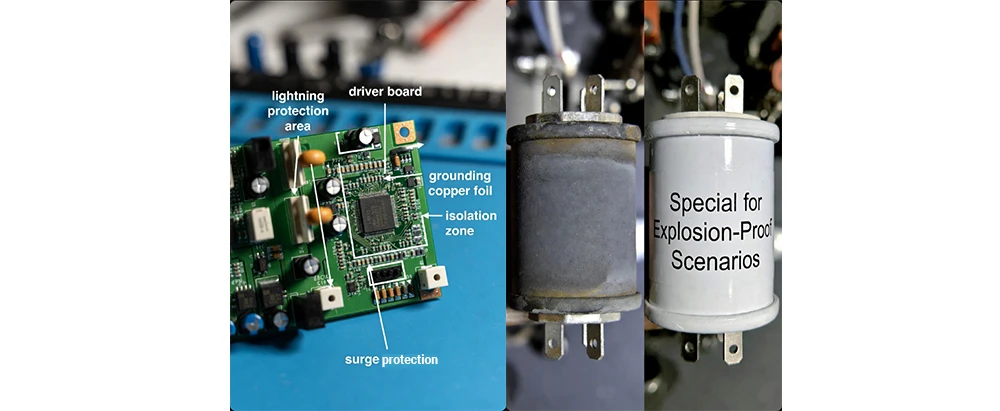
Even with proper topology and component selection, an unreasonable PCB layout can lead to ineffective surge protection. The PCB layout of explosion-proof drivers must follow the principle of "lightning protection area division": divide the input protection circuit into a "high-energy area" and the core circuits such as rectification and inversion into a "low-energy area," with an isolation zone (width ≥5mm) between them to prevent surge energy from intruding into the core circuit through PCB copper foil.
At the same time, grounding design is crucial: the width of the grounding copper foil of the protection circuit should not be less than 3mm, and a "single-point grounding" method should be adopted to ensure that surge current can be quickly discharged to the ground, avoiding the formation of ground loop interference; the grounding pins of core components should be close to the grounding copper foil to shorten the current path and reduce the loss of surge energy on the path. In addition, the PCB board should use materials with a flame-retardant grade of not less than UL94 V-0 to prevent local high temperatures caused by surges from igniting the board.
4. Coordination with Explosion-Proof Structure
The driver power supply of explosion-proof lights is usually integrated into the explosion-proof housing. The design of the surge protection circuit must coordinate with the explosion-proof structure of the housing: the installation position of protection components should not affect the sealing performance of the housing (such as the gap of the flameproof surface, the compression of the sealing gasket); the heat generated during surge current discharge must be effectively dissipated through the housing to avoid local temperature exceeding the maximum surface temperature limit of the light (such as T4 grade ≤135℃); at the same time, the wire connection of the protection circuit should use explosion-proof cable glands to prevent flammable gases from entering the housing through wire holes.
3 Key Judgment Standards for Surge Protection of Explosion-Proof Lights
When selecting explosion-proof lights with 6kV surge protection, many users easily fall into the trap of "only looking at parameter labels and ignoring actual performance." The following 3 key judgment standards can help you avoid most selection pitfalls:
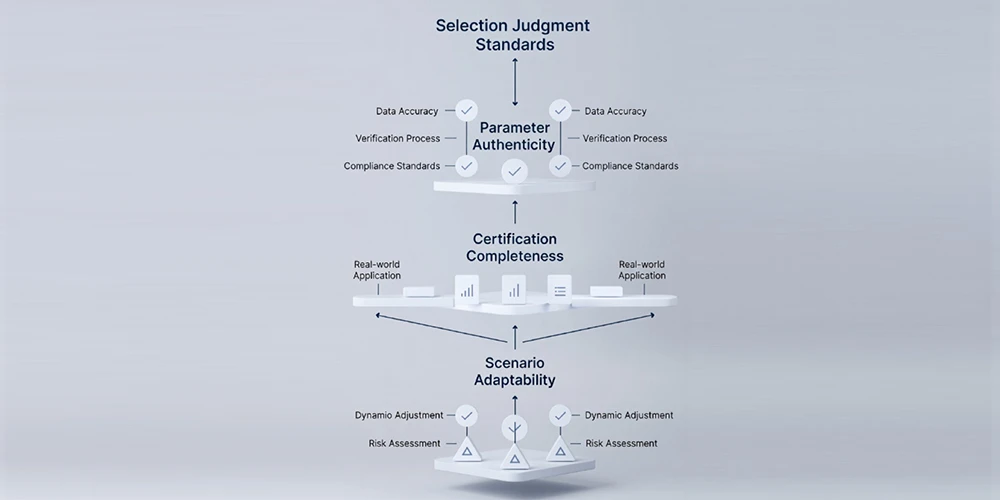
1. Confirm the Test Standard for Surge Protection
Many products are labeled "6kV surge protection" but do not specify the test standard—test conditions vary greatly under different standards. Compliant products must clearly mark "complies with IEC 61000-4-5 standard," which specifies the waveform (1.2/50μs voltage wave, 8/20μs current wave), number of tests (10 times for positive and negative poles each), and ambient temperature (23℃±5℃) for surge tests, making it a universally recognized surge immunity test standard in the industry. If a product only marks "6kV protection" without a standard number, it may be false propaganda based on non-standard tests.
2. Check Whether Certifications Include Surge Protection Tests
The ATEX, IECEx, and other explosion-proof certification reports of regular explosion-proof lights will clearly list the "surge immunity test" item and results, proving that the product's 6kV surge protection capability has been verified by authoritative institutions. During procurement, you can request a copy of the certification report from the supplier, focusing on checking whether the test items include "IEC 61000-4-5 6kV common-mode/4kV differential-mode" and whether the test result is "Pass." In addition, the certification number of the components should be consistent with the report to avoid using "refurbished components" or "non-certified components."
3. Check Protection Redundancy in High-Temperature and Humid Environments
Surge risks vary in different explosion-proof scenarios: for example, grid fluctuations are more frequent in chemical workshops, and surge peaks may approach the 6kV upper limit, so products with "6kV+ redundancy design" (such as actual protection capability up to 8kV) should be selected; outdoor explosion-proof lights (such as gas station canopy lights) need additional lightning surge protection (equipped with external lightning arresters, total protection capability up to 10kV); for humid and corrosive environments, products with anti-corrosion coatings on protection components should be selected to avoid protection failure due to oxidation of component pins.
Surge Protection Is the "Invisible Shield" of Explosion-Proof Safety
In explosion-proof environments, the safe operation of explosion-proof lights is a systematic project. The explosion-proof structure of the housing is the "first line of defense," while the surge protection of the driver power supply is the "invisible shield"—though not intuitively visible, it directly determines the stability and safety of the lights in complex industrial power grid environments. 6kV surge protection is not over-designed, but a necessary safety redundancy based on industrial scenario risks. Its core value lies in intercepting surges in all dimensions to avoid ignition source risks caused by driver damage, while extending the service life of the lights and reducing maintenance costs.
For enterprises and engineering and technical personnel, when selecting explosion-proof lights, they should not only focus on intuitive parameters such as housing explosion-proof grade and brightness but also attach importance to the surge protection performance of the driver power supply—verifying test standards, checking certification reports, and matching application scenarios to ensure that the product meets safety requirements.
As an enterprise specializing in explosion-proof lighting, AGC integrates drivers designed with a “common-mode + differential-mode” surge protection topology in its explosion-proof luminaires. This design approach is developed in line with IEC 61000-4-5 surge immunity levels (up to 6kV) and relevant ATEX and IECEx requirements.
By utilizing high-temperature resistant and long-life components, together with an optimized PCB layout that takes explosion-proof considerations into account, the overall system is engineered to deliver dependable performance in demanding hazardous environments.
If you need surge protection solutions for explosion-proof lights tailored to specific scenarios (such as chemical, dust, or outdoor environments), or want to learn more about product test details, you can contact our technical team for professional support.