

Selecting the correct installation method is a critical step in ensuring the safety, efficiency, and cost-effectiveness of an explosion-proof lighting system. It impacts not only fixture mounting but also light distribution, maintenance accessibility, and minimal disruption to the operational environment. Below is a detailed analysis of mainstream installation methods. Take our HA05 explosion-proof highbay light as an example.
1. Ceiling Mounting
(1)Primary Application Scenarios:
- General Indoor Areas: Production workshops, warehouses, and pipeline corridors in industries such as petrochemical, pharmaceutical, and food processing.
- Enclosed Spaces with Suspended Ceilings: Control rooms, electrical switchgear rooms, and equipment chambers with regular ceiling structures.
- Explosion-Proof Technical Key: The mounting surface must be flat and secure. Cable entry must utilize certified cable glands or sealed conduits to maintain the integrity of flameproof joints or the protective enclosure.
(2)Key Advantages:
- Optimizes Space Utilization: Does not occupy wall or floor space, facilitating equipment movement and material handling.
- Provides Excellent Uniformity: As the most common method for general lighting, it allows for easy layout planning to achieve wide-area, even illumination.
- Relatively Standardized Installation: Typically involves direct fixing to building structures or pendants, offering straightforward application

2. Wall Bracket Mounting
(1)Primary Application Scenarios:
- Localized & Safety Lighting: Equipment operator platforms, valve clusters, inspection walkways, exit signs, and emergency escape lighting.
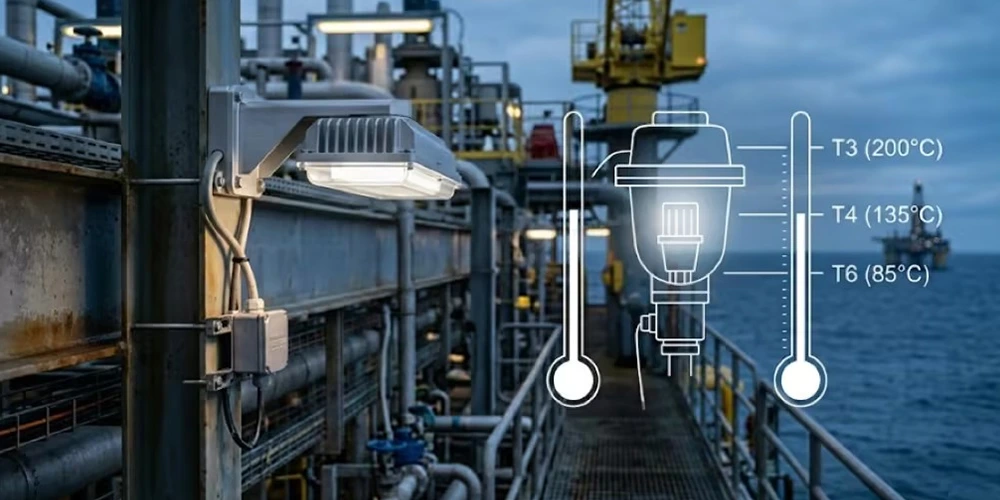
- Vertical Walls or Structural Columns: Perimeters of storage tank farms, under pipe racks, tunnel sidewalls, and deck bulkheads on offshore platforms.
- Space-Restricted Areas: Low-clearance spaces or passages where overhead mounting is not feasible.
(2)Key Advantages:
- Flexible Directionality: The aiming angle can be adjusted to illuminate specific equipment or work areas precisely, serving as an effective complement to general lighting.
- Flexible Mounting Height: Not constrained by roof structure, allowing optimal placement based on task plane height.
- Ease of Maintenance: Often installed at accessible heights or reachable via simple platforms, simplifying cleaning, inspection, and lamp replacement.

3. Pendant Mounting
(1)Primary Application Scenarios:
- High-Bay Spaces: Ultra-high bay buildings in refineries, interiors of large storage tanks, derrick areas on offshore drilling platforms, and large material warehouses.
- Need to Lower Fixture Height: When ceiling height is excessive, this method brings the luminaire closer to the work plane to achieve required illuminance levels.
- Requirement for Vibration Dampening: Applications with mechanical vibration or where horizontal fixture adjustment is beneficial.
(2)Key Advantages:
- Adjustable Height: Pendant rod or chain length can be customized to flexibly adapt to various space heights.
- Superior Flood Lighting Capability: Suspended fixtures provide 360-degree shadow-free illumination, ideal for areas requiring extensive, uniform light coverage.
- Vibration Dampening & Adaptability: Chain mounting offers some flexibility to buffer the effects of equipment vibration on the luminaire.

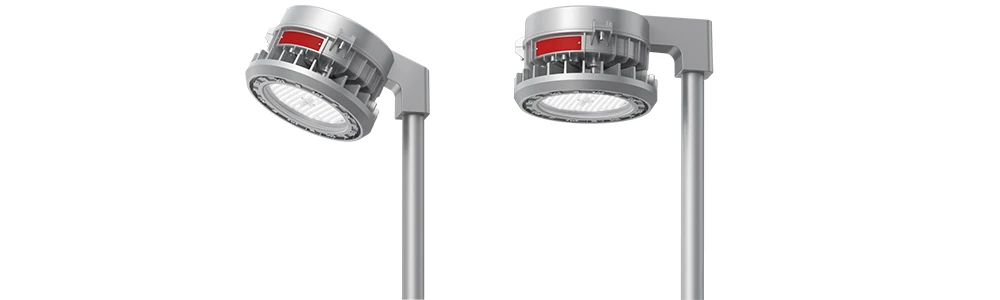
4. Stanchion Mounting
(1)Primary Application Scenarios:
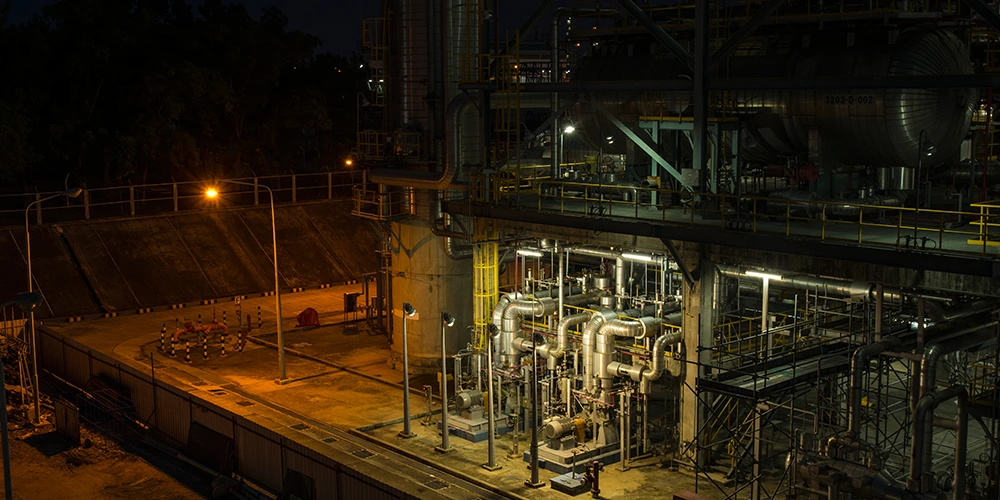
- Outdoor Area Lighting: Open process areas in petrochemical plants, truck/railcar loading racks, berths, mining operation areas, parking lots, and plant roads.
- Security & Safety Lighting: Perimeter fencing, entry/exit checkpoints requiring high-intensity coverage.
(2)Key Advantages:
- Enables Wide-Area Coverage: A single high-wattage luminaire, mounted on a pole at sufficient height, is designed to effectively illuminate an extensive area through optimized photometrics. A network of such poles provides efficient and uniform lighting across large facilities.
- Avoids Ground-Level Obstructions: Elevating fixtures minimizes light obstruction from mobile equipment or stored materials on the ground.
- Enhances Safety: Positioning electrical equipment at height reduces risks of accidental contact by personnel or collision with vehicles.
5. Trunnion Mounting
(1)Primary Application Scenarios:
- Equipment-Integrated Lighting: Direct mounting on specific machinery like large reactors, compressors, or pump sets to provide dedicated lighting for operation and maintenance.
- Mobile or Rotating Equipment: Lighting needs that must move in unison with the equipment.
(2)Key Advantages:
- Precise, Direct Illumination: Provides targeted, shadow-free light exactly where it is needed on the critical asset.
- Robust Integration: Becomes a solid, integral part of the equipment, occupying no separate space.
- High Customization Potential: Can be engineered to match equipment contours and connection interfaces.

Core Factors for Selection and Decision-Making
A systematic assessment is required for practical engineering selection:
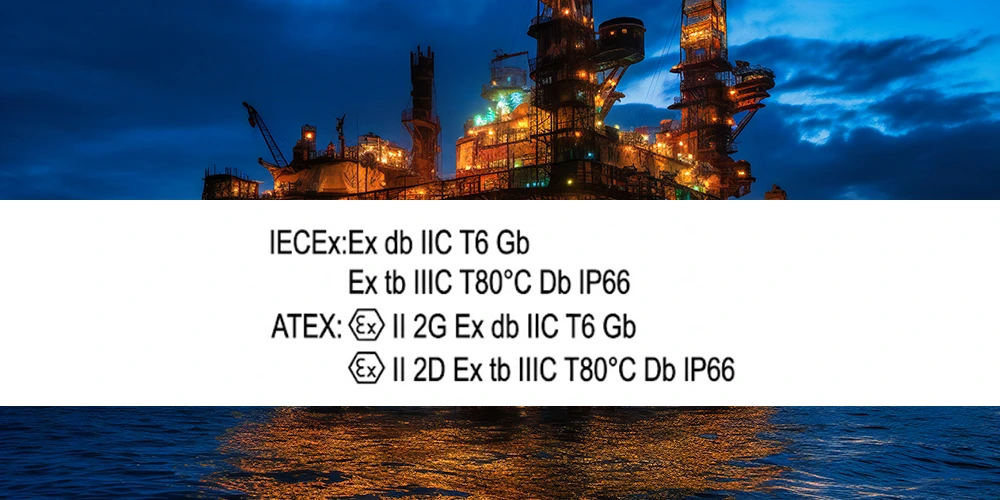
- Hazardous Area Classification: First, determine the Zone (0, 1, 2 for gas/dust or Div. 1/2 per NEC/CEC). This dictates the explosion-protection type (Flameproof "d", Increased Safety "e", Intrinsic Safety "i", etc.) and Ingress Protection (IP) rating.
- Architectural & Spatial Constraints: Load-bearing capacity of the ceiling, wall material, clear height, and presence of obstacles like pipe racks.
- Lighting Functional Requirements: Whether the need is for uniform task lighting (flood), focused equipment lighting (spot), or emergency evacuation lighting.
- Maintenance Accessibility: Consider future lamp replacement, cleaning ease, and safety. Avoid placements that are extremely difficult to access, as this increases long-term maintenance costs and risk.
- Environmental Corrosivity & Protection: In corrosive environments (coastal, chemical plants), select fixtures and accessories with a minimum C4-M (High Corrosivity) anti-corrosion rating alongside explosion-proof ratings to ensure long-term durability.
There is no single "best" installation method, only the "most suitable" solution. An optimal explosion-proof lighting design typically combines various methods organically, meeting mandatory safety codes while balancing operational efficiency, maintenance convenience, and total cost of ownership. For major projects, it is advisable to involve professional lighting designers and explosion-protection engineers early in the planning phase for a comprehensive evaluation.