
In hazardous locations—such as petrochemicals, pharmaceuticals, grain processing, and heavy industrial manufacturing—the reliability of LED luminaires directly impacts factory production safety and operational costs.
When selecting explosion-proof lights, procurement managers and engineers often face a critical dilemma regarding the material of the optical cover: Should they choose PC (polycarbonate) lens or tempered glass?
A common misconception is that one material can completely replace the other. In modern industrial lighting design, PC and tempered glass each have their own unique advantages. The key lies in how to scientifically match the material to the specific physical and chemical environment of the site.
This article provides an in-depth analysis of these two mainstream materials in hazardous environments across technical characteristics, environmental challenges, and total lifecycle costs.
PC (Polycarbonate) Lens: High Impact Resistance and Photometric Flexibility
Polycarbonate (PC) is a thermoplastic engineering polymer that is widely utilized in current industrial and explosion-proof lighting applications.
Core Advantages
Unparalleled Impact Resistance: PC exhibits an impact strength hundreds of times greater than standard glass, offering exceptional toughness. In outdoor harsh weather or applications with risks of falling objects, severe mechanical vibration, or hail, PC lenses are virtually shatterproof, effectively protecting the internal LED chips.
Lightweight Design: The density of PC is significantly lower than that of glass. This reduces the overall weight of the luminaire, dramatically easing the stress on high-altitude installation and mounting bracket load capacities.
Environmental Limitations
As a high-molecular polymer, PC's molecular structure is highly sensitive to certain organic solvents, strong acids, and alkalis. Furthermore, its surface is prone to electrostatic charge buildup.
Tempered Glass: Defense in Severe and Harsh Environments
In contrast, tempered glass undergoes a thermal treatment process that induces compressive stress on its surface. For specific high-risk, heavily polluted industrial applications, it remains an irreplaceable choice.
Core Advantages
Excellent Chemical and Oil Resistance
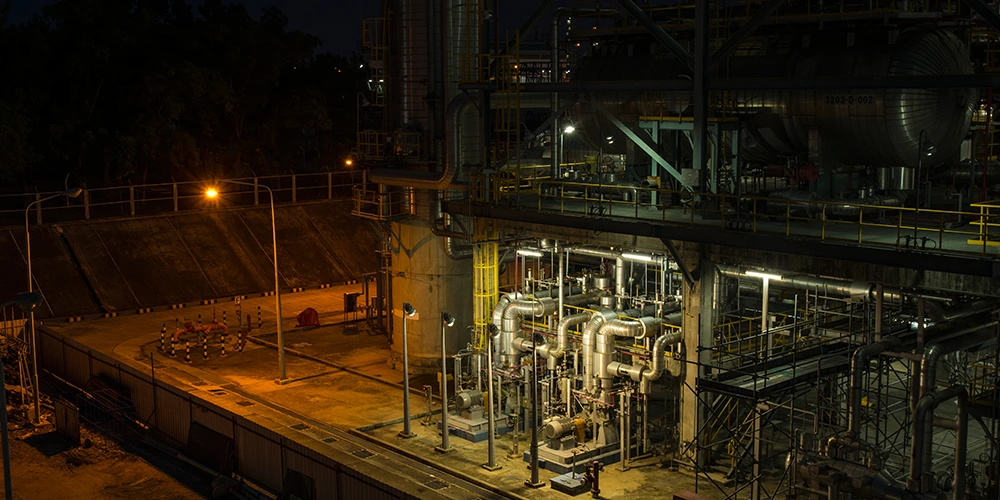
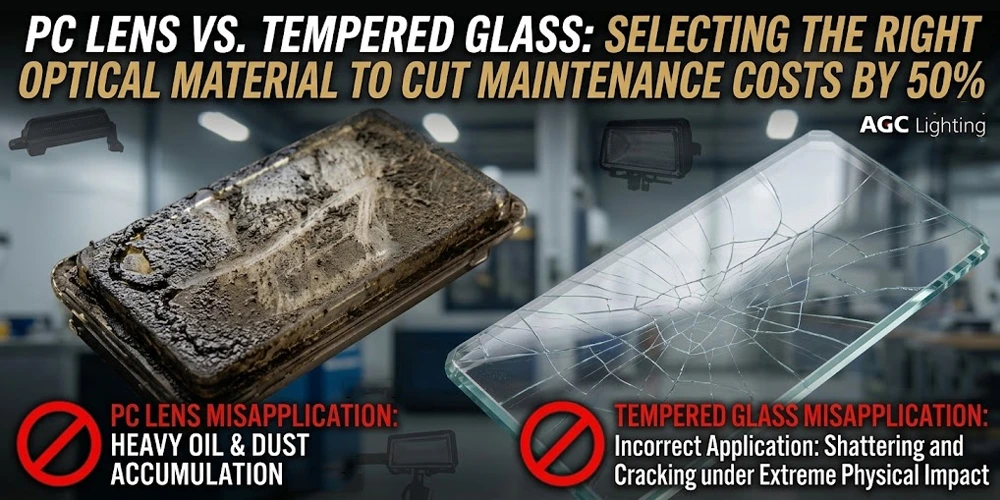
In environments saturated with heavy oil sludge and oil mist—such as petrochemical refineries and machining workshops—airborne chemical contaminants easily adhere to the luminaire's surface. Tempered glass possesses high chemical inertness. It will absolutely not experience environmental stress cracking or swelling under long-term exposure to oil mist or solvents, making it critical for the luminaire's long-term survival in hostile chemical environments.
Anti-static Properties and Superior Heat Dissipation Maintenance
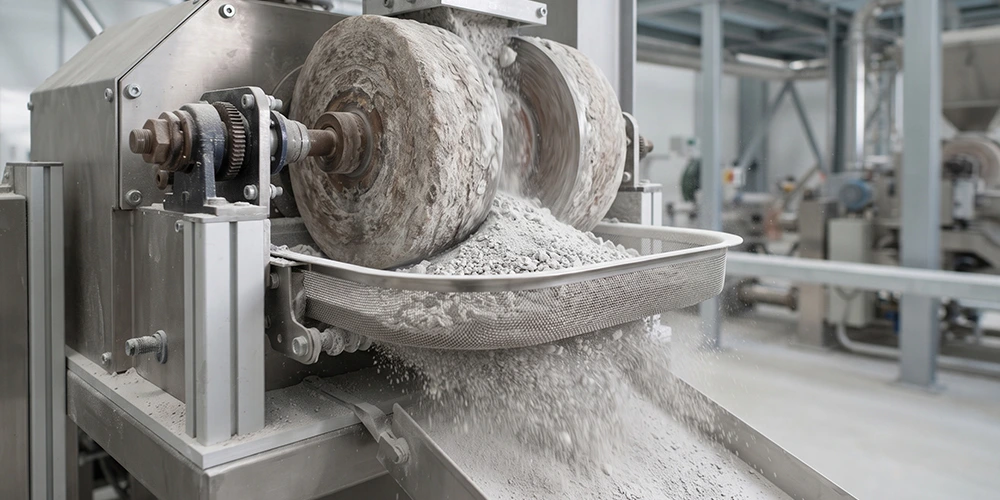
In high-dust environments like grain storage, flour processing mills, and coal mines, PC lenses tend to attract fine dust particles due to electrostatic effects, creating a thick thermal insulation layer that severely hinders heat dissipation. Conversely, tempered glass does not easily generate static electricity, preventing dust from adhering firmly. More importantly, even if dust accumulates, the exceptional thermal conductivity and temperature resistance of glass ensure the luminaire operates reliably without suffering from lumen depreciation or premature failure (dead LEDs) caused by heat buildup.
High Light Transmittance and Anti-aging
Tempered glass does not suffer from "yellowing" caused by UV exposure or high temperatures. It maintains its original optical transmittance even after years of continuous operation.
Environmental Limitations
Glass is inherently heavier and cannot be molded directly into complex microscopic photometric structures like PC (it typically relies on internal reflectors or secondary lens combinations). Additionally, despite being tempered, a risk of shattering still exists when subjected to extreme, localized impact from sharp, hard objects.
Summary & AGC’s Forward-Thinking Design
Selecting industrial lighting is ultimately about finding the perfect synergy between material properties and on-site environmental conditions.
While PC offers superior toughness and high impact resistance, tempered glass delivers unmatched stability and heat dissipation security under heavy oil and high dust conditions.
AGC Lighting has always adhered to an industrial design philosophy of "tailoring solutions to local conditions." Take our latest HAL03 ALU C1D2 Industrial Linear Light (with power outputs ranging from 15W to 100W, supporting field-adjustable CCT and wattage) as an example. To meet the stringent demands of diverse industrial clients globally, HAL03 offers configuration options for both high-quality PC lenses and professional-grade tempered glass.
Whether your project involves a modern hazardous materials warehouse requiring precise optical control, or a harsh, oil-and-dust-laden heavy industrial coal washing workshop, AGC provides customized, ultra-reliable lighting solutions.