

In hazardous industrial environments with flammable gases, vapors, or dusts, LED explosion-proof lighting serves as critical safety lighting equipment. Wide voltage input design (typically AC 85–265 V/90–305 V) has become an essential technical specification and industry standard for such lighting. This design is not merely an optional performance enhancement but a fundamental requirement to ensure operational stability, safety compliance, longevity, and universal applicability in volatile electrical and harsh environmental conditions.
LED explosion-proof lighting is mandated for use in Zone 0, 1, and 2 hazardous locations as defined by IEC 60079 and GB 3836 standards, including oil refineries, chemical plants, mines, gas stations, and grain processing facilities. These environments are characterized by two inherent challenges: severe voltage instability in the power grid and zero tolerance for electrical failures that could generate sparks, arcs, or excessive heat—potential ignition sources.
Traditional narrow-voltage (e.g., fixed 220 V ± 5%) lighting systems suffer from critical failures in industrial settings: premature burnout, flickering, intermittent operation, or catastrophic driver failure under voltage fluctuations. Since 2010, peer-reviewed studies on industrial lighting reliability, mine electrical systems, and explosion-proof equipment design have consistently identified voltage fluctuation as a leading cause of lighting system downtime and safety risks in hazardous areas. Consequently, wide voltage design has evolved from a competitive feature to a de facto standard and a core safety requirement for certified LED explosion-proof lighting.
- Definition and Technical Specifications of Wide Voltage Design
- Scientific and Safety Rationale: Peer-Reviewed Evidence
- Mitigating Severe Voltage Fluctuations in Hazardous Environments
- Preventing Thermal Runaway and Preserving Explosion-Proof Integrity
- Enhancing Reliability and Reducing Ignition Risk from Failures
- Engineering and Operational Necessities
- Global Compatibility and Standardization
- Adaptability to Extreme and Off-Grid Conditions
- Compliance with Modern Explosion-Proof Standards
- A Non-Negotiable Safety Standard
Definition and Technical Specifications of Wide Voltage Design
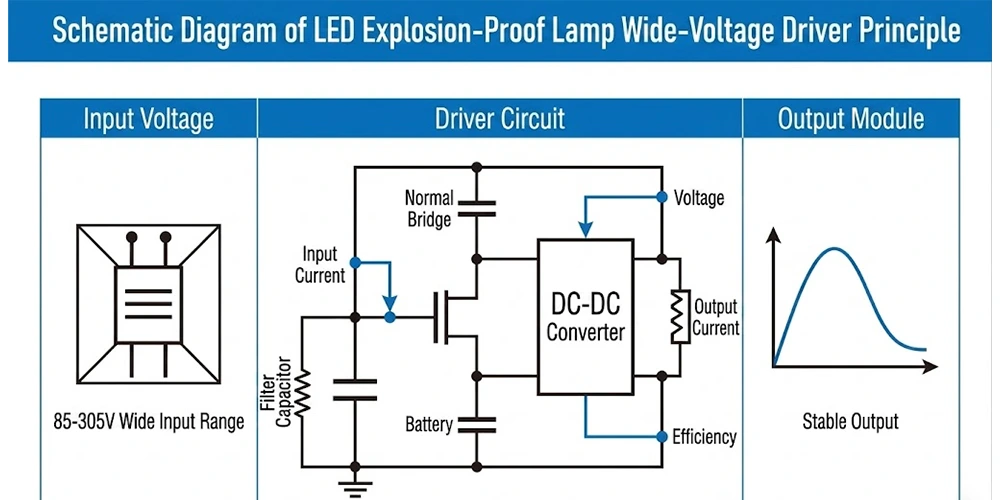
Wide voltage design refers to the integration of a highly adaptive, constant-current LED driver that maintains stable output power, luminous flux, and thermal performance across an extended AC input voltage range, typically AC 85–265 V or 90–305 V (50/60 Hz). This range covers nominal voltages of 110 V, 120 V, 220 V, 230 V, and 240 V used globally, as well as common industrial voltage sags (down to 170 V) and surges (up to 270 V).
Key technical characteristics include:
- Active Power Factor Correction (PFC): PF > 0.95 across the entire voltage range
- Constant Current Output: Maintains ±3% current stability despite input variations
- Multi-Level Protection: Over-voltage, under-voltage, surge, short-circuit, and over-temperature protection
- Fast Startup: No delayed ignition or low-temperature startup failure
Scientific and Safety Rationale: Peer-Reviewed Evidence
Mitigating Severe Voltage Fluctuations in Hazardous Environments
Industrial and mining power systems are inherently unstable. Research by an expert on underground coal mine electrical systems documented voltage fluctuations ranging from 160 V to 280 V due to heavy machinery startup/shutdown, long cable runs, and high reactive loads. Similarly, studies in petrochemical facilities recorded voltage dips of 30–40% during process equipment operation.
Impact of Narrow-Voltage Systems:
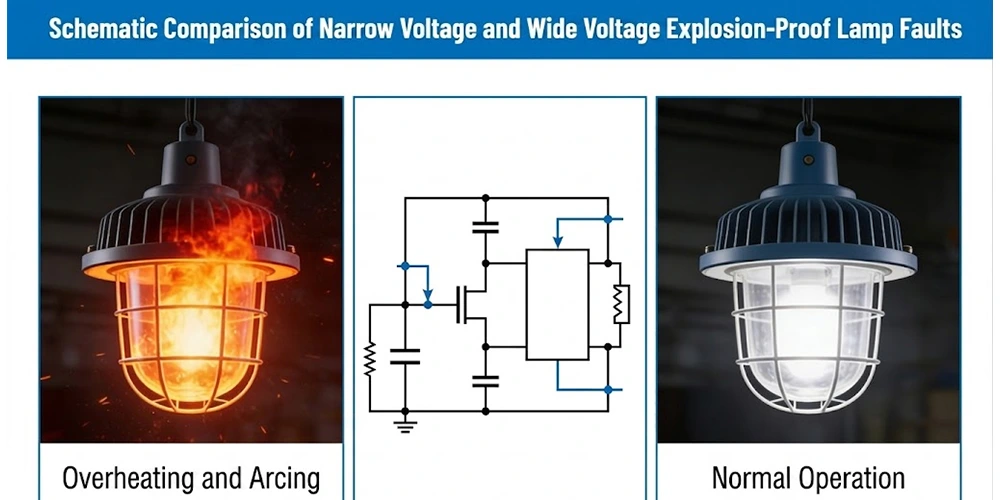
- Over-Voltage: Exceeds driver component ratings, causing electrolytic capacitor breakdown, MOSFET failure, and internal arcing—a direct explosion risk.
- Under-Voltage: Forces the driver into over-current operation to maintain light output, leading to excessive junction temperature rise (ΔT > 40 K), accelerated thermal degradation, and potential breach of the T-class temperature rating.
Wide Voltage Solution:
Studies confirm that wide-range buck-boost converters actively regulate input, preventing over-voltage breakdown and under-voltage overheating. This eliminates ignition sources caused by electrical stress—a primary safety objective of Ex e/t/d designs.
Preventing Thermal Runaway and Preserving Explosion-Proof Integrity
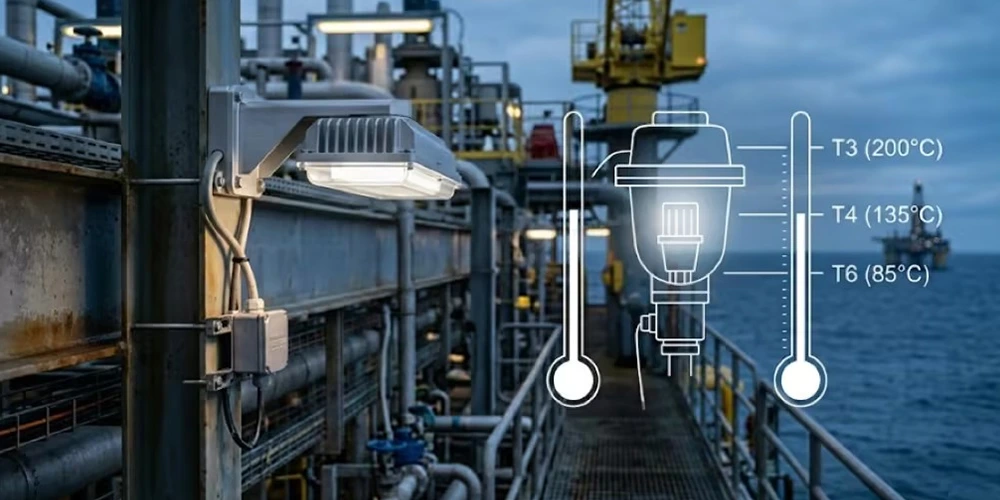
A core principle of explosion-proof design (IEC 60079-7 for Ex e, IEC 60079-1 for Ex d) is limiting surface temperatures below the autoignition temperature of the surrounding gas (T1–T6 classes).
Voltage instability directly disrupts thermal balance:
- A 10% over-voltage increases LED drive current by ~15%, raising junction temperature by 12–18°C.
- Chronic over-temperature accelerates light degradation and compromises the insulation system, reducing electrical clearance and creepage distances—critical safety parameters in Ex e design.
Peer-reviewed thermal analysis shows that wide voltage drivers with closed-loop thermal regulation stabilize LED junction temperature (Tj ≤ 65°C) and housing surface temperature, ensuring compliance with T4/T6 temperature classes even at voltage extremes. This preserves the structural and thermal integrity of the explosion-proof enclosure.
Enhancing Reliability and Reducing Ignition Risk from Failures
Lighting failure in hazardous areas causes safety-critical darkness and emergency response risks. More importantly, component failure (e.g., driver short-circuit) can generate an internal explosion or ignite external gases.
A 2017 industry report noted LED explosion-proof ligthing failure rates of 1–50% within two years in plants with unstable grids, primarily due to voltage-related driver breakdown. Research found that wide voltage designs reduce component stress by 60–70%, extending Mean Time Between Failures (MTBF) from <20,000 hours to >50,000 hours. This dramatically lowers the probability of failure-induced ignition—a key factor in IECEx and ATEX certification.
Engineering and Operational Necessities
Global Compatibility and Standardization
International projects (oil platforms, global mining operations) use 120 V (US), 230 V (EU), 240 V (AU), and 110 V (shipboard) systems. Wide voltage design enables a single certified luminaire to operate worldwide, eliminating region-specific variants. This aligns with IEC 60079's push for global harmonization of explosion-proof equipment.
Adaptability to Extreme and Off-Grid Conditions
- Mining/Underground: Long cables cause significant voltage drop; wide voltage ensures stable operation at the end of long feeder lines.
- Remote/Off-Grid: Generators and unstable microgrids produce highly variable voltage.
- Temporary Sites: Construction/retrofit sites with inconsistent power quality.
Compliance with Modern Explosion-Proof Standards
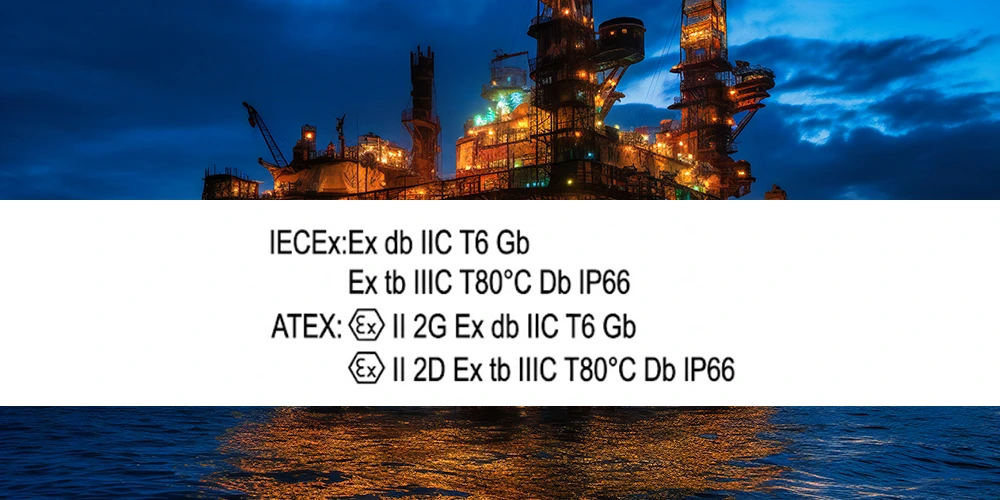
Leading standards and technical specifications (GB 3836.1-2021, T/ZZB 3435-2023, IEC 60079-28) strongly recommend or require wide voltage input for LED-based Ex equipment. Certification bodies (CNEX, ATEX, IECEx) routinely verify voltage adaptability (85–265 V) as part of safety assessment, as it directly impacts:
- Stability under fault conditions
- Temperature rise control
- Prevention of dangerous malfunctions
A Non-Negotiable Safety Standard
Based on a decade of peer-reviewed research, field studies, and standardization progress, wide voltage design is an indispensable, safety-critical standard for LED explosion-proof lighting, not an optional feature. Its necessity is grounded in:
- Safety: Eliminates sparks, arcs, and thermal runaway caused by voltage fluctuations—the primary ignition risks in Ex environments.
- Reliability: Ensures uninterrupted operation and reduces failure probability in harsh industrial grids.
- Compliance: Meets the strict thermal, electrical, and operational requirements of IEC 60079, GB 3836, and ATEX.
- Versatility: Enables global deployment across all nominal voltages and unstable grids.
For any LED explosion-proof lighting to be considered safe, certified, and fit for purpose in hazardous locations, wide voltage input (minimum AC 85–265 V) must be a fundamental, non-negotiable design requirement.